By Michael Phillips | Election Desk
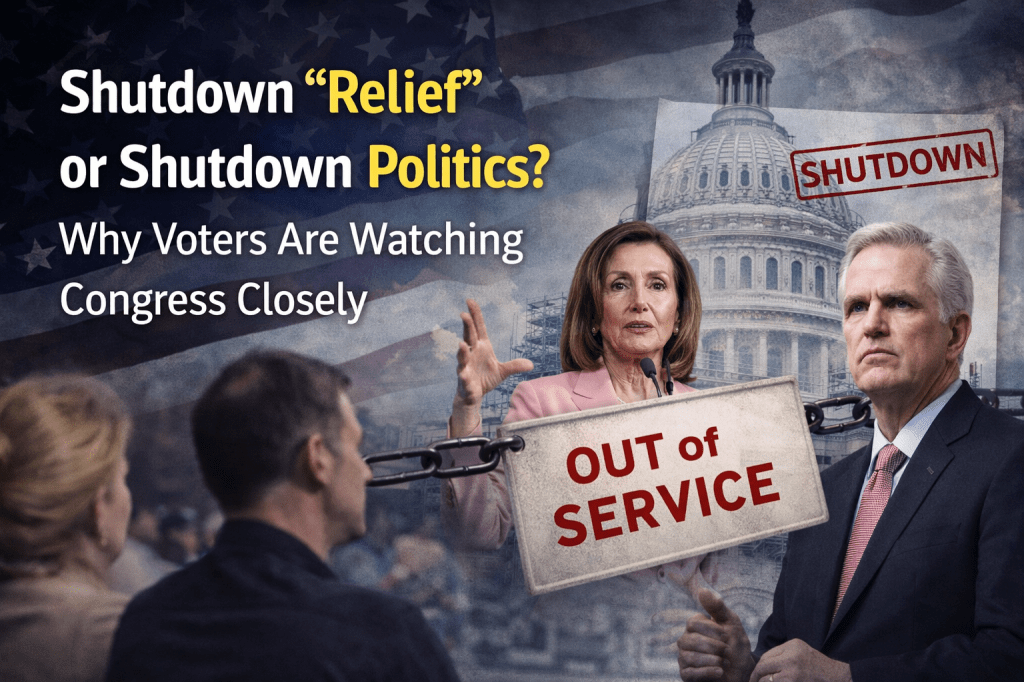
As another election cycle approaches, members of Congress are once again offering “relief” for the consequences of government shutdowns—rather than preventing shutdowns themselves.
That distinction is drawing growing scrutiny from voters who increasingly see shutdowns not as unavoidable accidents, but as the predictable result of political incentives, missed deadlines, and congressional dysfunction.
This week, lawmakers promoted new legislation aimed at easing financial strain on federal workers during shutdowns. Supporters framed the bill as worker protection. Critics argue it represents something else entirely: an admission that Congress has accepted shutdowns as normal.
Planning for Failure Instead of Preventing It
The legislation, which would provide targeted financial relief to certain federal employees during shutdowns, does not address the root cause of shutdowns—Congress’s repeated failure to pass budgets on time.
It does not impose consequences on lawmakers.
It does not reform the budget process.
It does not guarantee timely paychecks.
Instead, it attempts to manage the fallout after Congress has already failed.
That approach reflects a larger shift in Washington: shutdowns are no longer treated as emergencies to be avoided, but as recurring events to be mitigated. Relief bills have become substitutes for responsibility.
Who Benefits — and Who Doesn’t
While the bill is promoted as protecting federal workers, its scope is limited.
- Federal employees without student loans receive no benefit.
- Federal contractors—often the first to lose income during shutdowns—are excluded entirely.
- Small businesses reliant on federal activity receive no relief.
- Communities dependent on federal paychecks absorb economic shock with little assistance.
Yet political messaging often implies broad worker protection, glossing over these distinctions. For voters, that gap between rhetoric and reality is becoming harder to ignore.
Shutdowns Are a Political Choice
Shutdowns remain deeply unpopular across party lines. Polling over the past decade consistently shows voters view them as signs of government failure, not principled governance.
Federal workers also vote at high rates and are acutely aware that shutdowns are avoidable. Budget deadlines are known years in advance. Temporary funding mechanisms exist. Failure is not a surprise—it is a choice.
When lawmakers focus on relief rather than prevention, voters are left with a troubling message: Congress is more comfortable managing dysfunction than fixing it.
Campaign Messaging vs. Governing Results
As elections near, shutdown relief bills offer a politically convenient narrative. Lawmakers can claim to be “fighting for workers” without confronting the harder task of bipartisan budgeting, compromise, and deadline discipline.
But voters increasingly distinguish between symbolism and results.
Relief during a shutdown does not erase the shutdown itself. It does not restore trust. It does not compensate for missed paychecks, disrupted services, or economic instability.
The Electoral Risk of Normalizing Dysfunction
Treating shutdowns as inevitable carries political risk.
Once dysfunction is normalized, accountability shifts—from Congress to workers, families, and communities forced to adapt. That shift may protect incumbents in the short term, but it undermines confidence in the institution as a whole.
Voters frustrated by repeated shutdowns have historically punished incumbents—often regardless of party—when they perceive that governing responsibilities have been neglected.
A Question Voters Will Answer
Relief bills may help lawmakers weather the next shutdown.
They may help campaigns survive the next news cycle.
But they may not help incumbents survive the next election.
As voters head toward another election season, the question is no longer whether shutdowns can be managed—but whether a Congress that plans for failure instead of preventing it deserves another term.
 Election Desk
Leave a comment