Resetting expectations in an era of permanent campaigns
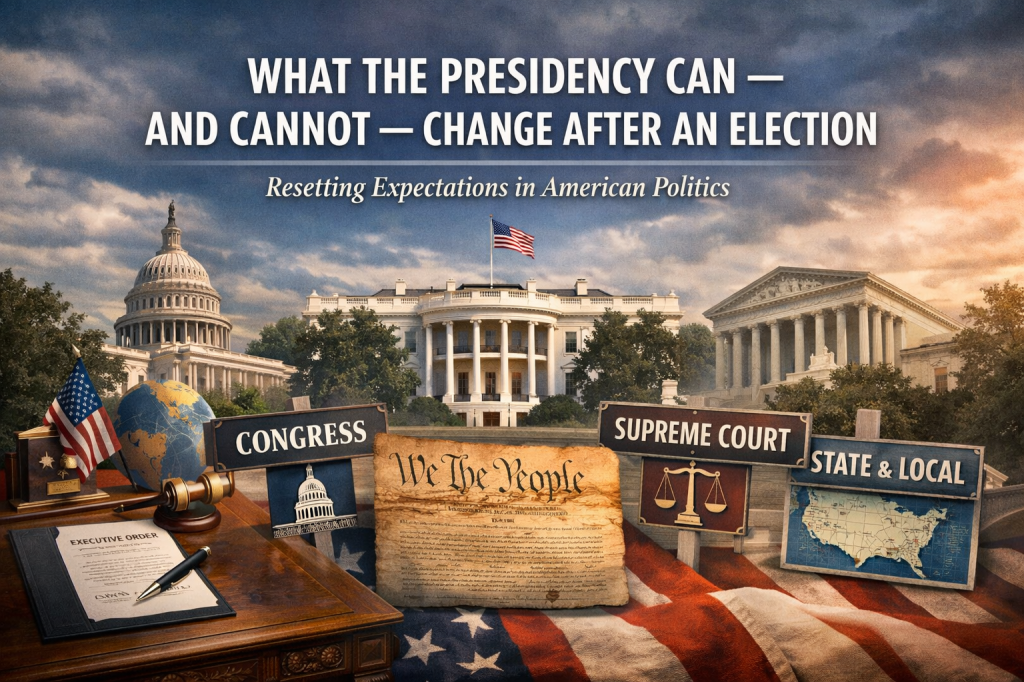
Every presidential election comes with a familiar drumbeat: everything will change—or everything will be saved. That framing is powerful, but it’s also misleading. The American system was designed to slow change down, not speed it up, and to distribute power across institutions rather than concentrate it in one office.
Here’s a grounded look at what a president actually controls after taking office—and what remains largely out of reach, regardless of party or personality.
What a President Can Change
1. Executive Branch Priorities
A president sets direction for the federal bureaucracy—how laws already on the books are enforced, which issues get attention, and where agencies focus their resources.
That includes:
- Enforcement emphasis (e.g., immigration, antitrust, environmental rules)
- Agency leadership and internal guidance
- Rulemaking within statutory limits
This power is real—but bounded by existing law, budgets, and courts.
2. Executive Orders (Within Limits)
Executive orders can:
- Organize how agencies operate
- Clarify enforcement priorities
- Implement statutes passed by Congress
They cannot create new laws or override statutes. Courts can—and often do—block orders that exceed legal authority.
3. Appointments (Over Time)
Presidents nominate:
- Cabinet officials
- Agency heads
- Federal judges
But confirmations require the consent of the United States Senate, and judicial impact unfolds slowly. Even Supreme Court appointments depend on timing and vacancies—not campaign promises.
4. Foreign Policy Tone and Diplomacy
The president has significant latitude in:
- Diplomacy and negotiations
- Alliance management
- Trade posture (within statutory frameworks)
Yet treaties require Senate approval, and Congress controls war funding and trade authorities.
What a President Cannot Change (Alone)
1. The Law Itself
Only United States Congress can pass or repeal laws. A president can propose, pressure, or veto—but cannot legislate unilaterally.
Divided government often means stalled agendas, regardless of election margins.
2. The Constitution
Presidents do not rewrite constitutional rules. Amendments require supermajorities in Congress and ratification by the states—a deliberately high bar.
3. Independent Institutions
Several key bodies are insulated by design:
- The Supreme Court of the United States
- The Federal Reserve
- Independent inspectors general
- State and local election authorities
Presidents influence these indirectly, not by command.
4. State Law and Local Governance
States run elections, criminal justice systems, school policy, zoning, and most day-to-day governance. Federal pressure exists—but it’s constrained by federalism.
That’s why many policy fights shift to governors, legislatures, and courts after national elections.
Why Expectations Keep Getting Inflated
Modern campaigns reward maximal promises. Cable news, social media, and fundraising thrive on urgency and fear. The result is a public expectation that the presidency is an all-powerful switch—when it’s actually one lever among many.
This mismatch fuels:
- Voter disappointment
- Institutional distrust
- Claims that “democracy failed” when systems simply functioned as designed
The Reality Check
Elections matter—but they are not revolutions. They set direction, not destiny.
Real change in the U.S. system usually requires:
- Sustained congressional majorities
- Judicial alignment over years
- State-level action
- Administrative competence
- Public patience
Understanding the limits of presidential power isn’t cynicism. It’s civic literacy.
Why This Matters for Voters
A healthy democracy depends on informed expectations. When voters know where power actually lives, they can:
- Hold the right officials accountable
- Focus pressure where it matters
- Resist demagogic promises
- Engage beyond presidential cycles
The presidency is powerful—but it is not a magic wand. And that restraint, frustrating as it can be, is one of the system’s core safeguards.
Election Desk covers the mechanics of democracy—what the rules allow, what they prevent, and why that structure still matters after Election Day.
 Election Desk
Leave a comment