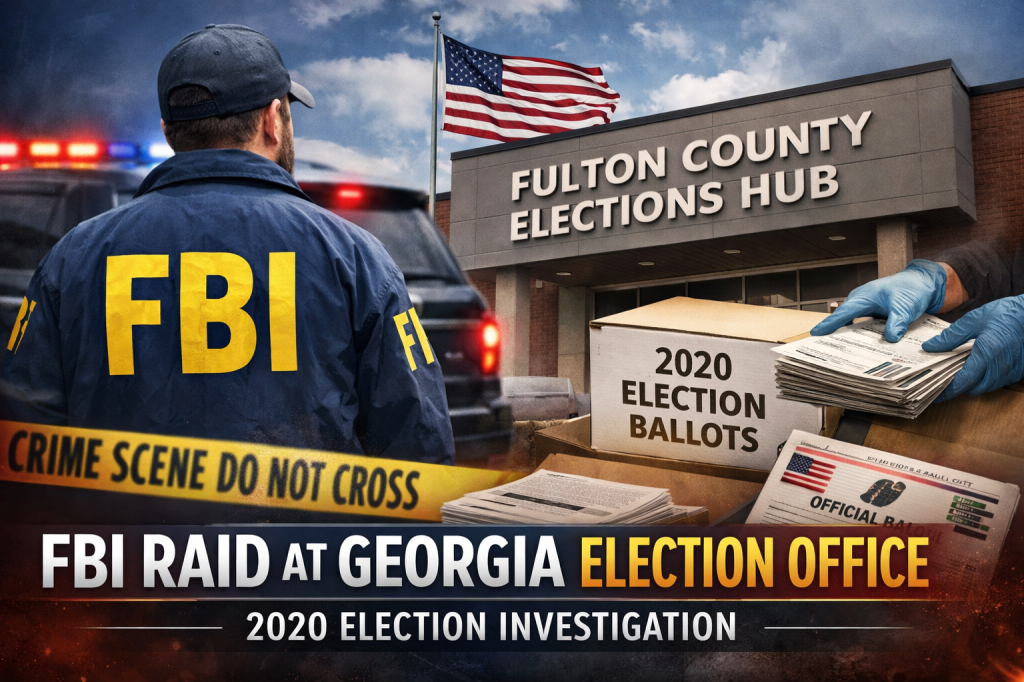
On January 28, 2026, FBI agents executed a court-authorized search warrant at the Fulton County Election Hub and Operation Center, located in Union City near Atlanta, Georgia, as part of an ongoing federal investigation into the 2020 presidential election and related allegations of election fraud.
The action — which saw agents seize boxes of materials, including ballots, tabulator tapes, digital ballot images, and voter rolls — represents one of the most visible law enforcement moves yet in probing events surrounding the 2020 election in one of the nation’s most politically contentious battleground jurisdictions.
What Happened Today
Agents from the FBI’s Atlanta Field Office began executing the search warrant early Wednesday afternoon at the Fulton County elections facility, securing the area and moving materials into federal vehicles. The warrant was authorized by a federal judge, and agents repeatedly described the operation as a “court-authorized law enforcement action.”
Officials at the county said the warrant specifically sought records tied to the 2020 general election, including physical ballots and associated documentation that Georgia law typically requires election officials to preserve for a defined period.
A spokesperson for the FBI declined to comment on the specifics of the investigation, citing its ongoing nature. The Department of Justice also declined to provide further details.
Background: Election Controversy and Legal Disputes
Fulton County — Georgia’s most populous county and a Democratic stronghold — was a central flashpoint in efforts by former President Donald Trump and his allies to overturn the result of the 2020 presidential election. Trump lost Georgia by fewer than 12,000 votes and repeatedly made baseless claims that widespread fraud had tainted the result.
In January 2021, Trump famously pressed Georgia officials in a recorded phone call to “find” enough votes to change the outcome — a call that was met with bipartisan rejection and ultimately did not alter certified results.
In 2023, Fulton County District Attorney Fani Willis indicted Trump and 18 others on racketeering and other charges alleging coordinated efforts to overturn the election. However, that case was dismissed in 2024 after a court found a conflict of interest involving the lead prosecutor.
Last year, the Justice Department sued Fulton County in federal court, seeking access to 2020 election materials after state officials and the Republican-controlled Georgia State Election Board repeatedly sought to compel production of ballots and related records. A Fulton County judge denied the county’s request to block a subpoena, setting the stage for the search action.
Reactions and Political Fallout
The search warrant has immediately reignited debate over election integrity, federal authority, and political influence in law enforcement:
- Supporters of the warrant — including some GOP figures and allies of Trump — framed the action as a necessary step toward investigating unresolved questions related to 2020 voting records.
- Critics, including voting rights advocates and Democratic leaders, described the FBI move as a dangerous escalation that could erode public trust in elections and potentially inflame conspiracy theories about ballot security.
State Sen. Josh McLaurin (D-GA) warned that the continued focus on unfounded claims of election fraud risks further harassment of election officials and voters.
What This Means for the 2026 Election Cycle
Coming as the U.S. gears up for midterm and presidential contests in 2026 and 2028, the search adds fresh fuel to the national conversation about election administration, federal oversight, and the lingering legacy of 2020 dispute narratives. The Georgia action could also have ramifications for broader legal and legislative battles over federal access to state and local election records.
Legal experts suggest that the manner in which federal authorities obtain and handle election materials will be scrutinized in courts and legislatures alike, particularly around issues of voter privacy, record retention law, and the scope of federal investigative powers.
 Election Desk
Leave a comment