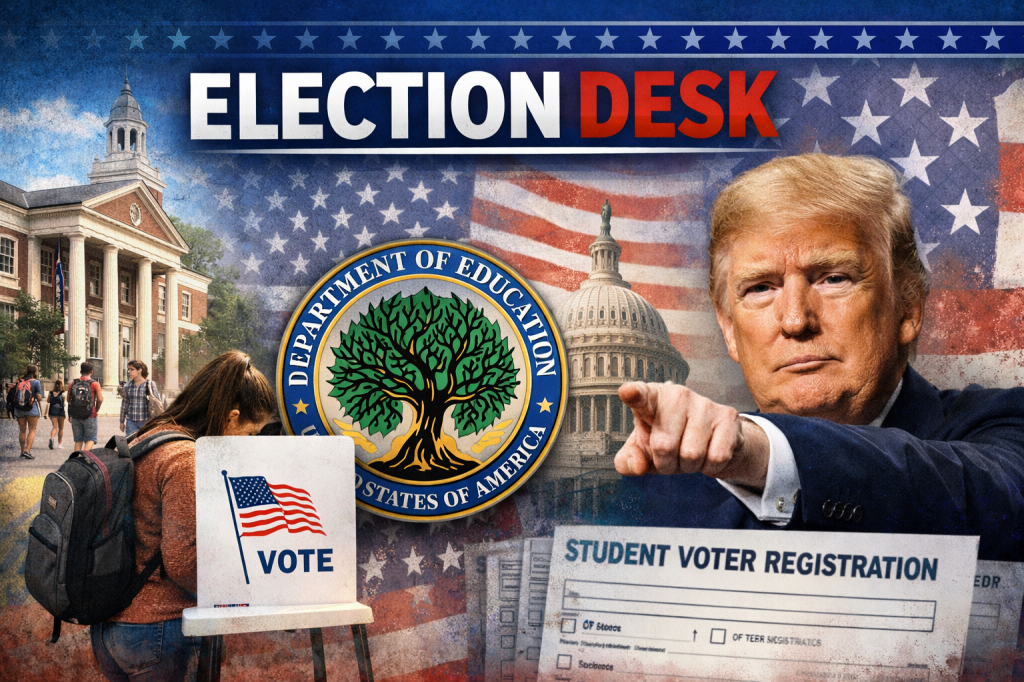
The U.S. Department of Education (DOE) under the Trump administration has opened a formal investigation into prominent voter engagement efforts on college campuses and simultaneously issued guidance that could chill student voter registration and turnout programs ahead of the 2026 elections. The move is part of a wider pattern of federal interventions into election-related activity and voting rights nationwide.
In February 2026, the DOE’s Student Privacy Policy Office launched an investigation into Tufts University and the National Student Clearinghouse for their involvement in the National Study of Learning, Voting, and Engagement (NSLVE), a nonpartisan research initiative that tracks student voting patterns and helps campuses boost civic participation. At the same time, the department rescinded previous encouragement for institutions to participate in the study and issued new guidance warning that using NSLVE data could put colleges at risk of violating the Family Educational Rights and Privacy Act (FERPA), which governs the confidentiality of student educational records.
The DOE’s press release claims the study may have involved “significant FERPA compliance issues” related to what data was collected and whether proper student consent was obtained. It also states that data may have been shared with “political organizations which aim to influence elections,” a characterization that critics say conflates neutral research and civic engagement with political advocacy.
Impact on Campus Voting Programs
For more than a decade, NSLVE has served as a key resource for colleges seeking to understand gaps in voter registration and turnout, particularly among first-time voters and historically underrepresented students. Reportedly anonymized and designed for academic use, its findings have informed outreach and campus get-out-the-vote efforts. The DOE’s new stance may prompt institutions to scale back or halt programs that depend on such data to evaluate participation trends, given the potential threat of losing federal funding for FERPA violations.
Even before this specific DOE action, legal and policy experts had warned about a broader federal push to limit campus voter engagement. Critics described earlier federal changes that curtailed Federal Work-Study programs from funding nonpartisan voter mobilization as part of the same trend to restrict student voting initiatives.
Context in Broader Voting Rights Debates
This DOE investigation comes amid heightened national conflict over federal involvement in voting and election administration. Other civil liberties groups and election rights advocates have raised concerns about federal agencies’ roles in monitoring or challenging voting practices and data use. These concerns form part of larger debates over the balance between preventing voter fraud and protecting access to the ballot.
Scholars and civic engagement organizations note that young voters, including college students, have increasingly participated in elections at higher rates in recent cycles. Federal actions that disincentivize or complicate campus-based outreach and registration efforts could disproportionately affect turnout among this demographic group — which historically leans toward Democratic candidates.
Political and Legal Fallout
Supporters of the DOE’s position argue that enforcing FERPA and safeguarding student privacy are legitimate federal responsibilities. They contend that institutions must be careful not to jeopardize students’ personal information or cross legal boundaries in election-related research.
On the other hand, civil rights advocates and voting rights organizations warn that labeling nonpartisan research as politically influential could undermine routine civic engagement practices, diminish transparency around voter participation trends, and chill legitimate efforts to encourage eligible voters to take part in elections.
Legal challenges may emerge if institutions or advocacy groups assert that federal actions exceed statutory authority or unjustly restrict access to voting. This DOE initiative is likely to join other contentious federal moves affecting election law and voting participation that have been reported throughout the Trump administration’s second term.
What’s Next
As the 2026 elections approach, educational institutions, legal advocates, and civic organizations will be watching the DOE’s investigation closely. The outcome could have significant implications not only for campus voter engagement programs but also for how federal agencies interpret student privacy laws in the context of elections.
Enrollment officials and university administrators may need to reassess their engagement strategies to ensure compliance — or risk unexpected enforcement actions with financial consequences. At the same time, voting rights groups are expected to challenge measures they view as disproportionate or politically motivated. How courts interpret FERPA’s application to voter engagement data could ultimately shape the future of student voting participation nationwide.
 Election Desk
Leave a comment