
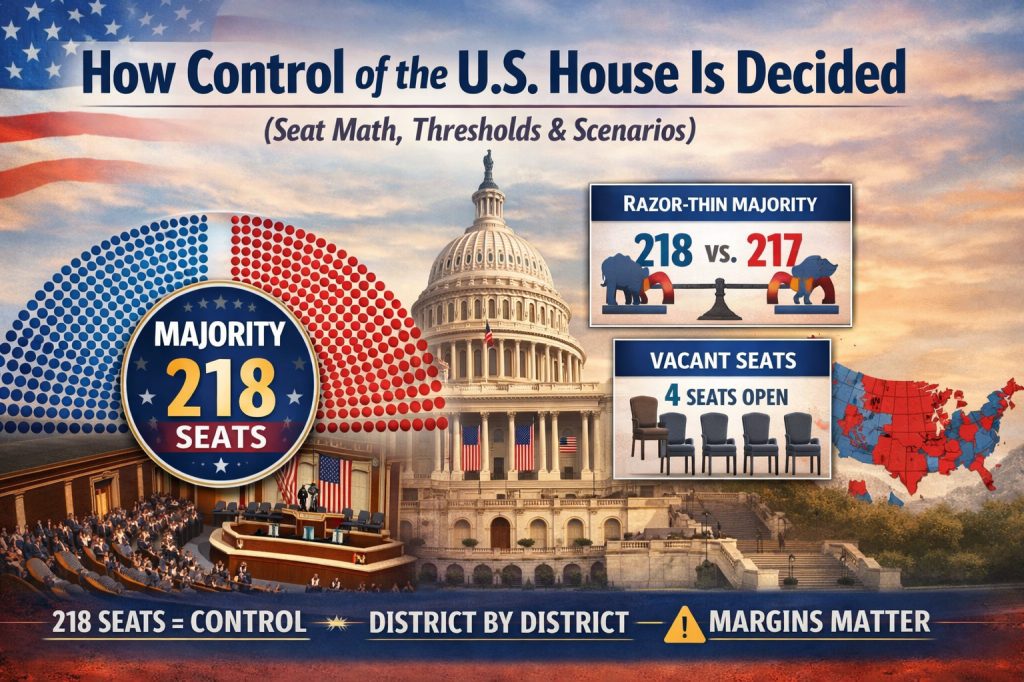
(Seat math, thresholds, and scenarios)
Control of the U.S. House of Representatives comes down to straightforward arithmetic—but real-world outcomes can hinge on vacancies, independents, and razor-thin margins. Here’s the clean, practical breakdown.
1) The Basic Seat Math
- Total seats: 435
- Majority threshold: 218 seats
- Why 218? A majority is more than half of all seats (435 ÷ 2 = 217.5 → round up).
If a party reaches 218, it controls the House—regardless of the national popular vote.
2) What “Control” Actually Means
The party with a majority:
- Elects the Speaker of the House
- Sets the legislative agenda
- Controls committee chairs and hearing schedules
- Decides which bills reach the floor
In practice, this determines whether legislation advances or stalls—and whether oversight intensifies or fades.
3) Common Control Scenarios
Scenario A: Clear Majority
- Party A: 220 seats
- Party B: 215 seats
- Result: Party A controls the House with a small but functional margin.
Scenario B: Razor-Thin Majority
- Party A: 218 seats
- Party B: 217 seats
- Result: Control exists, but leadership must hold near-perfect party unity on key votes.
Scenario C: Vacancies Lower the Bar (Temporarily)
- Example: 4 seats vacant
- Sitting members: 431
- Effective majority to pass votes: 216 (a majority of those sworn in)
- Important: Formal control still depends on overall party alignment and organization.
Scenario D: Independents or Cross-Endorsements
- An independent member may caucus with a party, effectively boosting its working majority.
- Control depends on caucus agreements, not just party labels.
4) Why the Popular Vote Doesn’t Decide Control
House control is determined district by district, not nationally. A party can:
- Win more total votes nationwide but fewer districts
- Lose the House despite strong overall turnout
This is why narrow shifts in competitive districts often matter more than landslide margins in safe seats.
5) What Happens If No One Reaches 218?
This is rare but possible due to:
- Deadlocked results
- Vacancies
- Independents refusing to caucus
Outcome:
- The House may struggle to elect a Speaker
- Negotiations, concessions, or power-sharing agreements follow
- Legislative activity slows until organization is resolved
6) Why Margins Matter More Than Headlines
A 5-seat majority is very different from a 30-seat majority:
- Thin margins increase the power of individual members
- Leadership faces constant risk of internal revolts
- A few special elections can flip control mid-Congress
Bottom Line
- 218 seats = control
- District wins matter more than national totals
- Vacancies and independents can complicate outcomes
- Small margins create big consequences
This seat math is the foundation for understanding every House election—and why control can change quickly even after Election Day.
 Election Desk
Leave a comment