
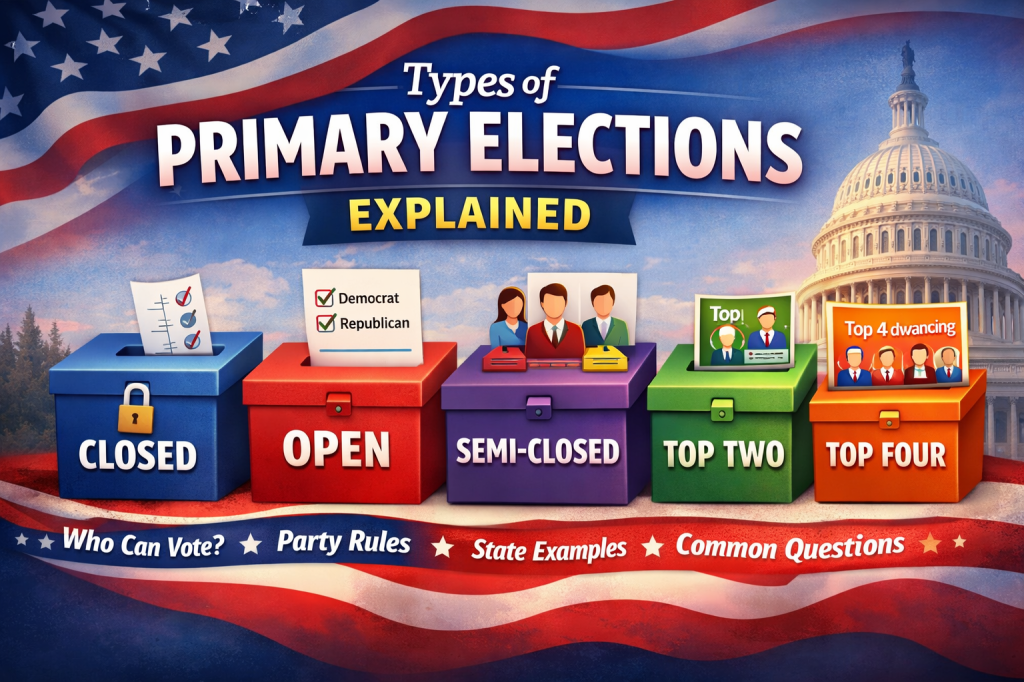
Primary elections determine which candidates advance to the general election. While the goal is the same everywhere, how primaries work varies widely by state and party. Below is a clear, neutral guide to the five main primary systems used in the United States—what they are, who can vote, and why they often cause confusion.
1) Closed Primaries
What it is:
Only voters registered with a political party may vote in that party’s primary.
Who can vote
- Registered Democrats vote in Democratic primaries
- Registered Republicans vote in Republican primaries
- Independents and unaffiliated voters cannot participate
Party rules
- Parties control access and typically support closed systems to prevent “cross-party” voting
State examples
- New York
- Florida (for most primaries)
Common confusion points
- Registering as “Independent” often means no primary ballot at all
- Party registration deadlines may be weeks before Election Day
2) Open Primaries
What it is:
Voters do not register by party and may choose which party’s primary to vote in on Election Day.
Who can vote
- Any registered voter
- Voters select one party ballot (not both)
Party rules
- Parties have less control; state law governs participation
State examples
- Texas
- Virginia
Common confusion points
- Voters may assume they can vote in multiple primaries—they cannot
- Choosing a party ballot may affect eligibility in runoffs
3) Semi-Closed Primaries
What it is:
A hybrid system. Party members vote in their party’s primary, while independents may choose which party’s primary to join.
Who can vote
- Party-registered voters (their party only)
- Independents/unaffiliated voters (choice of party)
Party rules
- Parties decide whether to allow independents
State examples
- Maryland
- Massachusetts
Common confusion points
- Independents may think they are excluded (often they are not)
- Party members cannot cross over, even if independents can
4) Top-Two Primaries (Nonpartisan Blanket)
What it is:
All candidates appear on one ballot, regardless of party. The top two vote-getters advance to the general election—even if they’re from the same party.
Who can vote
- All registered voters receive the same ballot
Party rules
- Parties do not control nominations; the state does
State examples
- California
- Washington
Common confusion points
- Voters may expect party nominees—there may be none
- Minor-party candidates often fail to reach the top two
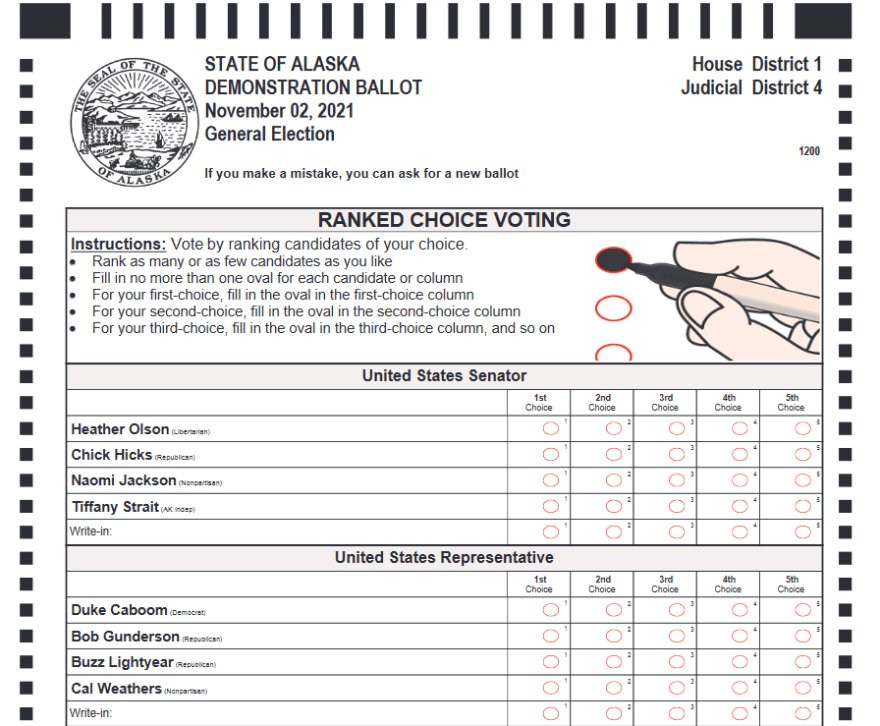
5) Top-Four Primaries (With Ranked-Choice General)
What it is:
All candidates run in a single primary. The top four advance to the general election, which uses ranked-choice voting (RCV).
Who can vote
- All registered voters
Party rules
- Party labels appear, but parties do not nominate candidates
State examples
- Alaska
Common confusion points
- Voters confuse this with Top-Two—it advances four, not two
- The primary is not ranked; only the general election uses RCV
Quick Comparison Table
| System | Who Votes | Party Control | General Election Outcome |
|---|---|---|---|
| Closed | Party members only | High | One nominee per party |
| Open | All voters (choose one) | Low | One nominee per party |
| Semi-Closed | Party + independents | Medium | One nominee per party |
| Top-Two | All voters | None | Two candidates, any party |
| Top-Four | All voters | None | Four candidates, RCV |
Why This Matters
Primary rules directly shape:
- Voter access (especially for independents)
- Candidate strategy and coalition-building
- General election choices, including whether voters see competitive races at all
Understanding your state’s primary system is essential to knowing when and how your vote counts—and why primary elections often determine outcomes long before November.
 Election Desk
Leave a comment