Clearing Up a Widely Misunderstood but Crucial Democratic Process
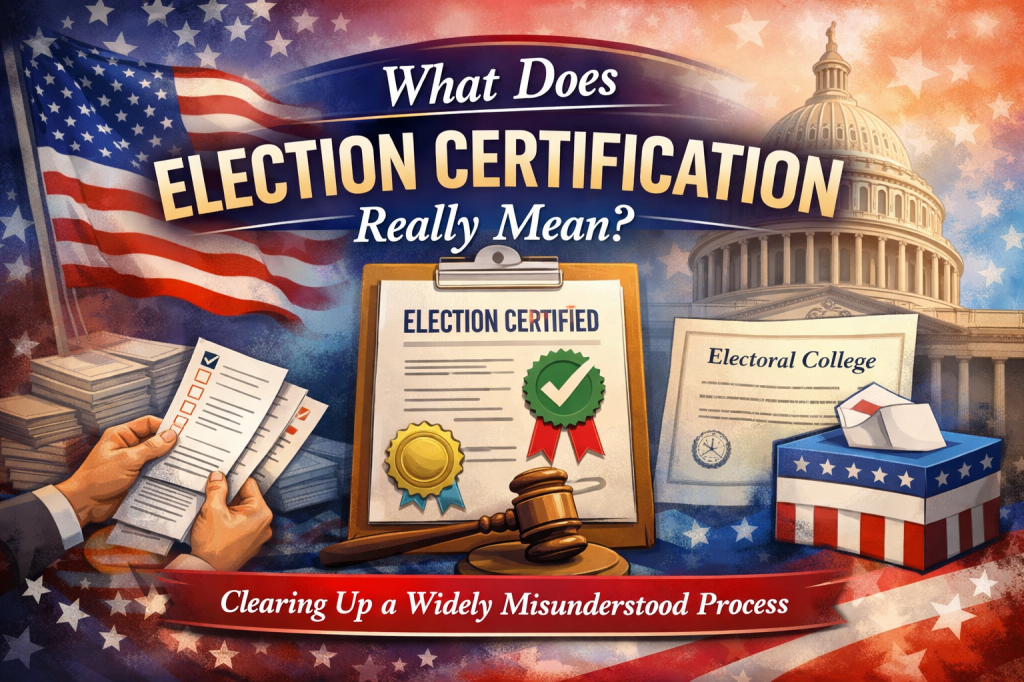
In recent years, “election certification” has shot into the public spotlight — sometimes inaccurately portrayed as a moment when political actors can choose a winner, overturn votes, or interpret the true will of the electorate. The truth is far more grounded, yet deeply important: certification is an administrative, legal step that confirms the results of an election after all votes have been counted and verified. It’s not an opportunity to alter outcomes, nor is it optional for officials.
1. Certification Is a Formal Conclusion to the Vote-Counting Process
After Election Day, votes don’t magically become final. There’s a structured sequence of steps before results are official:
- Ballots are tallied and reconciled to ensure every lawful vote is counted.
- Canvassing occurs: election officials review, check, and validate vote totals against poll books and provisional ballots.
- Audits and checks are often conducted to verify the accuracy of voting equipment and record keeping.
- Certification is the final step where officials officially attest that the process is complete and the results reflect every valid vote cast.
Think of certification like the final “period at the end of a sentence” in the election process — it signals completion and confirms the outcome, but it doesn’t change what was already counted.
2. It’s a Legal Obligation, Not a Discretionary Choice
State laws across the country make certification a mandatory duty for election officials. They are legally required to sign off on results once the canvass and necessary post-election procedures are finished.
This obligation isn’t new — it was codified in part to prevent officials from delaying or sabotaging election outcomes for political reasons. Refusal to certify has triggered legal action in several states, with courts affirming that officials cannot withhold certification simply because they disagree with or question the outcome without evidence.
3. Certification Is Not About Fixing Problems or Deciding Winners
A major misunderstanding is that certification is a moment to “fix” errors or adjudicate disputes about vote counts. That’s not its purpose. By the time officials reach the certification stage:
- Ballots have already been verified and examined, including absentee and provisional ballots.
- Discrepancies are resolved through canvassing or legal challenges before certification.
- Certification does not provide a mechanism for investigating fraud or recounts — other established legal and procedural tools handle those.
In other words, certification is an essential administrative acknowledgment that the election process has run its course according to law and that the results are ready to be used for whatever office is at stake.
4. Federal Elections Follow Additional Certification Steps
For presidential elections, there’s an added layer of certification involving the Electoral College. After states certify their popular vote results and appoint electors, those electors meet and cast their ballots. Their votes — transmitted via formal documents like the certificate of ascertainment — are then opened and counted by Congress in a joint session in early January.
This federal certification step is ministerial, meaning the presiding officer reads the electoral votes without authority to alter them — and objections require specific rules and thresholds to be met.
5. Why All This Matters
Certification is one of the guardrails that uphold democratic legitimacy:
- It ensures a consistent, lawful end to elections across jurisdictions.
- It protects against political interference by making completion a documented obligation.
- It differentiates between results being counted and results being official — a critical nuance in an era of rapid media reporting and public speculation.
Elections are complex. While casting a ballot is the heart of participation, certification is one of the final steps that makes that participation meaningful and fair.
Bottom Line
“Election certification” isn’t a political pivot point — it’s a legal, administrative confirmation that an election’s vote counting and verification are complete and accurate. It doesn’t change outcomes, it doesn’t settle disputes, and it certainly isn’t optional. It’s the formal declaration that democracy has run its course.
 Election Desk
Leave a comment