
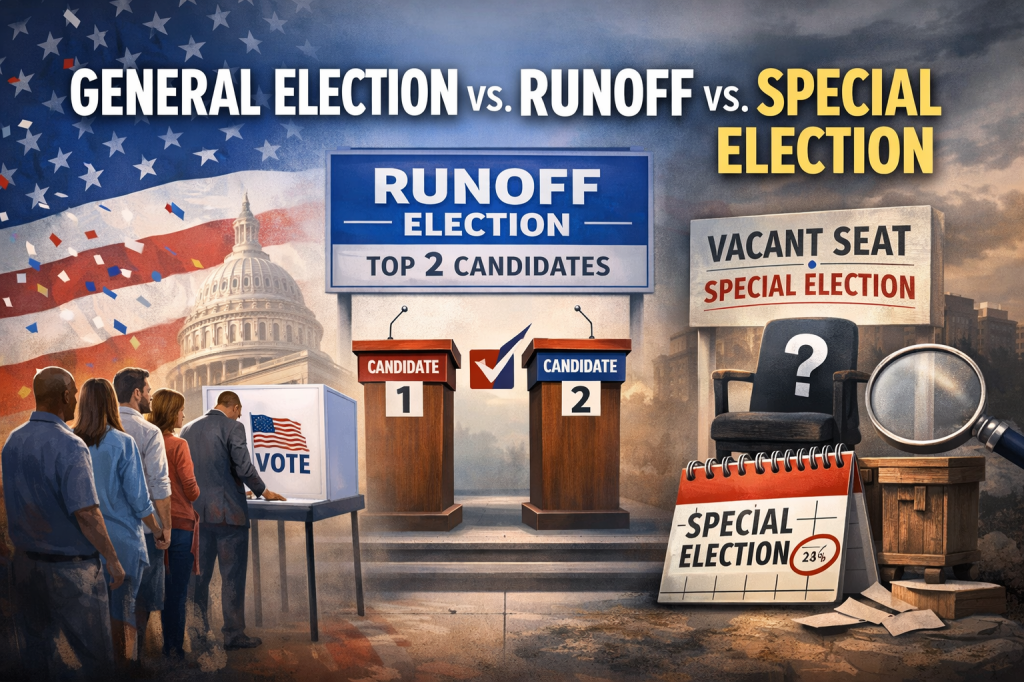
Elections don’t all serve the same purpose. Understanding general elections, runoff elections, and special elections helps voters decode why a race is happening, who can vote, and what’s at stake. Here’s a clear, side-by-side explainer you can keep evergreen.
1) What Triggers Each Type of Election?
General Election
- Trigger: The regularly scheduled election at the end of an election cycle.
- Purpose: Choose officeholders from among party nominees (and independents).
- Examples: November elections for president, Congress, governor, mayor, school board.
Runoff Election
- Trigger: No candidate reaches a required threshold (often 50%+1) in the initial election.
- Purpose: Produce a clear majority winner.
- Examples: Common in states or localities with majority-vote rules; often the top two advance.
Special Election
- Trigger: An unexpected vacancy mid-term.
- Purpose: Fill an office outside the normal election calendar.
- Examples: A legislator resigns, dies, is removed, or takes another office.
2) Turnout Dynamics (Who Shows Up—and Why It Matters)
General Elections
- Highest turnout. Media attention, party mobilization, and multiple races on one ballot drive participation.
- Broader electorate tends to moderate outcomes.
Runoffs
- Lower turnout than the initial round.
- More motivated voters (often older, more partisan) can have outsized influence.
- Outcomes can shift significantly from the first round.
Special Elections
- Often the lowest turnout.
- Timing (off-cycle dates, short notice) favors highly engaged voters and strong ground games.
- Results can diverge from district partisanship due to turnout effects.
3) Timing & Scheduling
General Elections
- Fixed dates set by law (e.g., November in most jurisdictions).
- Predictable campaign timelines.
Runoffs
- Soon after the first election—anywhere from 2–8 weeks, depending on law.
- Compressed campaigns; fundraising and mobilization matter more than persuasion.
Special Elections
- Variable timing set by statute or executive action.
- Some states allow temporary appointments until the election; others require an election only.
4) Vacancy Rules (Especially for Special Elections)
Special elections are governed by office-specific rules, which can differ even within the same state:
- U.S. House: Vacancies must be filled by special election; no appointments.
- U.S. Senate: States may allow the governor to appoint an interim senator until a special election.
- State & Local Offices: Rules vary widely—appointments, special elections, or a mix based on how much time remains in the term.
Why it matters: Appointment power can temporarily shift policy outcomes, while election timing can shape who ultimately wins.
Quick Comparison Table
| Feature | General Election | Runoff Election | Special Election |
|---|---|---|---|
| Why it happens | Regular cycle | No majority winner | Unexpected vacancy |
| When it happens | Fixed date | Weeks after initial vote | Off-cycle, variable |
| Turnout | Highest | Lower than general | Often lowest |
| Who benefits | Broad coalitions | Highly motivated voters | Strong organizers |
| Vacancy involved | No | No | Yes |
Bottom Line
- General elections are the backbone of democratic accountability.
- Runoffs ensure majority support but can skew outcomes due to turnout drop-off.
- Special elections restore representation but often reflect who mobilizes best, not the full electorate.
Understanding these differences helps voters—and readers—interpret surprising results and the real stakes behind election timing.
 Election Desk
Leave a comment