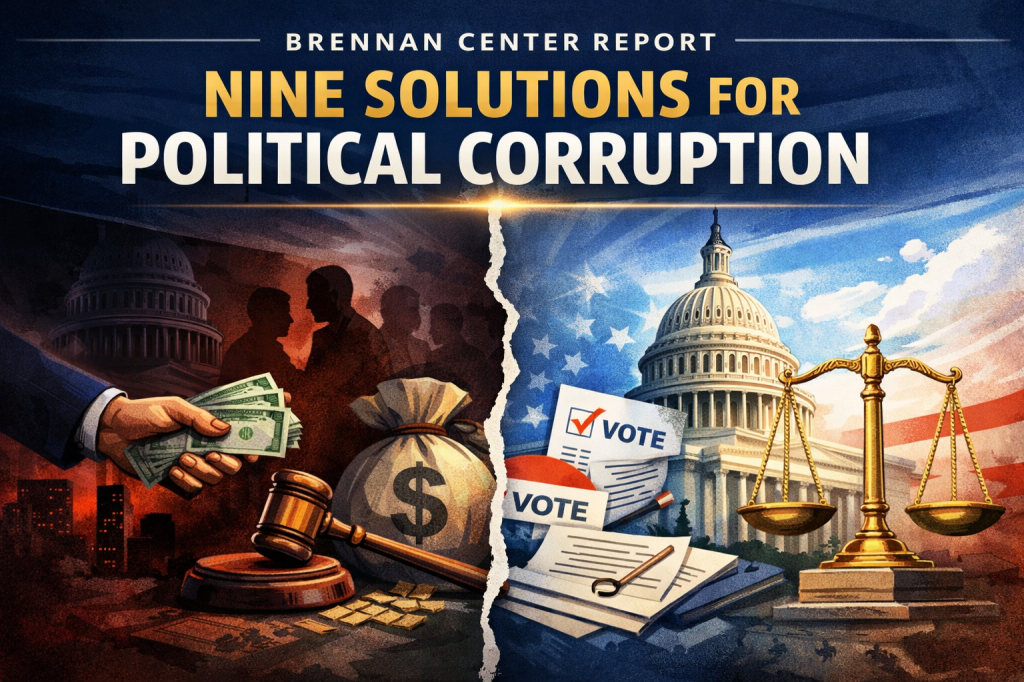
The Brennan Center for Justice has just released a timely and far-reaching policy agenda aimed at tackling what it describes as a new and unprecedented era of political corruption in America. In Nine Solutions for Political Corruption, reformers lay out concrete proposals designed to reduce the influence of private wealth on public power and restore confidence in democratic institutions.
Political corruption—broadly defined as the use of public office for private gain—has long been a concern in American governance. Yet the Brennan Center argues that the fusion of concentrated private wealth with public authority today demands an ambitious response akin to past reform movements in U.S. history.
Why Now? The State of Corruption
The report assesses the current landscape as one in which:
- Supreme Court rulings such as Citizens United removed meaningful campaign finance limits, enabling vast sums of private money to pour into elections.
- Presidential, congressional, and judicial ethics rules lag far behind those that apply to most federal employees, creating loopholes for self-dealing and private enrichment.
- “Dark money”—political spending where the source of funds is undisclosed—has emerged as a major force in modern campaigns.
According to polling cited in the report, a large majority of Americans believe corruption is a serious problem in today’s federal government, reflecting widespread public distrust.
The Nine Solutions: A Framework for Reform
The Brennan Center’s agenda encompasses nine interconnected proposals. Together they aim to reduce the influence of money and special interests, strengthen ethical rules for public officials, and reinvigorate democratic accountability:
- Amend the Constitution to Restore Campaign Finance Limits
The Supreme Court’s expansive interpretation of political spending as protected speech constrains legislative action. The Center endorses a constitutional amendment empowering elected officials to regulate campaign finance more robustly. - Ban Large Donations from Government Contractors
Contracts with the federal government should not be paired with political donations from the same entities. Tightening current prohibitions would limit direct conflicts of interest. - End Dark Money in Elections
Congress should pass laws requiring full disclosure of donors supporting political expenditures, including online ads and groups currently exempt from transparency rules. - Publicly Fund Campaigns
A voluntary system of small-donor matching or “clean money” financing could reduce candidates’ dependence on wealthy patrons. State systems like those in New York, Arizona, and Maine offer existing templates. - Overhaul Federal Ethics Laws
Federal ethics rules should apply broadly to presidents, members of Congress, and judges, closing existing gaps. Proposals include mandatory divestment from conflicting assets and stricter disclosure requirements. - Create a More Effective Ethics Watchdog
A strong, independent agency empowered to enforce ethics and conflict-of-interest laws could bring real accountability to federal officials. - Codify and Enforce the Constitution’s Emoluments Clauses
Although the Constitution bars officials from accepting undue benefits from foreign or domestic sources, enforcement mechanisms are weak. New legislation could make these provisions enforceable. - Restrict the President’s Power to Issue Corrupt Pardons
While preserving legitimate clemency authority, the report proposes a constitutional amendment to prevent politically motivated or self-serving pardons. - Ban Congressional Stock Trading (and Raise Congressional Pay)
Members of Congress should be prohibited from trading individual stocks to prevent conflicts of interest. At the same time, fair compensation is proposed to reduce incentives for outside income that might undermine impartial governance.
A Platform for Action?
The Brennan Center acknowledges that none of these reforms alone will fully “cure” corruption, but together they represent a comprehensive platform for limiting private interests’ sway over public affairs.
Reformers argue that ambitious change has historical precedent: late-19th and early-20th century movements successfully curbed Gilded Age graft through constitutional amendments and structural reforms. The new proposals aim to replicate that scale of reform to match the modern challenges posed by moneyed influence in politics.
Whether lawmakers will take up these solutions remains uncertain. But with trust in government at historic lows and public concern over corruption mounting, Nine Solutions for Political Corruption offers a clear policy starting point for Election Desk readers and civic advocates weighing the future of democratic accountability.
 Election Desk
Leave a comment