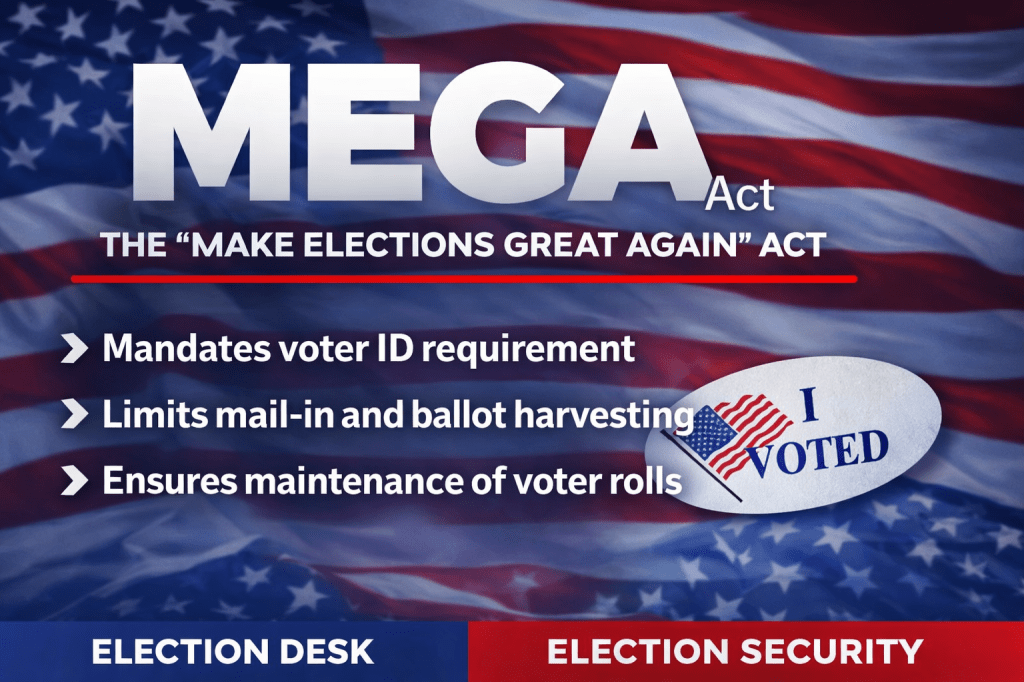
Republicans on the House Administration Committee have formally unveiled a major elections proposal that party leaders are calling the Make Elections Great Again Act (MEGA Act), and Congresswoman Mary Miller (R-IL) has touted the package as “the most comprehensive election integrity package in modern history.”
The bill is a high-profile Republican effort to set new national standards for federal elections, framed by supporters as a way to strengthen voter confidence and protect the security of the ballot. But election law experts and voting rights advocates warn that the changes could significantly alter access to voting and how elections are run across the country.
Key Provisions of the MEGA Act
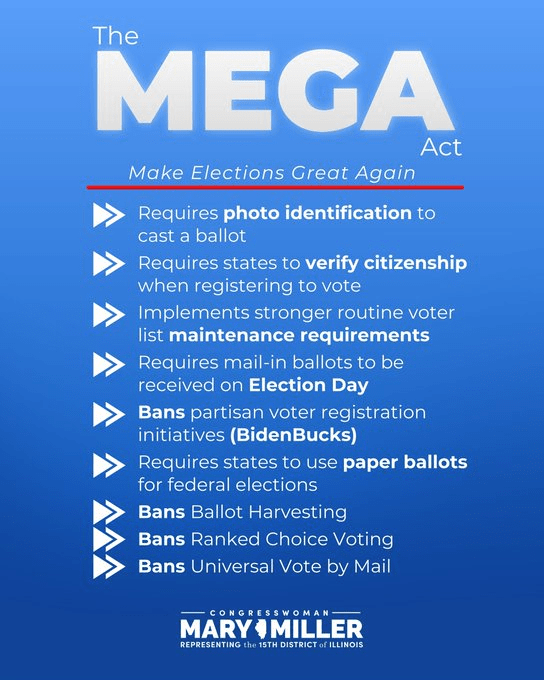
According to the text released by the House Administration Committee, the bill contains a wide range of provisions focused on election administration and voter eligibility. Highlights include:
Photo ID Requirement
The law would require voters to present a qualifying form of photo identification in order to cast a ballot in federal elections.
Voter Registration Changes
States would face new requirements around voter registration, including documentary proof of U.S. citizenship for registration and more frequent list-maintenance procedures to remove ineligible voters.
Voter Roll Maintenance and Verification
The bill imposes standards for maintaining accurate voter rolls, with mandates for states to verify the eligibility of registered voters using available databases and to remove names when ineligibility is found.
Ballot Timing and Methods
Mail-in ballots would be required to be received by Election Day — rather than counted if postmarked by that date — and voters would have to opt in to mail voting rather than being automatically mailed ballots in all states.
Ban on Certain Practices
The legislation would prohibit ballot harvesting, ban ranked-choice voting for federal elections, and end universal mail-in voting programs.
Supporters argue these measures will enhance transparency and prevent fraud, a concern frequently raised by Republican lawmakers. But critics call the bill an aggressive overhaul that could restrict access to voting in ways that disproportionately impact certain groups of eligible voters.
Political Context and Debate
The MEGA Act is being advanced by House Administration Committee Chairman Rep. Bryan Steil (R-WI) and backed by a cohort of conservative House members, including Rep. Mary Miller, who described it as protecting “the voice of every American citizen.”
Republican proponents frame the bill as a corrective to what they see as a lack of uniform standards across states and a response to declining public trust in the integrity of elections. They argue that requiring photo ID, tightening voter rolls, and setting national baselines will prevent fraud and restore confidence.
Opponents — including voting rights organizations and civil liberties advocates — counter that widespread fraud in U.S. elections has not been demonstrated, and that these changes could suppress participation among eligible voters, particularly in communities with lower access to qualifying identification or stable addresses.
What’s Next
The bill has been unveiled to the public and House members, but still must clear committee and floor votes in both chambers of Congress before becoming law. As election policy continues to be a flashpoint in national politics ahead of the 2026 midterms, the MEGA Act is likely to be a focus of intense debate over the balance between election security and voter access.
 Election Desk
Leave a comment