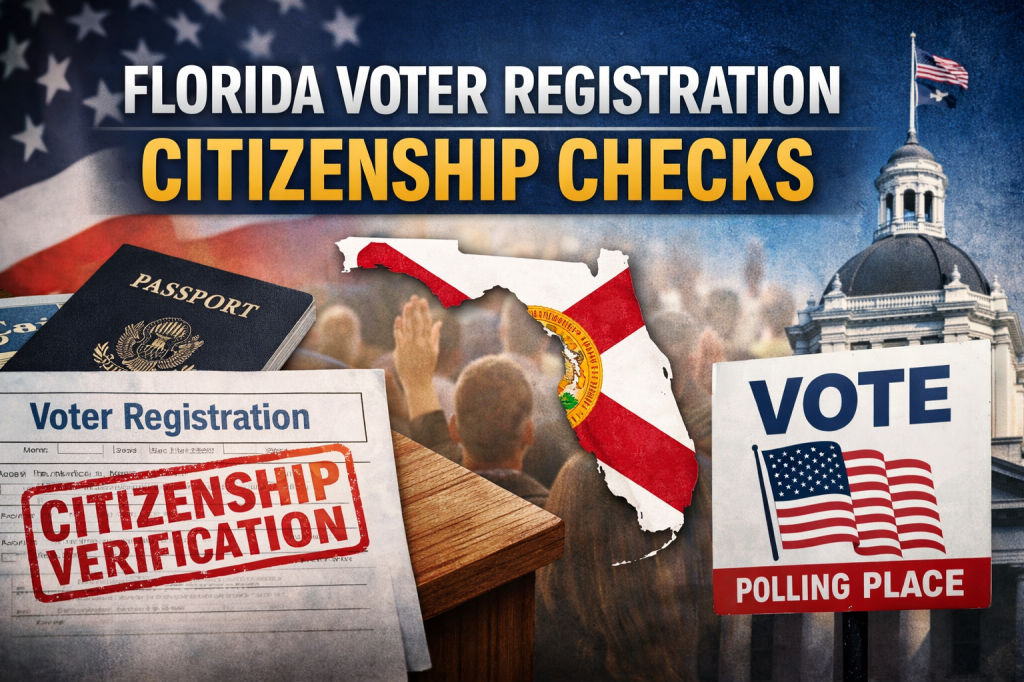
TALLAHASSEE, Fla. — Florida legislators are advancing a controversial election reform that would require prospective voters to verify their citizenship before registering, part of a broader push this session to tighten voter eligibility rules.
What’s Being Proposed
Republican lawmakers, led in the House by Rep. Berny Jacques (R-Seminole), have introduced legislation — most commonly referenced as House Bill 985 — that would add several strict new requirements to the state’s voter registration process:
- Citizenship Verification: Supervisors of elections would be authorized to confirm the U.S. citizenship status of individuals applying to register.
- Identification Changes: The bill would require Florida IDs issued to non-citizens to include an “NC” (non-citizen) designation on the back.
- Provisional Ballots: A person presenting a non-citizen-marked ID at the polls would be issued a provisional ballot that would only count if their citizenship is later proven.
- Voter Roll Maintenance: Individuals who obtain an out-of-state driver’s license could be removed from Florida’s voter rolls.
Proponents frame the changes as “common-sense safeguards” to protect election integrity, arguing that ensuring only eligible citizens are registered is fundamental.
Legislative Momentum and Opposition
On Feb. 4, a Florida Senate committee advanced the measure alongside other election bills, signaling serious legislative momentum. Supporters highlighted how the measure would boost confidence in the voter rolls and leverage existing data (such as REAL ID status) to verify eligibility.
However, opponents — including voting rights advocates and civil liberties organizations — strongly reject the proposal as unnecessary and potentially suppressive. Critics argue that Florida already constitutionally requires U.S. citizenship to vote — through Florida Amendment 1, passed with nearly 80% of the vote in 2020 — and prevents non-citizens from voting by law.
Civil rights groups have raised concerns that additional verification requirements could create bureaucratic barriers for eligible voters, including naturalized citizens, those with limited documentation access, students and seniors.
Context: National and State Trends
Florida’s effort comes as similar citizenship verification proposals gain traction nationally. At the federal level, the Safeguard American Voter Eligibility Act (SAVE Act) — which would require documentary proof of citizenship to register for federal elections — passed the U.S. House in 2025 but faces criticism and legal questions.
In addition, Florida — like several other Republican-led states — has enacted other election laws in recent years that have tightened voter ID requirements and changed how elections are administered. Earlier this legislative session, bills addressing voter eligibility and timelines for special elections also moved forward, underscoring lawmakers’ focus on election policy.
Legal and Practical Implications
While non-citizens are already prohibited from voting, advocates warn that codifying additional verification steps could increase administrative burdens and heighten legal exposures for election supervisors. Data mismatches and documentation hurdles — such as missing birth certificates or passports — could result in eligible citizens being left off the rolls or facing provisional ballot challenges.
Similar proof-of-citizenship requirements in other jurisdictions have previously been criticized for disenfranchising voters without significantly uncovering non-citizen participation. National analysis has shown non-citizen voting is exceptionally rare, and automatic barriers can unintentionally block eligible voters.
What’s Next
The bill now moves through committee deliberations and potential floor votes in both chambers of the Florida Legislature. Gov. Ron DeSantis has signaled support for strict election security measures in the past, which may influence final consideration.
As lawmakers, advocates and voters weigh in ahead of the 2026 midterm elections, this proposal remains a focal point in the broader national debate over election integrity versus access — with competing visions of what it means to secure democracy in practice.
 Election Desk
Leave a comment