Annapolis — Maryland does not require most voters to show photo identification at the polls, and that policy remains unchanged for the 2026 election cycle. But a new Republican-backed proposal has put voter identification back on the agenda in Annapolis, reopening a familiar debate over election security, access, and public confidence.
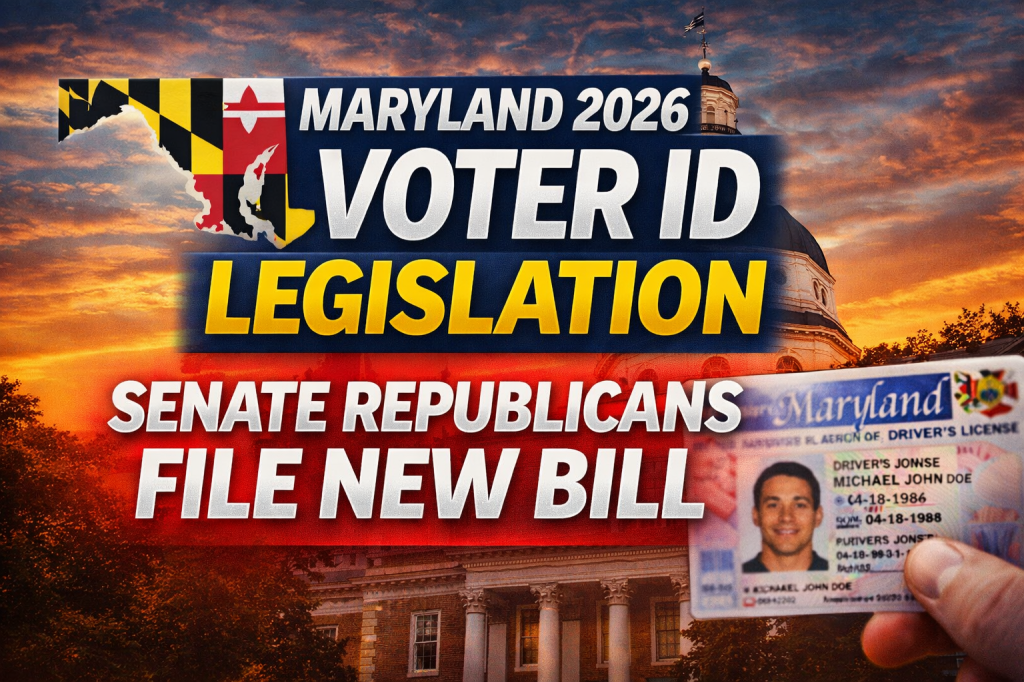
Earlier this month, Senate Republicans announced the filing of legislation that would require voters to present identification before casting a ballot. The measure was disclosed by Justin Ready, who said the bill is sponsored by all 13 members of the Senate Republican caucus. As of early February 2026, the bill has been filed but has not yet been assigned a formal Senate bill number.
Ready said a bill number and hearing date will be announced once the General Assembly completes its intake and referral process.
Maryland’s Current Voter ID Rules
Under existing Maryland law and guidance from the Maryland State Board of Elections, most voters are not required to present identification on Election Day.
Identification may be requested only in limited circumstances, including:
- First-time voters who registered by mail and did not provide a driver’s license number or the last four digits of a Social Security number, as required under the federal Help America Vote Act.
- Situations where a voter’s identity is formally challenged at the polling place.
- Certain provisional ballot or same-day registration scenarios.
In those cases, acceptable identification can include photo ID, such as a driver’s license or passport, or non-photo proof of residence, such as a utility bill or bank statement.
Maryland is among a small group of states that do not have a general voter ID requirement for in-person voting.
What the Senate Proposal Would Change
According to statements from Ready and Senate Republicans, the newly filed bill would:
- Require voters to present government-issued identification before voting.
- Allow multiple forms of ID, rather than limiting voters to a single document.
- Provide provisional ballot options for voters unable to produce ID at the polls.
- Bring Maryland’s election procedures closer to those used in many other states.
Supporters argue that voter ID requirements are widely used nationwide and are intended to strengthen confidence in election outcomes rather than restrict participation.
Related Election Bills in the 2026 Session
The Senate filing comes amid a broader set of Republican-backed election proposals during the 2026 session of the Maryland General Assembly.
In the House of Delegates, lawmakers have introduced:
- HB 462 – Elections – In-Person Voting – Proof of Identity, sponsored by Republican delegates, which would require a government-issued photo ID or a non-government photo ID paired with proof of address. Voters without ID could cast provisional ballots.
- HB 454 – “SAVE Our Elections Act of 2026,” which focuses on voter registration rather than in-person voting by requiring the state to use the federal SAVE program to verify U.S. citizenship for registrants.
These measures have been referred to committee but have not advanced beyond early stages. Maryland’s legislature is controlled by Democrats, and similar voter ID proposals in prior sessions have not passed.
Support and Opposition
Republican sponsors describe voter ID as a basic verification measure and note that identification is routinely required for activities such as banking, air travel, and employment. They argue the policy would increase public confidence in elections without preventing eligible voters from participating.
Democratic leaders and voting-rights advocates are expected to oppose the bill, citing concerns that ID requirements could disproportionately affect elderly, low-income, or marginalized voters. Opponents have made similar arguments in past sessions, contributing to the failure of earlier voter ID proposals.
What Happens Next
Key developments to watch include:
- Assignment of a formal Senate bill number.
- Committee referral and scheduling of a public hearing.
- Whether House leadership advances or declines to act on companion legislation.
Until any legislation is enacted and takes effect, Maryland’s current voting rules remain in place. Voters participating in 2026 primaries or the general election are not required to present ID at the polls unless they fall into one of the limited existing exceptions.
Election Desk will continue to track the proposal as it moves through the legislative process.
 Election Desk
Leave a comment