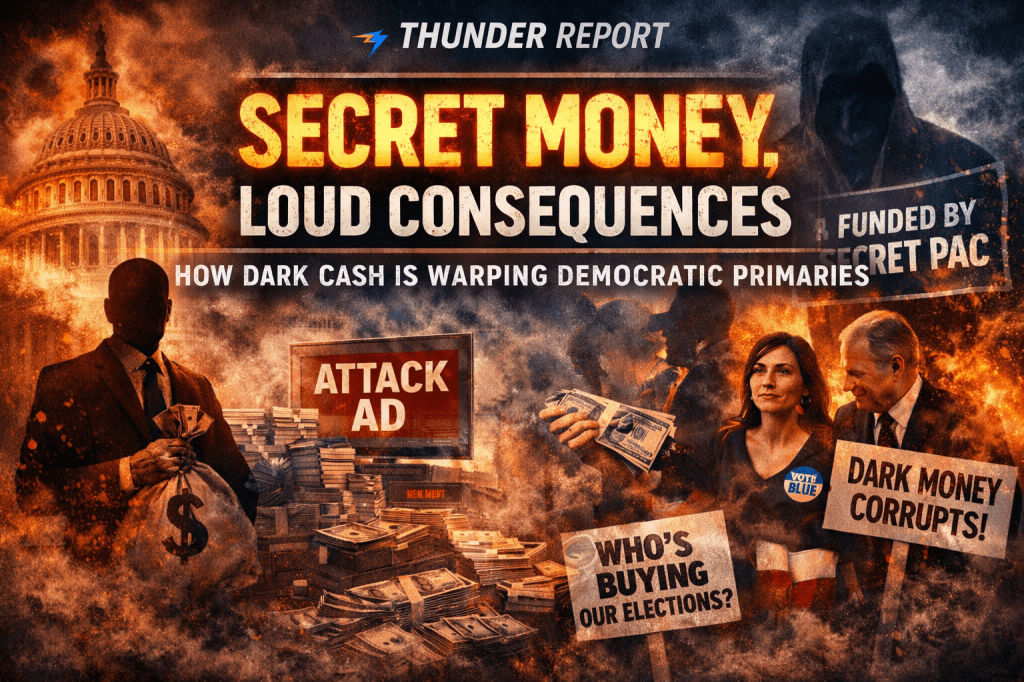
Political contests are supposed to be about voters making choices — but in key Democratic primaries this cycle, voters are increasingly spectators to a far less transparent force: secret money.
According to reporting from NBC News, Super PACs and other outside spending groups powered by donors who remain unknown to the public have poured significant sums into Democratic Party primaries, particularly in Illinois and other open House contests. These groups are buying ad time, shaping narratives, and influencing outcomes — all without voters knowing who is bankrolling that activity.
What Is Happening in Democratic Primaries?
In multiple House districts, outside groups aligned with the Democratic Party have deployed heavy spending in intraparty contests. These expenditures often dwarf the media budgets of the candidates themselves. Crucially, many of the largest spenders in these races are Super PACs and nonprofit organizations that do not have to publicly disclose their donors when they funnel money into political advocacy.
This regime of secret funding means that even grassroots challengers with strong local support can find themselves outgunned by well-financed attack ads or messaging campaigns — all without any clear accounting of who is bankrolling that opposition. The candidates themselves may have no visibility into or control over these expenditures, raising serious concerns about accountability and control.
A Democratic Irony
For years, many leading Democrats have vocally criticized the influence of big money in politics. They have condemned corporate PACs, lobbied for campaign finance reform, and echoed the public’s frustration with wealthy donors exerting outsized influence.
Yet as primary challenges emerge — particularly in districts where progressive insurgents or centrists threaten party orthodoxy — the party’s allied money vehicles have repeatedly stepped in with opaque spending to protect or target specific candidates.
This pattern reveals a fundamental tension: while the Democratic Party publicly decries the corrosive effects of secret money, its political operations — and allied outside groups — frequently rely on those same mechanisms when it suits strategic objectives.
The Broader Context
The rise of independent spending vehicles that can raise and spend unlimited funds stems from legal changes over the past decade that have dramatically reshaped campaign finance rules. Court decisions like Citizens United v. FEC opened the door to the proliferation of Super PACs and soft-money entities that can receive unlimited contributions — and often without disclosing their donors’ identities.
The result is a system in which a tiny slice of wealthy donors and special interests can exert tremendous influence over elections — including primaries that were once thought to be a more direct expression of local voter intent.
Why This Matters
Primary elections are especially important in many Democratic strongholds where the general election is effectively a foregone conclusion. In such places, winning the primary is tantamount to winning the seat, meaning that whoever controls the narrative and messaging in those primaries wields outsized political power.
When unaccountable spending dominates that process, it weakens the tie between candidates and constituents. Voters end up reacting to a flood of externally driven messages rather than evaluating candidates on their records and platforms.
The consequence is a party increasingly shaped by the priorities of wealthy, anonymous donors rather than rank-and-file members — even as its leaders continue to denounce the very financial mechanisms that now play an oversized role in their own contests.
Looking Ahead
If there is any bipartisan consensus in Washington, it is that Americans — regardless of party — are deeply skeptical of the role big money plays in shaping political outcomes. Public opinion research consistently shows overwhelming concern about money in politics and the influence of wealthy interests on elected officials.
Yet without meaningful reforms to transparency and campaign finance law, the current cycle’s reliance on secret money in primaries may be a harbinger of continued influence by unaccountable spending in elections at every level.
For voters who care about openness and accountability, this shouldn’t be merely a Democratic problem — it’s a broader challenge for the health of American democracy itself.
 Election Desk
Leave a comment