

Voters in Georgia’s 13th Congressional District went to the polls Tuesday to choose a temporary successor to the late Rep. David Scott, but the race isn’t over. With no candidate clearing the 50-percent threshold Georgia law requires, the contest moves to an August 25 runoff between the top two finishers — both Democrats.
Here’s what happened, what Georgia’s rules require, and what’s still to be decided.
What triggered the election
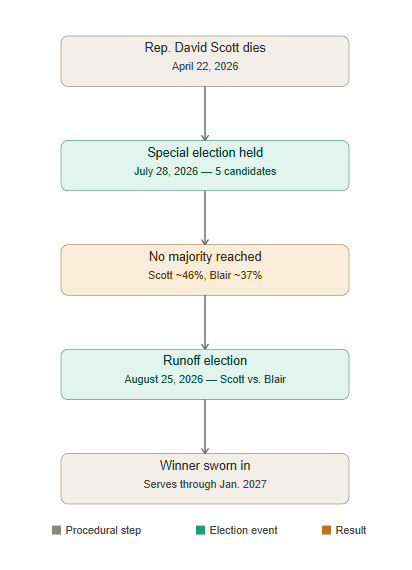
Scott, a Democrat who represented the district for more than two decades, died on April 22 at age 80, one day after casting his final House vote. His death created a vacancy that Gov. Brian Kemp was required to fill by calling a special election. Kemp set the date for July 28.
Because the seat became vacant so close to Georgia’s regularly scheduled primary, the state ended up running two separate contests for the same seat: a special election to serve out the remainder of Scott’s current term, and a separate primary-and-general-election track to determine who holds the seat for the full two-year term beginning in January. State Rep. Jasmine Clark had already won the Democratic nomination for that full term in May and is expected to face Republican Jonathan Chavez in November — a race with a much smaller current-office stake, since the district backed Scott with roughly 72 percent of the vote in 2024.
The special election decides only who fills the seat for the next several months.
How Georgia’s special election format works
Georgia special elections use a nonpartisan, all-candidate format: every contender, regardless of party, appears together on a single ballot. If one candidate wins an outright majority — more than 50 percent — that person takes the seat immediately. If no one does, the top two vote-getters, regardless of party, advance to a runoff.
Five candidates qualified for Tuesday’s ballot (a sixth, Democrat Tony Brown, was disqualified after his qualifying fee was returned for insufficient funds, and any votes cast for him will not be counted). With unofficial results showing Marcye Scott, the late congressman’s daughter, at roughly 46–47 percent and former Gwinnett County School Board Chair Everton Blair at roughly 36–37 percent, neither reached the majority threshold. Republican Caesar Gonzales finished a distant third at under 10 percent, according to the Associated Press.
Because both leading candidates are Democrats, the August 25 runoff will be a head-to-head contest between Scott and Blair, not a partisan matchup.
What’s still ahead
The runoff winner will be sworn in to complete only the remaining months of Scott’s current term, which ends when the new Congress convenes in January 2027. That winner is not guaranteed the seat beyond that point — Clark, who is unopposed in the special election track, is separately positioned to hold the seat for the full term starting in January regardless of who wins the August runoff.
Turnout in Tuesday’s special was modest — under 20,000 votes were cast districtwide, out of roughly 584,000 registered voters, typical for special elections held outside the regular election calendar.
The runoff timeline gives the winner only a few months in office before facing the district’s voters again in the separately decided general election. Georgia’s Secretary of State’s office is expected to certify the July 28 results before the runoff, following the state’s standard certification process.
Sources
This story draws on unofficial results and reporting from the Georgia Secretary of State’s Office; the Associated Press; the Atlanta Journal-Constitution; the Georgia Recorder; Rough Draft Atlanta; Georgia Public Broadcasting; NBC News; and Roll Call, along with Wikipedia’s summary of the district’s special election filings. Vote percentages reflect unofficial, in-progress counts as reported the night of and day after the election and should be updated with certified totals once the Georgia Secretary of State finalizes them.
 Election Desk
Leave a comment