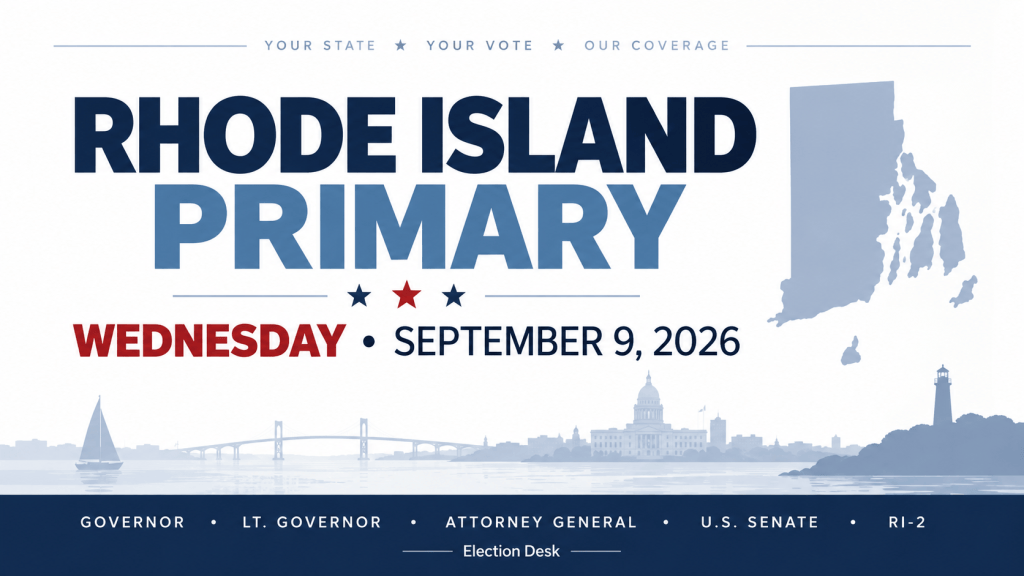
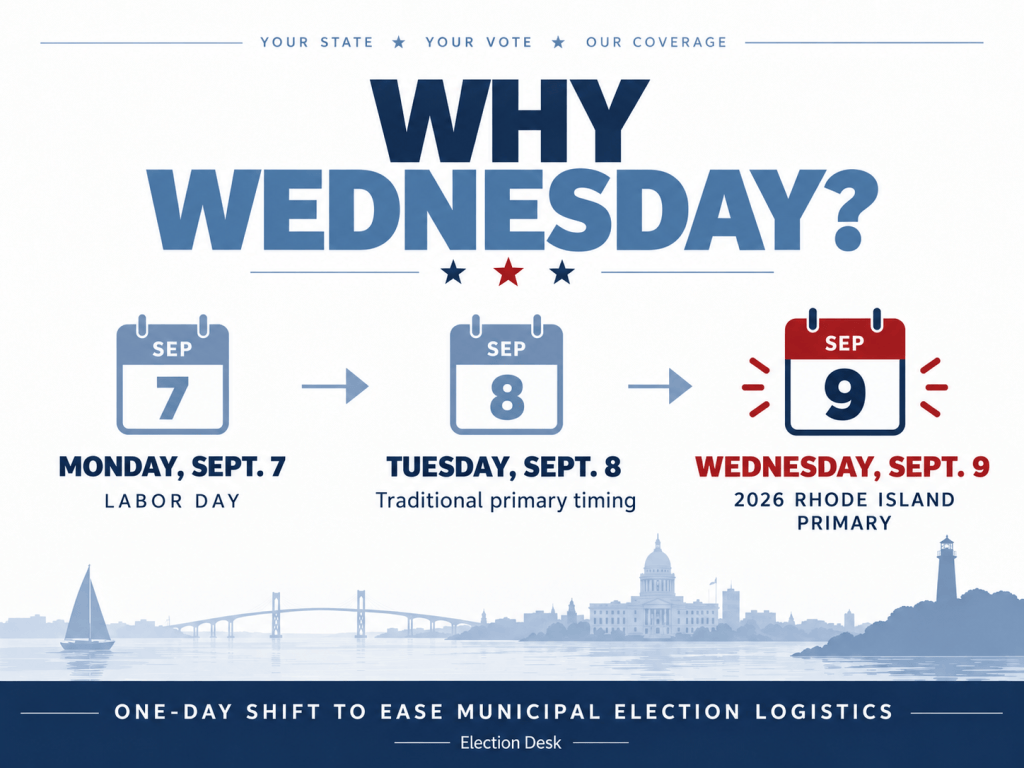
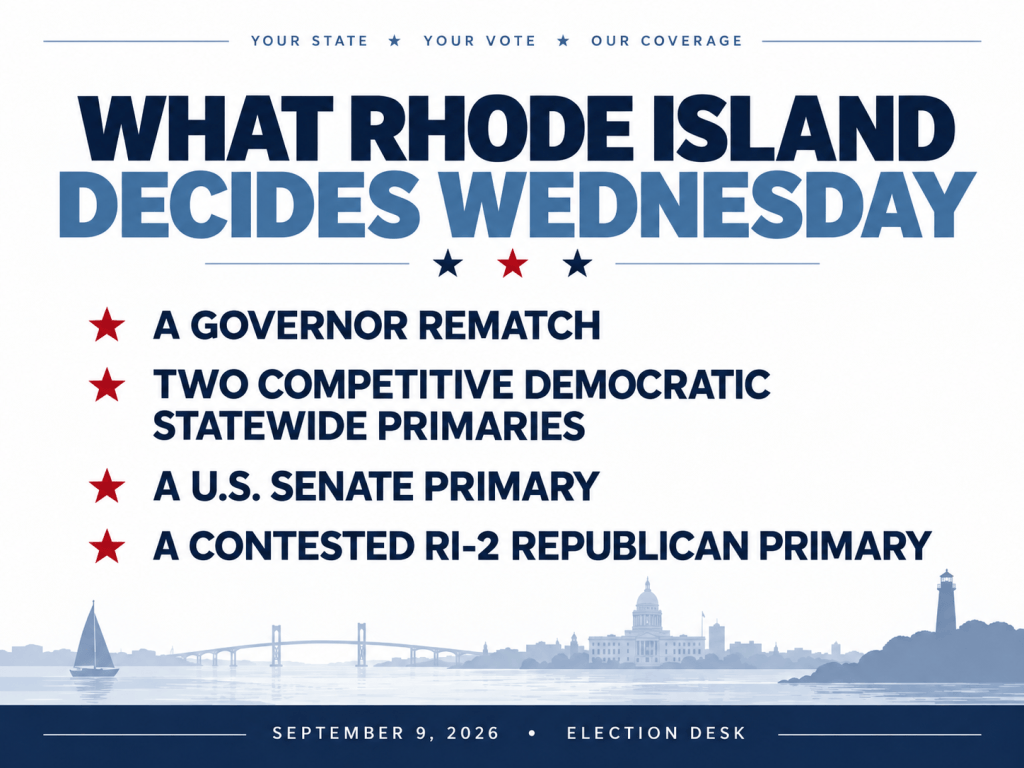
Rhode Island holds its state primary on Wednesday, September 9 — a day later than the state’s traditional first-Tuesday-after-Labor-Day schedule, after the General Assembly moved the date to ease logistical strain on municipalities. The ballot’s marquee contest is a rematch of the 2022 Democratic gubernatorial primary, alongside competitive Democratic primaries for lieutenant governor and attorney general and a Republican primary in the 2nd Congressional District.

Why the date moved
“Rhode Island’s primary is arriving a day later than usual — not because of a recount, court fight or emergency, but because Tuesday fell immediately after Labor Day.”
Rhode Island law has generally set the state primary for the first Tuesday in September, which in 2026 fell the day after Labor Day. Citing added costs and logistical difficulty preparing polling places on that turnaround, the General Assembly passed legislation shifting the primary to Wednesday, September 9; Gov. Dan McKee signed it into law in April 2026. The move affects timing only — early voting and the mail-ballot period still conclude beforehand, and the general election remains November 3.
A gubernatorial rematch, with a bridge in the middle

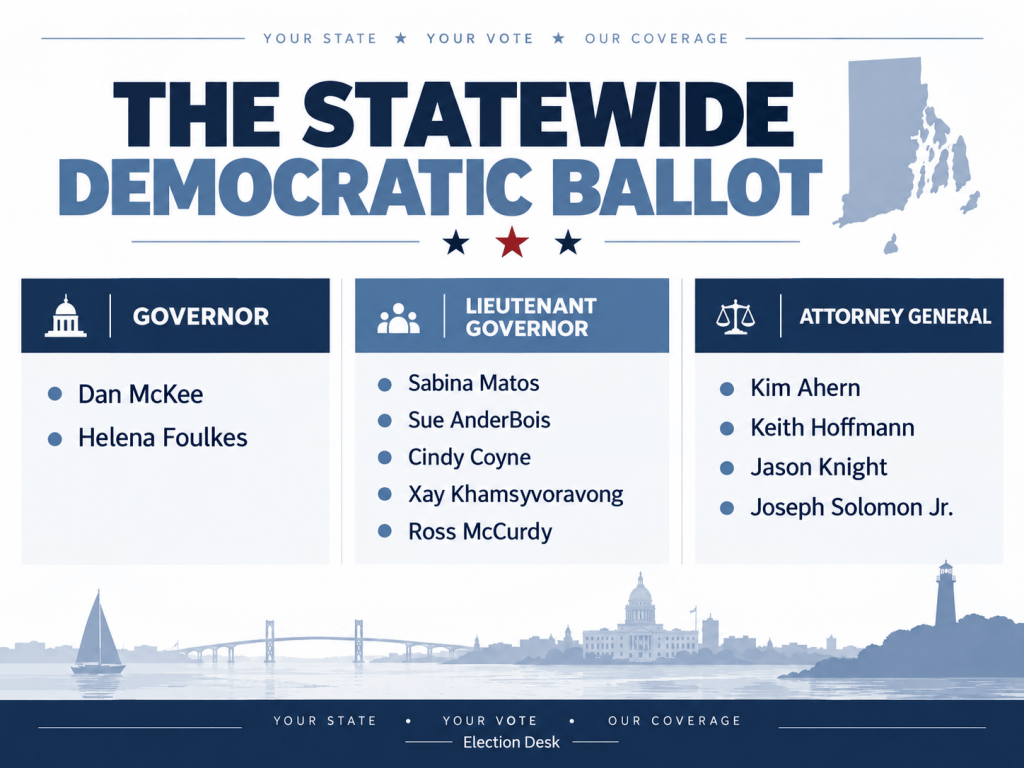
Gov. Dan McKee, seeking a second full term, faces a repeat challenge from Helena Buonanno Foulkes, a former CVS Health executive. McKee narrowly defeated Foulkes in a five-way 2022 primary. Public polling released in the closing weeks of the campaign — including surveys from Emerson College/WPRI-TV and the Pell Center at Salve Regina University — has shown Foulkes leading McKee among likely Democratic primary voters, with both candidates showing high unfavorable ratings overall. The candidates have sparred over the prolonged closure and repair of the Washington Bridge in Providence, McKee’s handling of a 2024 cyberattack on the state’s RIBridges benefits system, and Foulkes’s past work as a CVS executive during a period covered by a federal complaint alleging the company contributed to the opioid crisis.
“Four years after their first primary fight, Dan McKee and Helena Foulkes are back on the same Democratic ballot.”
On the Republican side, Aaron Guckian and Elaine Pelino are seeking the nomination. Three independents — Ken Block, Jasjit “Jay” Gotra and Christopher “CD” Reynolds — have filed to appear on the November ballot; none face a primary.
Down-ballot Democratic primaries
With Lt. Gov. Sabina Matos and Attorney General Peter Neronha’s successor-in-waiting both facing open contests, two other statewide offices carry competitive September ballots:
- Lieutenant governor: Matos, who has held the office since 2021, faces four Democratic challengers — Sue AnderBois, Cindy Coyne, Xay Khamsyvoravong and Ross McCurdy. Republican John Loughlin, a former state representative and longtime radio host, faces no primary opponent for his party’s nomination.
- Attorney general (open, as term-limited incumbent Peter Neronha cannot seek reelection): Four Democrats — Kim Ahern, Keith Hoffmann, Jason Knight and Joseph Solomon Jr. — are competing for the party’s nomination. Republican Alan Gordon, who lost to Neronha in 2022 and is running again without the state party’s backing, according to the Boston Globe, faces no primary opponent.
“The governor’s race has the marquee names, but Rhode Island Democrats are also choosing nominees in two consequential statewide contests.”
Neither office has a contested Republican primary, though both have a Republican candidate on the ballot.
U.S. Senate and the 2nd District
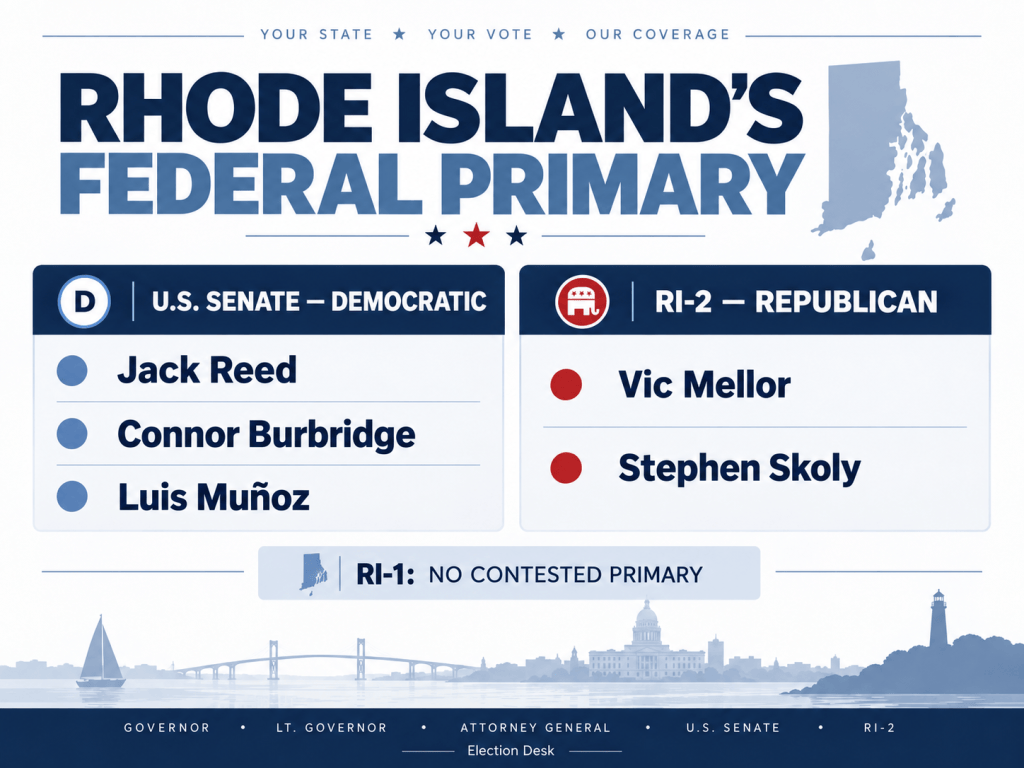
Democratic Sen. Jack Reed, seeking a sixth term, faces two primary challengers, Connor Burbridge and Luis Muñoz; Republicans have not won a U.S. Senate election in Rhode Island since 2000, and no Republican has filed to run in 2026. In the 2nd Congressional District, Democratic Rep. Seth Magaziner faces no primary opponent; Republicans Vic Mellor and Stephen Skoly are competing for their party’s nomination. The 1st District, represented by Democratic Rep. Gabe Amo, has no contested primary this cycle.
“Rhode Island’s federal ballot is comparatively quiet, with the state’s only contested House primary occurring on the Republican side in the 2nd District.”
Ahead
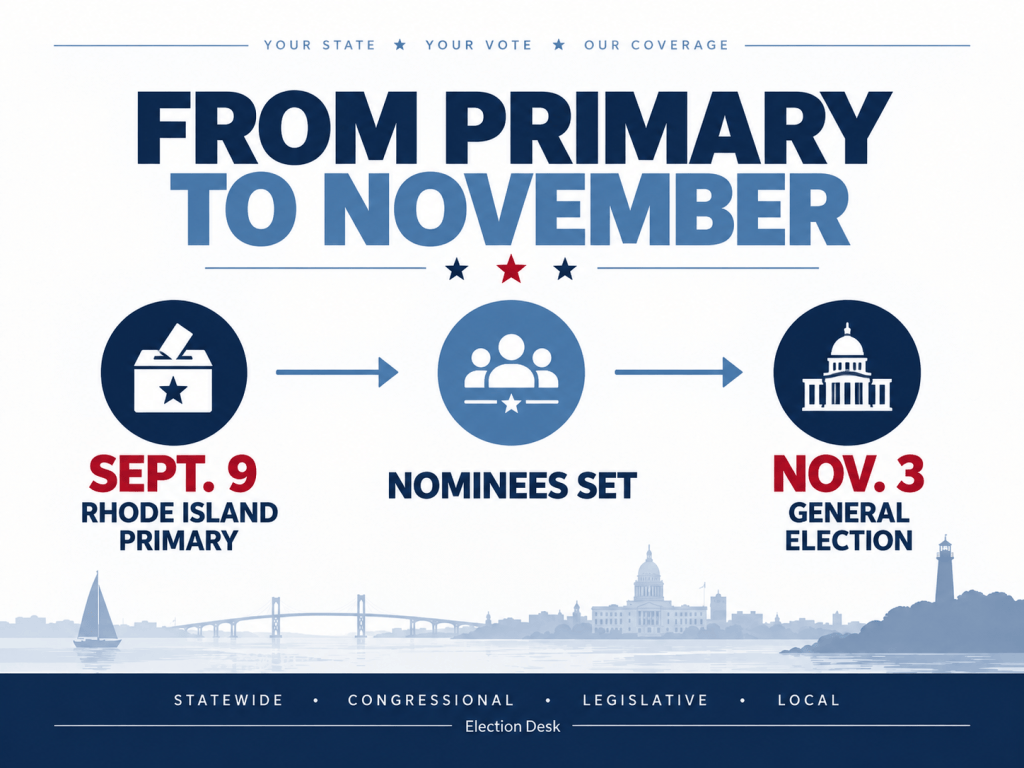
Rhode Island Current and other outlets are also tracking a competitive Democratic primary for mayor of Providence between incumbent Brett Smiley and City Councilman David Morales, along with select General Assembly races. All primary winners advance to the November 3 general election, where Rhode Island’s Democratic-leaning electorate — Republicans have not won a statewide race since 2006 — will test whether that pattern holds.
Sourcing and methodology
This article is based primarily on the Rhode Island Current 2026 primary voter guide (as it stands ahead of the September 9 primary) and candidate pages, cross-checked against contemporaneous reporting from the Boston Globe’s Rhode Island Report, the Associated Press, WPRI-TV and GoLocalProv on the gubernatorial, lieutenant governor and attorney general races. Gregory Stevens was an earlier declared Democratic gubernatorial candidate who did not make the final primary ballot; he does not appear in this article. Polling figures are attributed to their respective sponsors (Emerson College Polling/WPRI-TV 12 News; the Pell Center at Salve Regina University, fielded by Embold Research, Aug. 3–11, 2026; the University of New Hampshire Survey Center) and are not blended into a single average. One discrepancy surfaced in reporting and was resolved rather than carried forward silently: the lieutenant governor’s Democratic field is listed at five candidates (including Matos) by Rhode Island Current’s guide but at three by Ballotpedia and an April 2026 GoLocalProv report; this article uses Rhode Island Current’s count. Legislative primary races are not itemized here.


Leave a Reply