By Michael Phillips | Election Desk
A calm, big-picture analysis
As the 2026 U.S. midterm elections draw closer—and as the new congressional session begins amid ongoing debates over spending levels, tariffs, and the direction of economic policy—the political environment offers a revealing snapshot of how American voters are behaving. All 435 seats in the U.S. House, 34 Senate seats, and dozens of governorships and state legislatures will be contested this November, with Republicans holding the White House under President Donald Trump and narrow congressional margins.
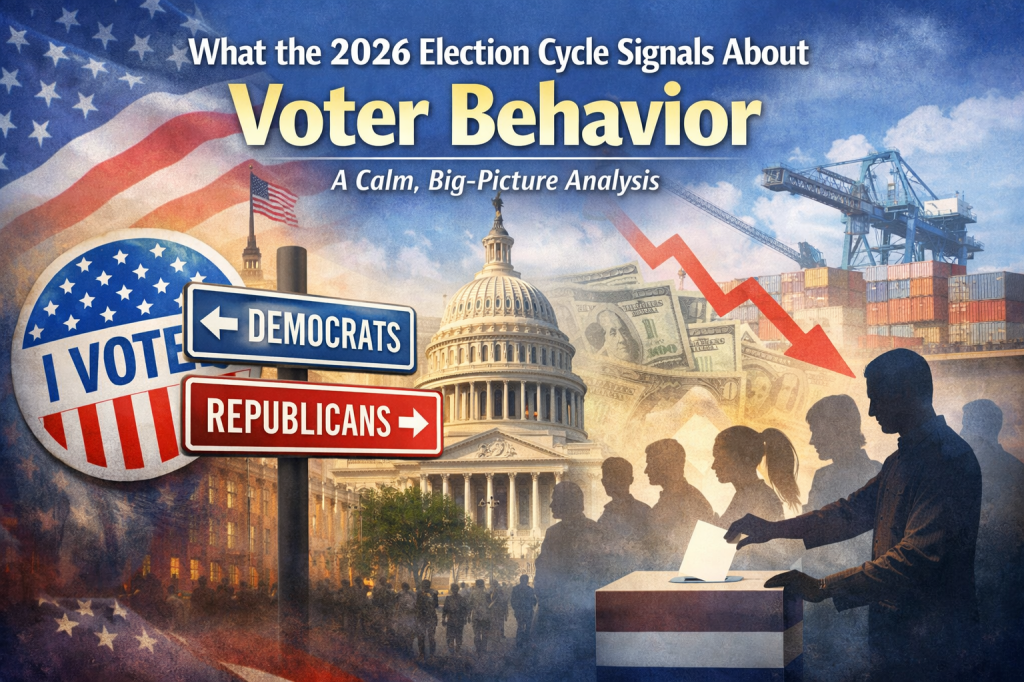
While midterms traditionally function as a referendum on the sitting president, the early contours of the 2026 cycle suggest something more layered: a fatigued yet discerning electorate, less anchored to party identity and more focused on performance, accountability, and material outcomes. Drawing on polling and public sentiment from late 2025 and early 2026, this analysis examines what voter behavior itself—rather than race-by-race forecasting—reveals about the moment.
Widespread Dissatisfaction and Eroding Trust
One of the clearest signals in the 2026 cycle is persistent voter dissatisfaction with both major political parties. Surveys conducted in late 2025 and early 2026 show unfavorable views outweighing favorable ones for both parties, with Democrats in particular struggling to inspire confidence among their own coalition. Only a minority of Americans associate either party with “good ideas,” while majorities describe both as too extreme or ineffective.
Institutional trust remains similarly depressed. Confidence in Congress, party leadership, and the presidency continues to hover near historic lows, reinforcing a sense that elections offer limited leverage over entrenched systems. Among Democratic-leaning voters, frustration with their party has risen noticeably, driven by perceptions of weak governance and insufficient results. Republicans report higher internal cohesion and optimism, though that confidence may mask signs of fatigue following the 2024 cycle.
This environment has two countervailing effects on voter behavior. On one hand, cynicism risks dampening enthusiasm. On the other, it sharpens voter expectations. Candidates perceived as competent, achievement-oriented, and focused on delivery—rather than grievance or symbolism—appear better positioned to earn conditional support, particularly among younger and independent-leaning voters.
Turnout Dynamics and Motivation Gaps
Midterm elections reliably hinge on participation, not persuasion. Early 2026 data points to a meaningful motivation gap: Democratic-leaning voters consistently report higher certainty that they will vote compared with Republican-leaning voters. This is most pronounced among high-propensity groups such as college-educated voters, older suburban residents, and frequent midterm participants.
Republican engagement remains uneven. While certain issues—most notably immigration—generate episodic enthusiasm, overall intensity appears lower than in presidential cycles. This pattern aligns with historical midterm dynamics, where voters use off-year elections to register dissatisfaction with the governing party rather than to endorse sweeping ideological change.
Behaviorally, voters appear to be treating 2026 less as a choice between governing philosophies and more as an accountability checkpoint. That framing favors participation by the opposition coalition and places a premium on mobilization over persuasion.
Demographic Realignments and Fluid Coalitions
The 2026 cycle also underscores how unsettled modern voter coalitions have become. Latino voters remain a particularly dynamic bloc. While Republicans have narrowed Democratic margins over the past decade, recent data highlights growing independence among younger and newer Latino voters in the electorate—many of whom prioritize economic stability and affordability over partisan or cultural alignment.
Education and geography continue to structure voting behavior. College-educated voters and suburban residents lean Democratic, while rural voters remain more competitive than headlines often suggest. Younger voters maintain a strong Democratic tilt, though their participation remains less consistent than older cohorts.
Independents—now one of the largest and least predictable segments—show little attachment to either party brand and exhibit a growing tendency to vote against incumbents rather than for challengers. These patterns suggest voters are increasingly transactional: responsive to issue-specific appeals and candidate credibility rather than long-standing party loyalty.
Economic Priorities and Issue-Driven Rationality
Economic conditions dominate voter priorities heading into 2026. Across recent polling, cost-of-living concerns—particularly food prices, housing costs, and healthcare expenses—consistently rank as the top issue for roughly four to five in ten voters, well ahead of immigration or cultural debates.
This emphasis reflects a pragmatic electorate. Republicans retain advantages on issues such as border security and crime, while Democrats perform better on healthcare and cost-of-living concerns. Voters appear willing to split issue credit rather than align wholesale with a single party, rewarding perceived competence and penalizing unmet expectations.
Notably, cultural flashpoints that shaped earlier cycles appear to be receding in salience. This shift does not signal resolution, but exhaustion. Voters increasingly express impatience with rhetoric unaccompanied by tangible improvements, reinforcing a broader trend toward outcome-based evaluation.
Historical Patterns and Structural Constraints
Historically, the president’s party loses an average of roughly two dozen House seats in midterm elections, with only rare exceptions. Current generic ballot polling—showing modest Democratic leads—fits comfortably within that historical range. At the same time, structural factors such as redistricting and the large share of safe districts continue to blunt the electoral impact of voter swings.
These constraints help explain a recurring paradox: high dissatisfaction paired with relatively modest changes in congressional control. While technology and lower entry barriers may encourage more challengers and nontraditional candidates, institutional inertia remains a powerful stabilizing force.
Conditional Support in a Fatigued Democracy
Taken together, the 2026 election cycle points to an electorate that is weary but not disengaged. Voters express deep skepticism toward parties and institutions, yet continue to treat elections as a mechanism for accountability—even if expectations for transformational change are limited.
This shift toward conditional support has important implications. Campaigns that emphasize competence, restraint, and measurable results may resonate more than those built on ideological confrontation alone. While polarization remains entrenched, voter behavior suggests an incremental move toward issue-driven evaluation rather than automatic partisan alignment.
As the cycle unfolds, unforeseen events could reshape priorities. But the dominant signal as of early 2026 is clear: voters are demanding proof, not promises—and increasingly reserving their support until they see it delivered.
 Election Desk
Leave a comment