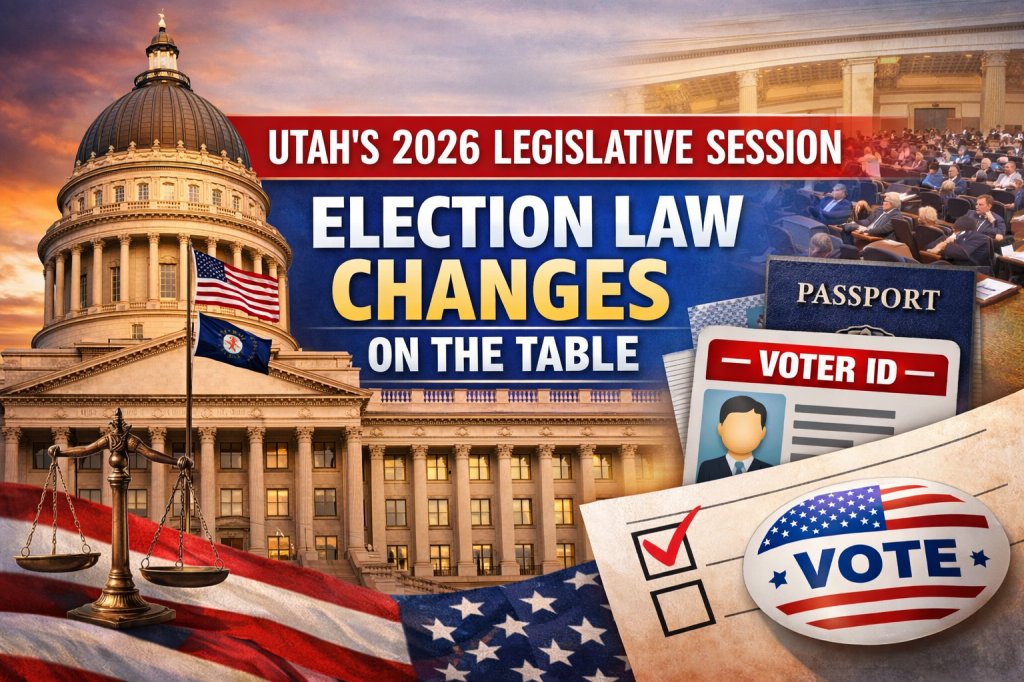
SALT LAKE CITY — As the Utah Legislature convened its 45-day 2026 general session on January 20, lawmakers quickly signaled that election law reforms will be a key part of the agenda — alongside judiciary restructuring, tax cuts and other major policy battles.
With all 75 seats in the state House and 15 in the state Senate up for election in November, 2026 is both a policy-heavy and politically charged year.
Election Law Tweaks Proposed in the Session
One of the most discussed bills early in the session is House Bill 209 — Voting Amendments. According to legislative summaries and local coverage, the bill would create a bifurcated voting system requiring voters to provide proof of U.S. citizenship in order to cast ballots in state elections.
The language of HB209, as described by Utah media outlets (e.g., ABC4 social media posts), would effectively split voters into two categories: those who prove U.S. citizenship — eligible to vote in all elections — and those who do not, presumably limited in participation in state or local elections.
While the legislature’s official bill text and status pages do not yet outline final language, the hearing record and committee referrals show that HB209 is under active consideration by the Government Operations Committee.
Context: Election Law Changes Already Underway
HB209 isn’t happening in a vacuum. Last year, Utah passed House Bill 300, a major overhaul of the vote-by-mail system that phases out automatic mail ballots by 2029, tightens ballot return deadlines, and adjusts signature verification requirements. Critics — including several county clerks — warned the changes could complicate election administration and pose barriers for voters unfamiliar with the new procedures.
Other election-related proposals debated in recent sessions include measures to:
- Transfer election oversight from the lieutenant governor’s office to an appointed director;
- Withdraw Utah from ERIC, a national voter-roll maintenance program;
- Eliminate same-day voter registration; and
- Adjust how election records are maintained and accessed.
Some of these proposals drew resistance from local election officials who argued that certain changes — such as those affecting election records and administrative burdens — could hamper rather than help voters.
Political and Legal Backdrop
Election law reforms are unfolding amidst broader political tensions in Utah. Republican lawmakers have been engaged in ongoing disputes with the courts over redistricting maps, prompting legal challenges and even resolutions condemning judicial decisions.
Utah’s Supreme Court has also issued rulings reinforcing protections for citizen initiatives, a foundational aspect of the state’s election system, notably in League of Women Voters v. Utah State Legislature. That July 2024 decision underscored that legislative changes to ballot initiatives must be tightly tailored to compelling state interests.
Adding to the backdrop, tensions over judiciary powers and electoral structures have spilled into debates over court expansions and voter-initiated constitutional amendments — including proposals to require a 60% voter threshold for tax-related initiatives.
Implications for Voters and 2026 Elections
If Utah lawmakers successfully advance HB209 or similar voting requirement bills, they could substantially change how and whether some residents participate in state elections — at the very moment voters head to the polls in 2026 for legislative, congressional, and gubernatorial contests.
Proponents of stricter voting standards argue that additional requirements will bolster election integrity and public confidence. Opponents warn that such changes risk disenfranchising legally eligible voters — particularly low-income residents, students, seniors, and others who may find documentation burdensome. Previous sessions’ debates over voter lists, mail-in ballots, and records access illustrate the broad spectrum of views on election administration within the state.
As the Legislature’s six-week sprint continues, Utahns with a stake in the democratic process — voters, clerks, advocates and candidates alike — will be watching closely to see which proposals survive committee hearings, floor votes and potential legal challenges.
 Election Desk
Leave a comment