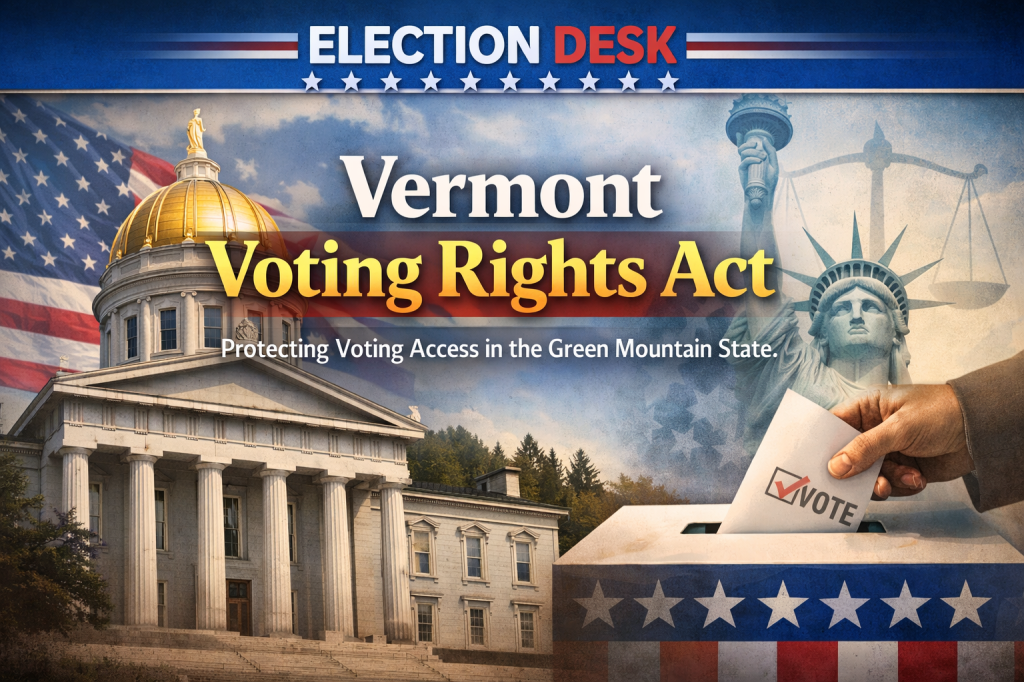
In a move that reflects broader national concerns about the future of voting protections, Democratic lawmakers in Vermont have introduced legislation to embed key elements of the federal Voting Rights Act into state statute. Supporters describe the proposal as a proactive safeguard at a time when federal voting rights protections face legal and political challenges in Washington.
Unveiled on Martin Luther King Jr. Day at a press event in Winooski, the Vermont Voting Rights Act would incorporate core protections from the 1965 federal Voting Rights Act—originally enacted to end discriminatory practices such as literacy tests, poll taxes, and racial gerrymandering—directly into state law.
“Free and fair elections are one of the last bright lines left in our democracy,” said Senate Majority Leader Kesha Ram Hinsdale (D-Chittenden), who is leading the bill. Supporters argue that codifying these protections at the state level ensures a baseline of rights for all Vermonters regardless of federal court rulings or national legislative shifts.
What the Vermont Voting Rights Act Would Do
Under the proposal, Vermont’s law would not simply mirror the federal act but expand access in several significant ways:
- Prohibit discriminatory election practices based on race, color, or membership in a language-minority group.
- Expand language assistance and other support services for voters with limited English proficiency.
- Strengthen accommodations for elderly and disabled voters, including measures to allow some voters to complete ballots outside a polling location.
- Increase protections against voter intimidation, misinformation, and suppression tactics that can discourage participation.
- End prison gerrymandering by counting incarcerated individuals at their home addresses rather than where they are incarcerated, aligning political representation more closely to community residence.
Advocates say the expansion of voting access is especially important for historically underrepresented groups. Disability Rights Vermont’s Laura Cushman noted that while Vermont generally ranks high in overall access to the ballot, it was recently ranked 49th in access for voters with disabilities, illustrating gaps the new law aims to address.
Political Context and Broader Debate
The push for a state equivalent of the Voting Rights Act comes as federal protections face ongoing legal scrutiny and political debate. Proponents argue that places like Vermont should not wait for uncertain outcomes at the federal level. Secretary of State Sarah Copeland Hanzas framed the proposal as a necessary defense of democratic participation.
While the effort has earned strong support among Democrats, some Republicans have offered measured endorsements of strengthening voter access while also raising questions about election uniformity. State Sen. Scott Beck (R-St. Johnsbury) suggested that Vermont’s mix of mail-in voting and in-person systems could be better harmonized for clarity.
At the same time, there are competing proposals from House Republicans — including bills that would require proof of citizenship for voter registration and mandate voter identification at the polls — generating pushback from Democratic lawmakers who argue such measures could suppress turnout.
A Wave at the State Level?
Vermont would join a growing list of states adopting their own versions of voting rights protections, a trend highlighted by the National Conference of State Legislatures which notes multiple states have enacted similar laws. Advocates see these state laws as both protective and aspirational — ensuring broad participation in democratic processes regardless of national political winds.
The bill is expected to be formally introduced this legislative week and referred to committee for consideration, where debates will unfold over its scope, implementation, and potential impacts ahead of future elections.
 Election Desk
Leave a comment