
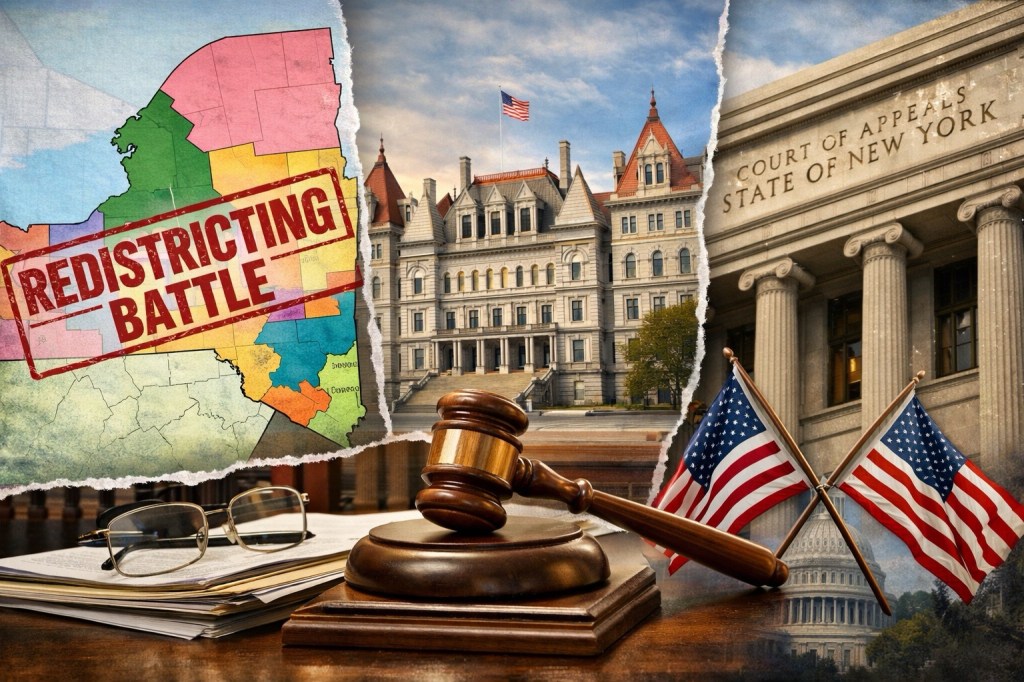
New York has been thrust back into the national arena of redistricting disputes after a state judge invalidated the boundaries of the 11th Congressional District and ordered a new map to be drawn ahead of the 2026 midterm elections. The decision, which affects the district represented by Republican Rep. Nicole Malliotakis, could reshape the political landscape in one of the nation’s most consequential states.
At issue is whether the current configuration of the Staten Island–Brooklyn district dilutes the voting power of Black and Latino residents—a violation, the court found, of New York’s constitution and the state’s voting rights protections. The judge directed the state’s Independent Redistricting Commission to produce a revised map by February 6.
The ruling is part of a broader national redistricting conflict playing out across the country, with states on both sides of the political aisle challenging and defending map lines well outside the usual post-census cycle. California, Texas and others have seen contentious legal battles over mid-decade map changes.
What This Means for New York
- The court’s decision could eliminate New York City’s only Republican-held U.S. House seat if a new configuration favors Democratic voters.
- Republicans have already appealed the ruling to higher state courts, including the New York Court of Appeals, continuing a legal tug-of-war that could extend into the spring.
- Democrats and voting rights advocates argue the decision reinforces protections against racially polarized voting and upholds constitutional standards.
New York’s independent redistricting process has already faced scrutiny in recent years, including a 2023 state high-court decision that found earlier congressional maps were unconstitutional and required fresh lines before the 2024 cycle.
Broader Election Implications
From an election administration perspective, the timing of this ruling — with candidate filing deadlines and primary season on the horizon — could complicate campaign strategy, ballot access and party planning. The state’s election authorities must balance legal compliance with the practical need to prepare ballots, precinct assignments, and public information. Any delays or uncertainties in map approval risk voter confusion.
Because redistricting ultimately helps determine the partisan composition of the U.S. House, New York’s dispute has ramifications far beyond Albany. With control of Congress often hinging on a handful of seats, even incremental changes in districts like NY-11 could have outsized effects on national power balances heading into 2026.
 Election Desk
Leave a comment