
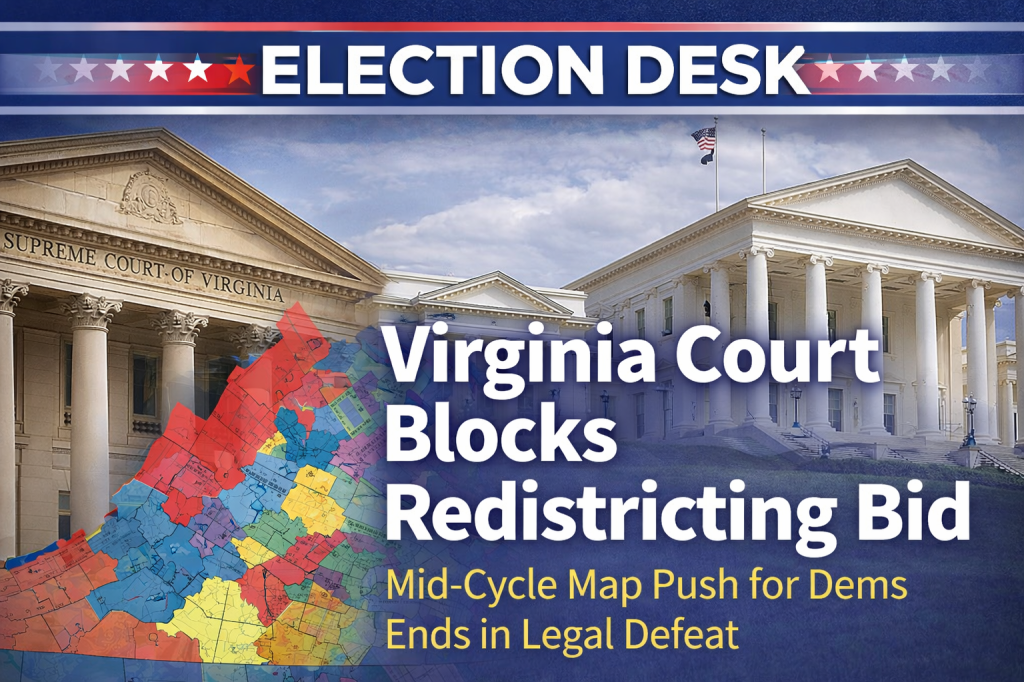
A Virginia state court has blocked a Democratic-led effort to place a mid-decade congressional redistricting amendment before voters in time for the 2026 midterm elections.
Circuit Court Judge Jack Hurley Jr. ruled that the process used by Democratic lawmakers to refer a constitutional amendment allowing the General Assembly to redraw Virginia’s U.S. House district lines did not comply with state constitutional requirements. As a result, the amendment cannot be placed on the ballot for 2026 until the procedural defects are resolved.
What the Amendment Would Have Done
Democratic legislative leaders advanced a constitutional amendment designed to re-grant the state legislature authority to redraw congressional maps between the decennial census cycles—a power normally exercised by Virginia’s bipartisan redistricting commission. Supporters argued the change would help counter mid-cycle map changes by other states, including Republican-led efforts in Texas, Missouri, North Carolina and elsewhere.
To qualify for the ballot, constitutional amendments in Virginia typically must be passed in two successive legislative sessions and comply with notice and timing requirements before being offered to voters. In this case, Judge Hurley found that Democrats did not meet those procedural obligations, including requisite publication deadlines tied to ongoing elections.
Legal and Procedural Concerns
The court’s ruling centered on state constitutional rules governing how amendments are submitted to voters. Virginia law requires that proposed constitutional measures be posted for public inspection by circuit court clerks at least 90 days before a House of Delegates election, and that they complete a multi-session approval process. Hurley found the Democratic-packaged amendment did not satisfy these benchmarks.
Democratic leaders have indicated they plan to appeal the ruling. However, for the moment, Virginia’s current congressional district lines will remain in place for the 2026 elections.
Broader Context
Mid-cycle redistricting—changing congressional district boundaries outside the usual post-census cycle—has been rare historically and typically arises only through litigation overturning previously adopted maps. Nationally, several states have pursued early map changes to secure competitive advantage ahead of the 2026 midterms.
Virginia’s bipartisan redistricting commission, established by voter referendum in 2020 to reduce partisan gerrymandering, currently sets district boundaries following the decennial census. The court’s decision underscores Virginia’s procedural guardrails for amending that process.
What Voters Should Know
- The constitutional amendment to change Virginia’s redistricting authority will not appear on the 2026 ballot as initially planned due to the court ruling.
- Appeals or revised legislative efforts could still alter the timeline, but any such changes must adhere to Virginia’s constitution and statutory notice periods.
- For now, the existing congressional maps will govern the 2026 elections, preserving the current lines as established through Virginia’s usual decennial process.
 Election Desk
Leave a comment