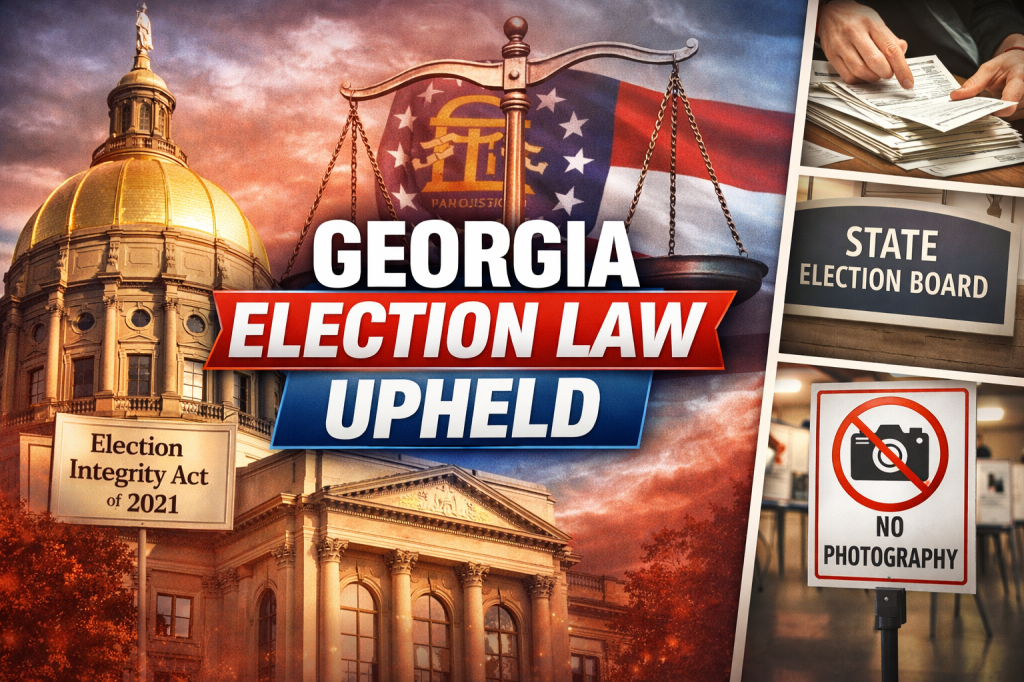
A federal appeals court has delivered a major legal victory for Georgia’s controversial 2021 election law, upholding provisions that give the state new authority over local election administration and ban ballot photography inside polling places.
On January 27, 2026, a unanimous three-judge panel of the U.S. Court of Appeals for the 11th Circuit ruled that plaintiffs challenging parts of the law lacked legal standing, allowing significant elements of the statute to remain in force.
What the Ruling Means
The 11th Circuit’s decision preserves two of the most contested components of Georgia’s sweeping 2021 election reforms:
- State Takeover Powers: The ruling keeps in place the ability of the Georgia State Election Board to assume control of county election boards that the state deems underperforming. While the board notably chose not to take over the Fulton County election board in 2023 after improvements were cited, the legal authority remains.
- Ballot Photography Ban: The appeals court sustained a ban on taking photographs of ballots while voting is underway, a restriction critics argued could suppress transparency and voter expression.
The court’s decision was procedural rather than substantive: it did not evaluate the merits of the law itself, instead holding that the plaintiffs — including election security advocates — failed to demonstrate that they suffered a legally cognizable injury traceable to defendants such as the State Election Board and Governor Brian Kemp.
Background: The 2021 Election Integrity Act
These challenged provisions are part of the broader Election Integrity Act of 2021, passed amid heightened national debate over Georgia’s elections following the narrow 2020 presidential result in the state. The law imposed a range of changes — from limits on ballot drop boxes and new ID requirements for absentee voting to greater legislative influence over election administration.
Critics argue that several provisions disproportionately burden certain voters and concentrate power in state hands. Supporters, including Georgia Secretary of State Brad Raffensperger, frame them as essential to election security. Raffensperger praised the appeals court decision, saying it affirmed the state’s commitment to secure voting.
Continued Legal Battles
While this appeals court decision clears hurdles for two major elements of the law, legal challenges persist. Other federal lawsuits remain pending, some addressing different aspects of the statute that were not before the 11th Circuit in this ruling.
Political observers are also watching how enforcement of these provisions might unfold — particularly the state takeover mechanism — as the 2026 midterms approach. Fulton County and other jurisdictions remain focal points for both election administration scrutiny and legal debate.
Why It Matters
The ruling has significant implications for both election administration and voter experience in Georgia. By upholding state oversight powers and restrictions on ballot photography, the court has solidified key pillars of a law that has reshaped how elections are managed and contested in a deeply divided political environment. Whether the law’s effects on turnout, administration, and public confidence will be understood only after more elections are held under it.
 Election Desk
Leave a comment