
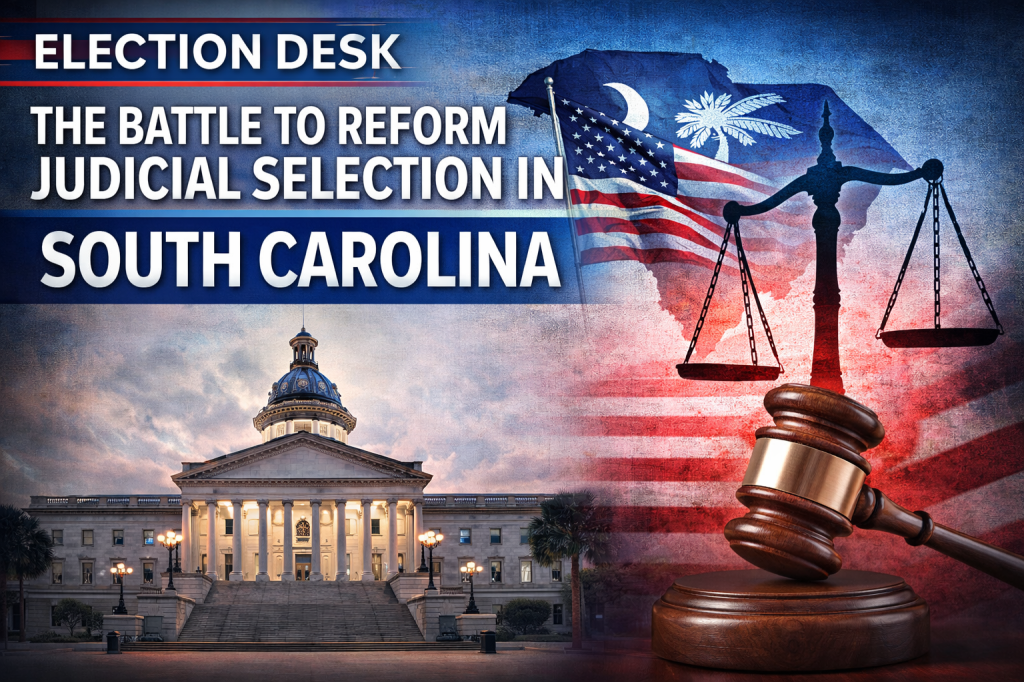
The way judges are chosen in South Carolina — a process long criticized for being opaque, insular, and dominated by legislative insiders — has suddenly become a central issue in the Palmetto State’s 2026 political landscape.
At the heart of the controversy is Rom Reddy, a Lowcountry businessman and founder of the grassroots organization DOGE SC (short for Direct Our Government Effectively). Reddy and his allies are pushing for transformational changes to how judges are vetted and selected, arguing that the current system undermines public confidence in the courts and consolidates too much power in the Legislature.
What’s at Stake
South Carolina remains one of only two states in the U.S. — alongside Virginia — where the Legislature elects judges rather than voters or the governor. Under the current system, all candidates for the state’s Supreme Court, Court of Appeals, circuit courts, and family courts must first be screened and certified as “qualified” by a body called the Judicial Merit Selection Commission (JMSC) before they can be elected by lawmakers.
Critics — including DOGE SC and the South Carolina Policy Council — say this system too often yields rubber-stamp appointments that reflect political alliances rather than broad public confidence. Proposed reforms seek to break legislative monopoly over candidate vetting and introduce executive influence or other checks into the process.
The DOGE SC Reform Proposal
The latest reform package, backed by DOGE SC and filed as H. 4755 / S. 696 in the South Carolina Legislature, would reshape the JMSC and significantly shift power toward the governor:
- Under the bill, the governor would have exclusive authority to select nominees for the JMSC, replacing much of the Legislature’s direct control.
- Lawmakers would still vote to confirm judges, but only from a pool of nominees provided by the governor’s office.
- The commission’s makeup, term limits, and eligibility rules would also be overhauled to limit insider influence.
Supporters argue this model increases accountability and reduces backroom influence in what has been described as a “notoriously secretive” candidate screening process.
Inside the Political Debate
Reddy has not hesitated to criticize other reform efforts he considers unrealistic or insufficient given constitutional constraints — including proposals floated by U.S. Rep. Ralph Norman, a Republican candidate for governor who has advocated for allowing direct elections of judges by the public. Reddy has called such ideas “pie in the sky,” noting that changing the system entirely would require a constitutional amendment and mass political will.
At the same time, DOGE SC’s emphasis on shifting power to the governor has drawn pushback from some legislative leaders, including Senate Majority Leader Shane Massey, who has publicly criticized the proposal.
Broader Reform Momentum
The current legislative session is not the first time judicial selection has drawn scrutiny. Over the past several years, multiple bills and advocacy campaigns have sought to tweak or overhaul the JMSC, raise the cap on nominee numbers, increase transparency in hearings, or otherwise curb conflicts of interest when lawmakers serve dual roles as lawmakers and judicial selectors.
Groups like the South Carolina Policy Council argue reform is essential not only to improve fairness, but to bolster public trust in the courts — a concern shared by voters across the political spectrum and evident in recent public opinion research.
What Comes Next
DOGE SC’s bill recently passed a key committee vote in the South Carolina House Judiciary Committee — a milestone that suggests a floor vote in the full House may be imminent. If approved, it would then have to clear the Senate before heading to the governor’s desk.
Whether this push represents real reform or merely a reshuffling of power within the state government remains a subject of intense debate in Columbia and among voters statewide. But one thing is clear: judicial selection — once a back-burner policy issue — has become a flashpoint in South Carolina politics as the 2026 elections approach.
 Election Desk
Leave a comment