
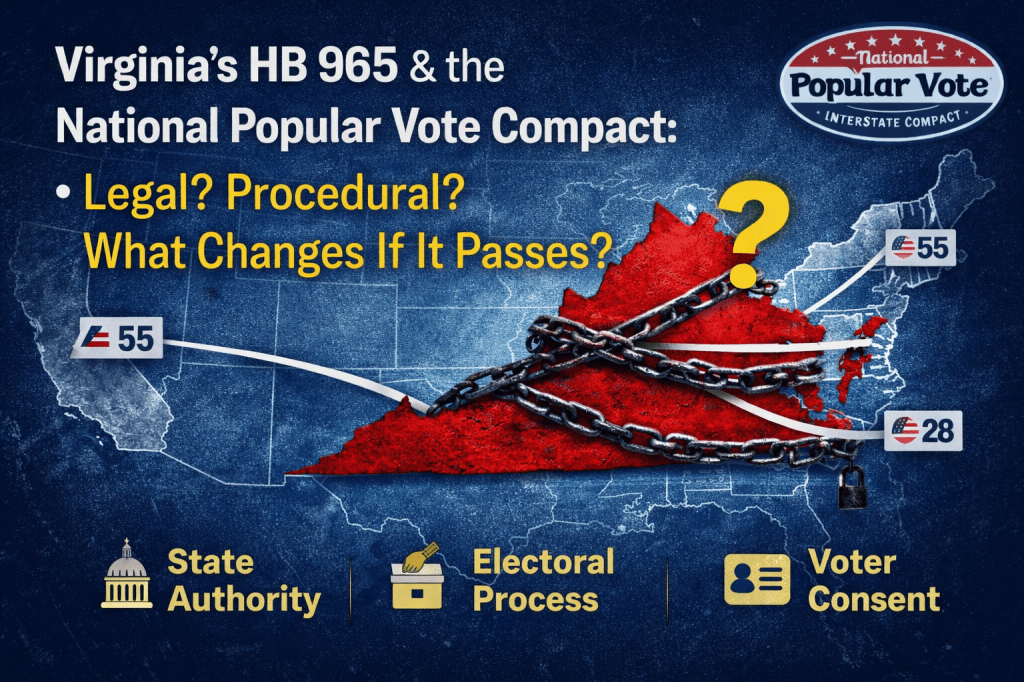
Virginia lawmakers are considering HB 965, legislation that would place the Commonwealth into the National Popular Vote Interstate Compact (NPVIC), a multi-state agreement designed to effectively determine presidential elections by the national popular vote rather than by state-by-state Electoral College outcomes.
The proposal raises significant questions about voter consent, state authority, and how presidential elections would function in practice if the compact becomes operational.
What HB 965 Would Do
Under current law, Virginia—like nearly all states—awards its presidential electors based on the statewide popular vote. HB 965 would change that rule.
If Virginia joins the compact, it agrees that once enough participating states collectively control at least 270 electoral votes, all member states will allocate their electors to the candidate who wins the national popular vote, regardless of how voters in those individual states voted.
Until the 270-vote threshold is reached, nothing changes. Once triggered, however, the compact becomes binding.
How the Outcome Could Differ From State Results
The compact is designed to prevent scenarios where a presidential candidate wins the Electoral College while losing the national popular vote. But it also creates a new scenario that does not exist under current law.
For example:
- A candidate could win Virginia’s statewide vote.
- That same candidate could lose the national popular vote.
- Under the compact, Virginia would be required to award its electors to the national popular vote winner, not the candidate preferred by Virginia voters.
This is not a flaw or unintended consequence—it is the core operating principle of the compact.
Legal Authority and the Compact Clause
Supporters argue states have clear constitutional authority to determine how electors are chosen under Article II of the U.S. Constitution. Opponents counter that interstate agreements affecting federal elections may require congressional approval under the Constitution’s Compact Clause.
Courts have not yet ruled definitively on whether the NPVIC can operate without explicit congressional consent. Legal challenges are widely expected if the compact ever determines an election outcome.
Federalism and Campaign Incentives
A major practical question is how presidential campaigns would adapt.
Under a national popular vote framework:
- Campaigns may prioritize high-turnout population centers.
- Smaller or politically balanced states could see reduced attention.
- Issues specific to Virginia—military installations, port infrastructure, rural broadband, regional energy policy—may matter less if they do not affect national vote totals.
Supporters argue every vote would count equally nationwide. Critics argue geographic representation would be diluted.
The Voter Consent Question
HB 965 would be enacted through legislative action, not a statewide referendum. That means Virginia voters would not directly approve or reject the change—even though it alters how their presidential votes are ultimately translated into electoral power.
From an election-administration perspective, this raises transparency and trust issues, particularly in close or contested elections.
Why HB 965 Is an Election-Systems Decision, Not a Partisan One
While the compact is often discussed in partisan terms, its effects are structural, not ideological. Either party could benefit—or lose—depending on future turnout patterns and demographic shifts.
Once enacted and activated, the compact would apply to all candidates, all parties, and all future elections unless repealed.
What to Watch Next
Key issues election officials, voters, and courts will be watching:
- Whether Virginia conditions implementation on congressional approval
- How election certification disputes would be resolved across state lines
- Whether voters challenge the law on constitutional or procedural grounds
- How close elections would be audited or recounted nationally
HB 965 is not simply about how votes are counted. It is about where electoral authority ultimately resides—with individual states or with a national aggregate built through interstate agreement.
That distinction will define the next phase of this debate.


Leave a comment