

Maine’s U.S. Senate race was already one of the most closely watched contests of the 2026 midterm cycle. Then, five weeks before Election Day filing deadlines began to bind, the Democratic Party found itself needing to replace its nominee entirely — a process that, by state officials’ own account, had not been tested in a federal race in Maine in living memory.
Here is how the state’s candidate-replacement law worked in practice, and where the race stands now.
The primary and the withdrawal
Maine held its primary elections on June 9, 2026, using ranked-choice voting for both parties’ contested races. On the Democratic side, Graham Platner — a combat veteran and oyster farmer making his first bid for office — won the nomination outright. His chief rival on the ballot was Gov. Janet Mills, who had suspended active campaigning in late April, citing a fundraising shortfall, but never filed formal withdrawal paperwork with the Secretary of State — meaning her name remained on the ballot and votes for her still counted. Mills did not reactivate her campaign or endorse Platner before the primary; a third candidate, David Costello, also remained on the ballot.
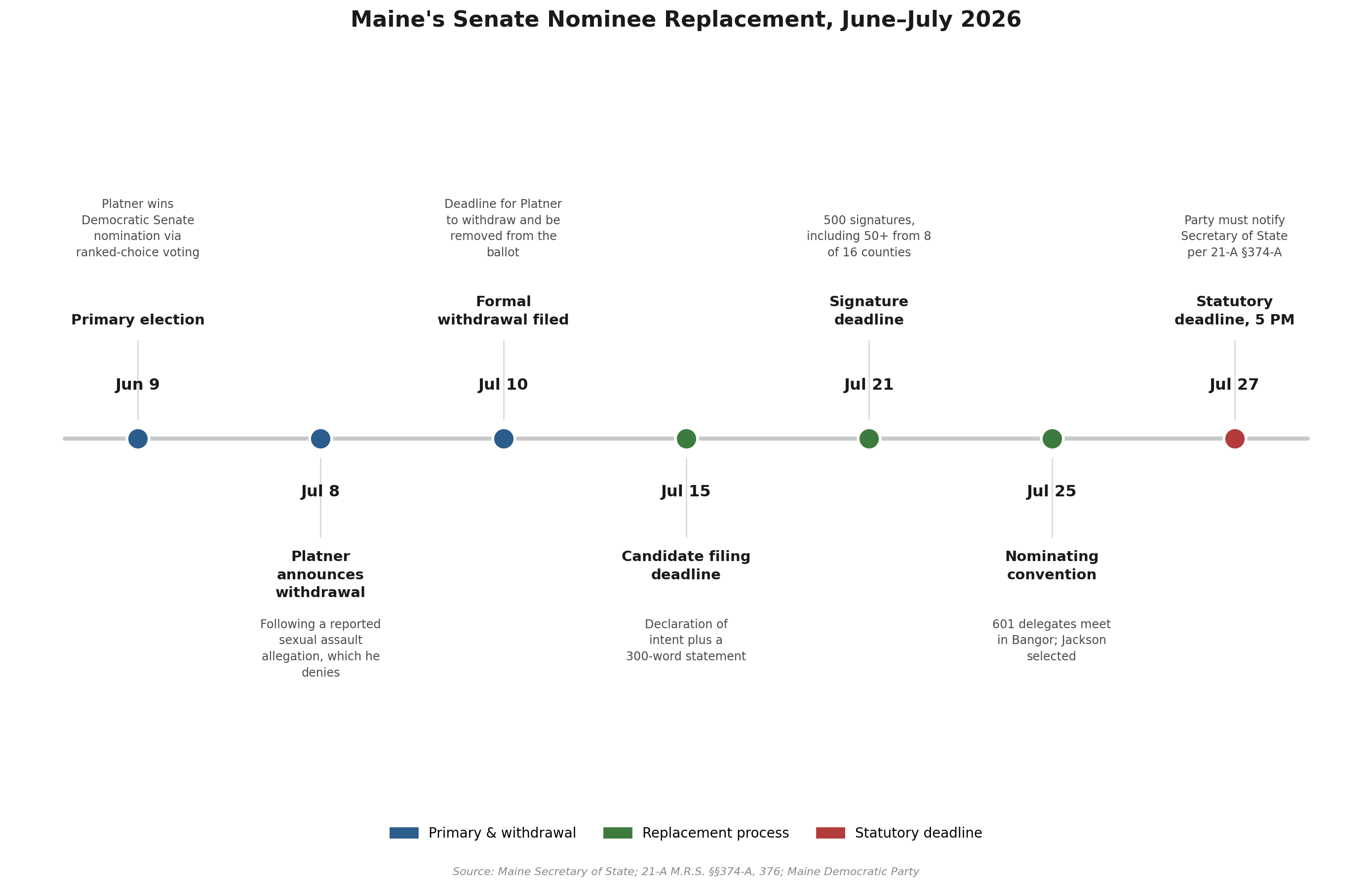
On July 6, Politico and CNN reported an allegation of sexual assault against Platner from a former romantic partner, dating to 2021. Platner denied the allegation. Within days, national Democratic figures — including Senate Minority Leader Chuck Schumer and Sens. Elizabeth Warren, Bernie Sanders and Ruben Gallego — called for him to leave the race or said the party would not fund it if he stayed. Platner announced on July 8 that he would withdraw, and he filed the formal withdrawal paperwork with the Maine Division of Elections on July 10.
What Maine law actually requires
Maine’s election statutes set out a specific sequence for replacing a candidate who leaves a general-election race after winning a primary. Under Title 21-A of the Maine Revised Statutes:
- A candidate’s name is removed from the ballot if they withdraw 70 or more days before the general election (21-A §376(1)).
- The political party may then submit a replacement nominee, but the deadline is fixed by statute at 5 p.m. on the fourth Monday in July of the election year — this year, July 27 (21-A §374-A(2)(A)).
- State law does not specify how a party must choose its replacement, only the deadline by which it must notify the Secretary of State. That procedural gap left the mechanics up to the Maine Democratic Party itself.
State law does not specify how a party must choose its replacement, only the deadline by which it must notify the Secretary of State.
The Secretary of State’s office said a review of its records did not turn up a comparable instance of a Maine federal candidate withdrawing between a primary and general election, making this a genuine test of a rarely used statutory provision. Nationally, Ballotpedia’s records show U.S. Senate nominee replacements after a primary have occurred just 11 times over the past 50 years.
The convention
With too little time before the deadline to hold a second primary, the Maine Democratic Party chose a replacement through a nominating convention.
With too little time before the deadline to hold a second primary, the Maine Democratic Party’s state committee voted to select a replacement through a nominating convention. The party set a compressed timeline:
- July 15 — Deadline for prospective candidates to file a declaration of intent and a 300-word statement.
- July 21 — Deadline for candidates to submit at least 500 signatures from registered Democrats, including a minimum of 50 signatures from at least eight of Maine’s 16 counties.
- July 19–24 — County Democratic committees held special meetings to select delegates to the convention.
- July 25 — The convention itself, held in Bangor, with 601 delegates: 101 members of the Democratic State Committee and 500 delegates apportioned by county.
- July 27, 5 p.m. — Statutory deadline for the party to notify the Secretary of State of its replacement nominee.
More than a dozen Democrats initially expressed interest in the seat, including several who had run and lost in this year’s gubernatorial or earlier Senate primaries. Troy Jackson, a former Maine Senate president who had placed among the contenders in the crowded Democratic gubernatorial primary earlier this year, consolidated support at county delegate meetings in the days before the convention; most of his remaining rivals withdrew and endorsed him ahead of the Bangor gathering, and delegates formally selected him as the replacement nominee.
Where the race stands
Jackson will face five-term incumbent Sen. Susan Collins, who was unopposed in the Republican primary, in the November 3 general election. A University of New Hampshire Survey Center poll conducted July 15–20 — before the convention, when Jackson was the presumptive but not yet formal nominee — found Jackson leading Collins 49% to 46% among likely general-election voters, a margin within or just outside the poll’s sampling error depending on the subgroup measured. Independent handicappers, including Fox News’s Power Rankings, have since listed the race as a toss-up alongside contests in Alaska, Iowa and Ohio.
Collins’s campaign has framed Jackson as the product of an insider selection process rather than a primary win and has criticized his support for Medicare for All; the Republican National Committee separately characterized his platform as out of step with Maine voters. Jackson’s campaign has centered on portraying Collins as insufficiently independent from the current administration.
The parallel governor’s race
The statutory replacement process hands that decision to several hundred party delegates operating under a hard, state-imposed deadline.
Maine’s Senate turmoil unfolded alongside a separate, less chaotic transition atop the state’s other marquee 2026 race. With Gov. Janet Mills barred by term limits from seeking a third term, Democrats nominated former Maine House Speaker Hannah Pingree through the standard June 9 ranked-choice primary — a process untouched by the Senate replacement fight, since Pingree’s nomination was decided by voters rather than a convention. She faces Republican Robert Charles and independent Rick Bennett in November; recent polling has shown her with a double-digit lead. Troy Jackson was also a candidate in that same crowded gubernatorial primary; he did not win it, and had no role in the Senate race until Democrats turned to him weeks later to replace Platner.
The contrast underscores what made the Senate replacement unusual: it wasn’t the outcome, but the mechanism.
The contrast underscores what made the Senate replacement unusual: it wasn’t the outcome, but the mechanism. Maine’s ranked-choice system is designed to let voters resolve crowded fields. The statutory replacement process, by contrast, hands that decision to several hundred party delegates operating under a hard, state-imposed deadline — a structure that drew scrutiny mainly because of the stakes involved, control of a Senate seat that could help determine which party holds the chamber’s majority in 2027.
Sources: Maine Secretary of State’s Office; Maine Revised Statutes Title 21-A §§374-A, 376; Maine Democratic Party; NBC News; NPR; Maine Public; CBS News; Bangor Daily News; Portland Press Herald; The Hill; Fox News; University of New Hampshire Survey Center.
 Election Desk
Leave a comment