
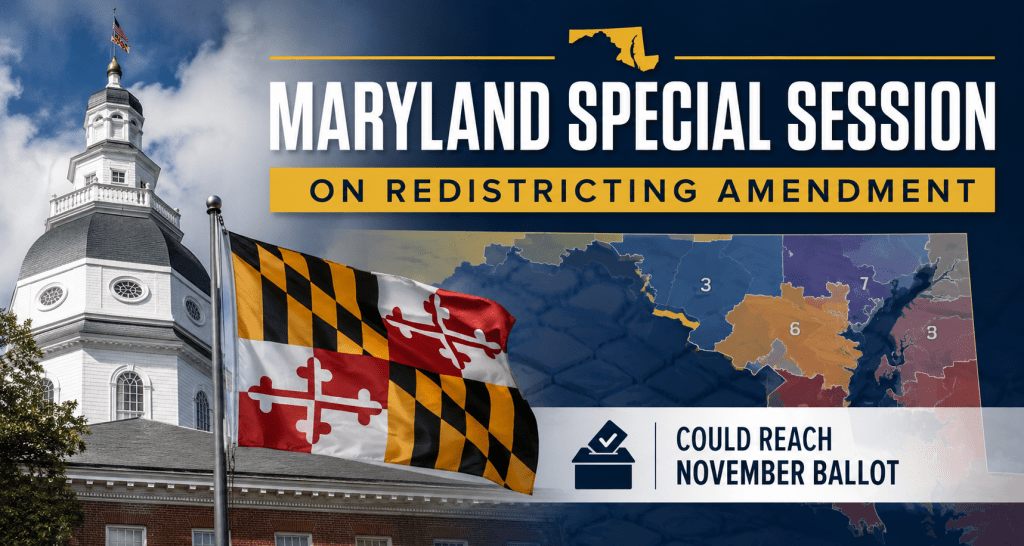
Maryland’s General Assembly gavels in for a special session Monday, August 3, that will decide whether voters get a say this fall on one of the most consequential changes to the state’s redistricting rules in decades. The session runs through August 5, though legislative leaders have said it could wrap sooner if lawmakers finish their work.
At its center is a proposed constitutional amendment that would not redraw Maryland’s congressional map itself, but would change the legal framework that governs how future maps are drawn — and, in doing so, could clear a path for the state to redraw its lines again before the next census.
What lawmakers are actually voting on
Despite months of public debate over whether Maryland should redraw its congressional districts, the special session itself will not produce a new map. Instead, the House and Senate will consider companion bills — HB2100 and SB2100 — proposing a constitutional amendment that would resolve a legal question left open since 2022: whether the compactness, contiguity, and political-subdivision standards written into Maryland’s constitution apply to congressional districts at all, or only to the state legislature’s own districts.
As introduced, the amendment would specify that those redistricting standards apply only to districts used to elect members of the Maryland Senate and House of Delegates. Congressional district lines would instead be governed by “applicable federal laws” — chiefly the one-person-one-vote population-equality requirement of the U.S. Constitution, rather than the state’s own compactness and subdivision criteria.
The special session itself will not produce a new congressional map—it will determine the legal rules governing future ones.
The amendment would also grant the General Assembly authority to give the Maryland Supreme Court original jurisdiction over congressional redistricting disputes, which would let a future map go directly to the state’s highest court rather than starting in circuit court, shortening the timeline for resolving legal challenges.
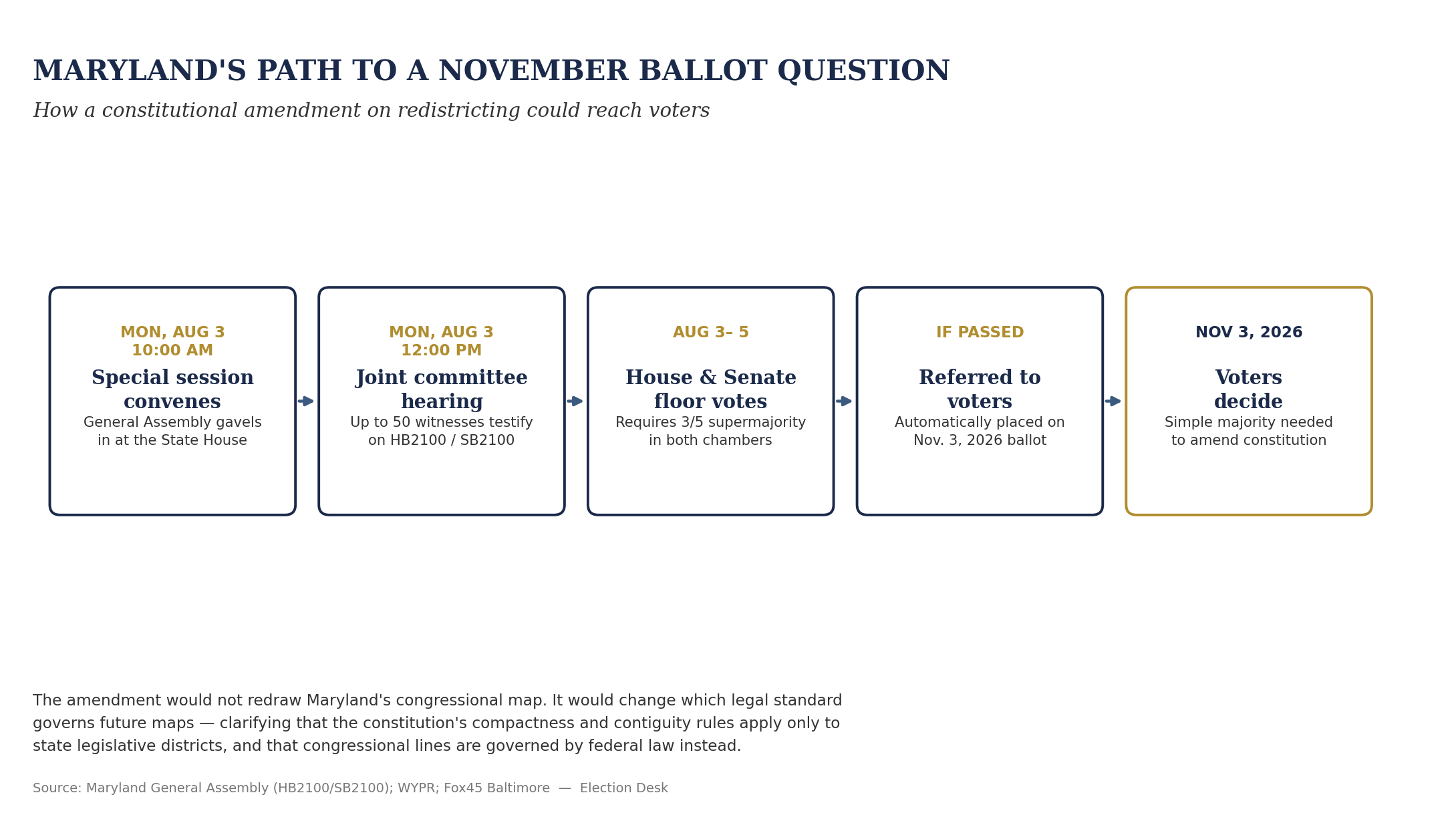
If both chambers pass the amendment by a three-fifths supermajority — a threshold Democrats currently have the numbers to meet — it would proceed automatically to Maryland voters on November 3, 2026, as a ballot referendum. The Maryland General Assembly, not the governor, controls whether a constitutional amendment reaches voters; Gov. Wes Moore’s signature is not required for it to appear on the ballot.
If both chambers approve the amendment, Maryland voters—not the governor—will have the final say this November.
The proposed ballot question
According to the version of the amendment filed by House Speaker Joseline Peña-Melnyk, the following language would appear before voters this November:
“The proposed Constitutional Amendment clarifies that certain standards in the Maryland Constitution apply only to districts used to elect members of the General Assembly; authorizes the General Assembly to grant original jurisdiction to the Supreme Court of Maryland to review the congressional districting plan of the State; and requires the criteria for boundaries of congressional districts to be determined by applicable federal laws.”
That language could still change as the bill moves through the special session; lawmakers have not finalized it.
A second, unrelated ballot question is also being addressed procedurally during the special session. Senate President Bill Ferguson has filed SB2101, a technical measure intended to prevent a wage-arbitration question — approved earlier this year, asking voters whether to require neutral arbitrators in state employee collective-bargaining negotiations and whether the governor’s budget must include agreed-upon union wages — from appearing on the November ballot twice.
Why this is happening now
The current fight traces back to a March 2022 ruling by Senior Judge Lynne A. Battaglia of the Anne Arundel County Circuit Court, who struck down a Democratic-drawn congressional map as an “extreme partisan gerrymander” that diluted the influence of Republican voters, in violation of the state constitution’s compactness and contiguity requirements. The General Assembly redrew the map within days to comply with her order, and that revised map — which preserves a 7-1 Democratic-to-Republican split in Maryland’s congressional delegation — has been used since 2022.
Legal analysts have noted that Battaglia’s ruling, issued as a trial-court decision, was never reviewed or affirmed by Maryland’s appellate courts, leaving open questions about how binding its reasoning would be in a future case.
Earlier in 2026, the Maryland House of Delegates passed a new congressional map along party lines that would likely have unseated Rep. Andy Harris (R), the state’s lone Republican member of Congress, shifting Maryland’s delegation from 7-1 to a full 8-0 Democratic lineup. Senate President Ferguson declined to bring that map to a floor vote, citing the 2022 ruling as a legal obstacle to any map that could again be characterized as a partisan gerrymander.
Two subsequent developments shifted the political calculation for Democratic leaders. First, at least nine states — California, Florida, Louisiana, Missouri, North Carolina, Ohio, Tennessee, Texas, and Utah — have enacted new congressional maps during the current mid-decade redistricting cycle, which began after the Trump administration urged Republican-led states to redraw lines ahead of the 2026 midterms. Maryland itself is among a separate group of states, including Indiana, Kansas, New York, South Carolina, Virginia, and Wisconsin, where a mid-decade redistricting attempt was floated but did not go forward. Second, the U.S. Supreme Court’s April 29, 2026 ruling in Louisiana v. Callais narrowed the circumstances under which a map can be successfully challenged under Section 2 of the federal Voting Rights Act, a decision that some legal observers say increases the odds of Republican-favorable map changes in Southern states and reduces the federal-law constraints Maryland Democrats would otherwise face.
Ferguson has said the amendment is meant to give Maryland legal “flexibility” rather than to enact any particular map. “This is not about a map, it’s about the rules that govern map making,” he said in a statement ahead of the session, adding that if voters approve the amendment, the state would be positioned “in a position of strength with options” rather than risking another court rejection.
The process this week
The General Assembly convenes at 10 a.m. Monday. At noon, a joint House-Senate committee hearing begins on the constitutional amendment, with public testimony capped at 50 witnesses who may appear in person in Annapolis or remotely via Zoom; each speaker is limited to two minutes. Witness sign-up and written testimony were made available through the General Assembly’s website beginning July 31.
Democratic leadership has said no legislation unrelated to redistricting will be considered during the special session, with the exception of Ferguson’s technical bill addressing the arbitration ballot question.
Supporters call it legal flexibility. Opponents call it the first step toward eliminating Maryland’s only Republican congressional seat.
Where the disagreement lies
Senate Minority Leader Steve Hershey (R-Caroline, Cecil, Kent and Queen Anne’s) and other Republican lawmakers have argued that the special session is aimed at eliminating the state’s only Republican congressional seat and have criticized the compressed hearing schedule, saying it limits public participation on a measure that could affect how more than a million Marylanders are represented. Democratic leaders counter that the amendment itself changes only the legal rules for drawing districts, not the districts themselves, and that no new map has been drawn or introduced; any future map would still need to comply with federal population-equality requirements.
The amendment would not redraw Maryland’s congressional boundaries; it would change which legal standards apply the next time lawmakers try.
Whether or how a new congressional map would actually be drawn remains a separate, later question. Passage of the amendment would not by itself change Maryland’s congressional boundaries; it would determine which legal standard applies the next time the General Assembly attempts to redraw them, with lawmakers signaling any new map would most likely take effect for the 2028 election rather than 2026.
Election Desk will continue to track the bill language, committee votes, and final ballot question as the special session proceeds through August 5.
 Election Desk
Leave a comment