
Connecticut voters go to the polls on November 3 to decide whether Governor Ned Lamont wins a third term — but first, both parties have to settle their own nominations in an August 11 primary that’s now just over a week away. Early voting runs August 3–9. Here’s how the field took shape and what’s still unresolved.
How Connecticut picks its nominees
Connecticut doesn’t hold open primaries by default. Candidates first compete for their party’s endorsement at a nominating convention; whoever wins a majority of delegate votes becomes the endorsed candidate. But any candidate who wins at least 15% of delegate votes at that convention automatically qualifies for an August primary against the endorsed candidate, regardless of what the party leadership wants. That rule is what determined which candidates ended up on this year’s ballot.
Democratic primary: Lamont vs. Elliott
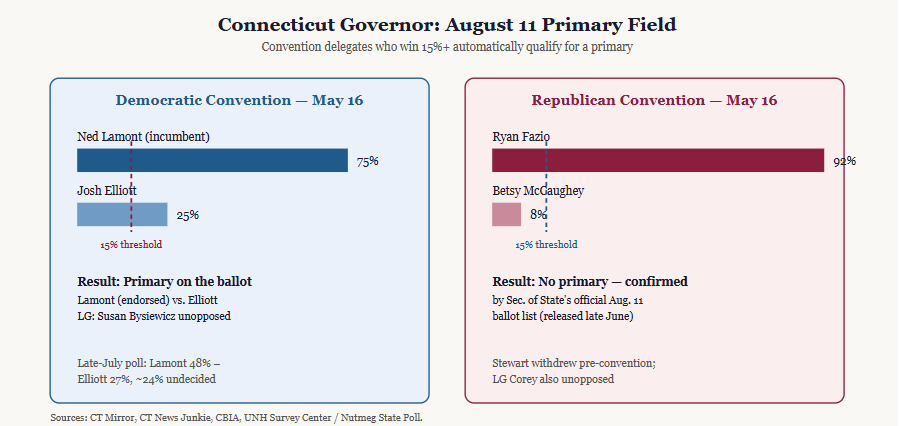
At the Democratic State Convention on May 16, Governor Lamont won the party’s endorsement with about 75% of delegate votes. State Rep. Josh Elliott of Hamden, running as a progressive challenger, took roughly 25% — comfortably clearing the 15% threshold and forcing an August 11 primary. Elliott has since qualified for Connecticut’s public campaign financing program, giving him roughly $3.75 million to spend on the primary.
Public polling has consistently shown Lamont favored heading into the primary, though two separate tracking series both show the margin narrowing. The University of New Hampshire’s nonpartisan Nutmeg Poll has surveyed the race four times since November: 55%–7% at the outset, 57%–13% in February, and 53%–23% by late June — Lamont holding steady in the mid-50s while Elliott’s share climbs. A separate poll from Impact CT, a group that promotes progressive causes and had not endorsed in the race, found Lamont up 58%–20% in early June, narrowing to 48%–27% (with 24% undecided) in a late-July survey conducted by Change Research; when the same poll read respondents brief biographical statements about each candidate, Lamont’s lead shrank further to 46%–35%. Elliott’s name recognition has risen substantially over the campaign — from roughly 59% of primary voters having heard of him in May to about 80% by late July — but he remains well behind on both recognition and overall support with just over a week to go.
Lamont’s running mate, Lieutenant Governor Susan Bysiewicz, is seeking renomination and faced no convention challenger, so she is not on the Democratic primary ballot.
Republican primary: no primary needed
The Republican side, by contrast, arrived at its convention already narrowing — and stayed that way. New Britain Mayor Erin Stewart, an early frontrunner in name-recognition polling, ended her campaign in mid-May after a report detailing personal use of a city credit card, and endorsed state Senator Ryan Fazio of Greenwich. That left Fazio facing only conservative commentator Betsy McCaughey, a former New York lieutenant governor making her Connecticut electoral debut, at the May 16 convention. Fazio won roughly 92% of delegate votes — well above the majority needed for the endorsement and far more than enough to keep McCaughey under the 15% threshold. McCaughey conceded from the convention floor and endorsed Fazio rather than petitioning for a primary spot, which remained a legal option for candidates who fall short of 15% but can gather enough voter signatures instead.
Lamont’s primary fight is a genuine rarity: he’s the first incumbent Connecticut governor to face a primary challenge since Ella Grasso in 1978.
The Connecticut Secretary of the State’s office confirmed this outcome when it released the official list of August 11 primaries in late June: Democrats have a primary for governor, but Republicans’ only primary contests that day are in two congressional districts and three state legislative races. Fazio is the Republican nominee for governor without a primary. (An earlier version of this reporting flagged a discrepancy in a candidate-tracking database that still listed McCaughey and Stewart as active contenders; the Secretary of the State’s official ballot resolves that — both withdrew before qualifying for the ballot.) For lieutenant governor, Fazio’s running mate, small-business owner and Navy veteran Matthew Corey, is also unopposed after defeating state Rep. Tim Ackert at the convention.
Lamont’s primary fight, by contrast, is a genuine rarity: he’s the first incumbent Connecticut governor to face a primary challenge since Ella Grasso in 1978.
A notable ballot-access wrinkle
In July, Fazio began circulating petitions to also secure the Connecticut Independent Party’s nomination for governor — a minor party that, per state law, must repoll at least 1% in a given race to retain automatic ballot status. The Independent Party fell just under that threshold for governor in 2022 (0.98%), so it isn’t automatically qualified for the office this cycle. Collecting enough signatures would put Fazio in position to appear on an additional ballot line if the party’s own nominating process selects him — a step beyond signature-gathering that hasn’t yet occurred as of this writing.
Looking to November
Assuming both frontrunners prevail on August 11, the general election shapes up as Lamont vs. Fazio. Recent nonpartisan polling puts Lamont ahead in that hypothetical matchup, and Connecticut’s Democratic lean and the governor’s approval ratings — 63% in an October 2025 Morning Consult survey, though a separate spring 2025 poll found 44% of voters thought he shouldn’t seek a third term — give him a starting advantage. Fazio has centered his campaign on electricity rates, taxes, and affordability, an issue set that’s shaped up as the race’s dominant theme regardless of which Democrat wins the nomination.
Sources: Connecticut Secretary of the State, Ballotpedia, CT Mirror, CT News Junkie, CBIA primary guide, University of New Hampshire Survey Center/Nutmeg State Poll, Impact CT poll, Ballot Access News.
 Election Desk
Leave a comment