Minnesota’s governor’s race looked settled a year ago: two-term incumbent Tim Walz was expected to seek a third term. It no longer is. Walz dropped his re-election bid in January amid a widening state fraud scandal, reshaping the race into an open-seat contest that now features a sitting U.S. senator, a MyPillow executive with a presidential endorsement, and a primary that’s just over a week away, on August 11.
Tim Walz’s decision not to seek re-election transformed what looked like a routine incumbent race into one of the country’s most competitive open-seat contests.
Why the seat opened up
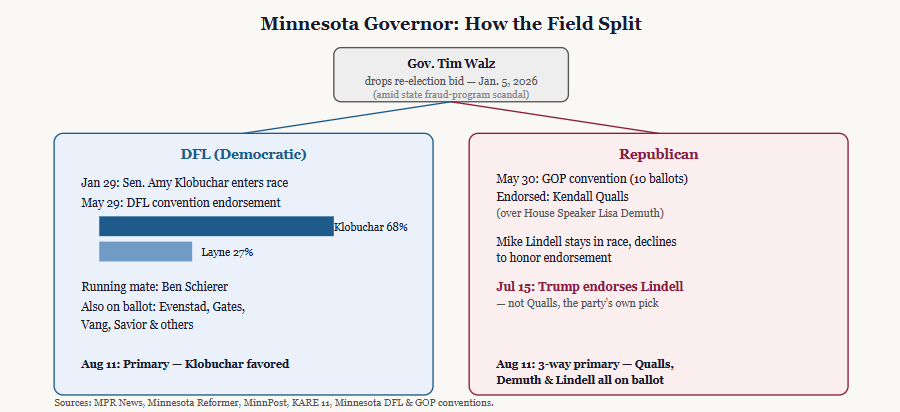
Walz ended his campaign on January 5, citing a need to focus on his job rather than campaign amid escalating scrutiny of fraud in state-administered programs. The scandal centers on Feeding Our Future, a nonprofit that federal prosecutors say funneled taxpayer funds intended for pandemic-era child nutrition programs to shell companies and individuals; estimates of the total stolen have ranged from roughly $240 million to nearly $300 million depending on the source and what related schemes are counted, and dozens of people have been charged, including founder Aimee Bock, who was convicted in 2025. A separate, viral set of allegations in December 2025 concerning child care centers in the Somali community triggered new state and federal scrutiny, though Minnesota’s initial investigation found the accused centers operating as expected. Walz testified before the U.S. House Oversight Committee in March; the Republican-led committee’s report accused him and Attorney General Keith Ellison of misleading the public about the state’s handling of fraud warnings, though neither has been criminally charged. The political fallout was significant enough that Walz chose not to seek re-election.
Democratic-Farmer-Labor primary: Klobuchar’s to lose
Three weeks after Walz’s exit, U.S. Sen. Amy Klobuchar announced her own campaign for governor — a move that would vacate a Senate seat she wasn’t up to defend until 2030. She quickly became the clear DFL frontrunner, picking former Fergus Falls Mayor Ben Schierer as her running mate and winning the party’s convention endorsement in May with about 68% of delegate votes.
Minnesota’s party endorsement carries political influence—but unlike some states, it doesn’t determine who appears on the primary ballot.
She didn’t win it unopposed. Kobey Layne, a 26-year-old former legislative aide making her first bid for office, gathered enough delegate support to force a floor speech and took roughly 27% of the vote, arguing Klobuchar’s nomination amounted to “the coronation of yet another corporate Democrat.” Minnesota’s party endorsement, unlike Connecticut’s, carries no legal weight: state law lets anyone file as a DFL or Republican candidate without party approval, and endorsement losers regularly proceed to the primary anyway — Walz himself won the governorship in 2018 after beating the DFL’s own endorsed candidate, Erin Murphy, in that year’s primary. Klobuchar heads into August 11 as the prohibitive favorite regardless. A handful of little-known Democrats — including Thomas Evenstad, Bill Gates Jr., Po Vang, and Ole Savior — were also listed on primary-ballot trackers as of mid-July, though Election Desk has not independently confirmed each remains an active candidate.
Republican primary: the party’s endorsement, and Trump’s, point different directions
The Republican field narrowed considerably by the time of the party’s May convention, after several contenders — including defense attorney Chris Madel, who cited disagreement with the party’s stance on the federal immigration crackdown — dropped out. Army veteran and former health care executive Kendall Qualls won the state party’s endorsement over House Speaker Lisa Demuth after a marathon 10 rounds of voting complicated by an electronic voting system malfunction. Former gubernatorial nominee Scott Jensen, who lost the 2022 endorsement fight to Qualls, ended his 2026 campaign in February and instead ran for state auditor.
The Republican Party endorsed Kendall Qualls. President Trump endorsed Mike Lindell. Minnesota Republicans now have to decide which signal matters more.
That should have settled the Republican field, but MyPillow CEO Mike Lindell entered the race and stayed in it after Qualls’ win, declining to commit to abiding by the party endorsement. In mid-July, President Trump endorsed Lindell over both Qualls, the delegate-endorsed candidate, and Demuth — a move the state party publicly criticized, urging voters toward more “electable” options. Independent and campaign-aligned polling in the weeks since has shown a close three-way race: a Minnesota Private Business Council survey in late June had Demuth at 34%, Qualls at 28%, and Lindell at 24%, with 15% undecided; more recent surveys, including some released by Lindell’s own campaign, have shown him leading. All three Republicans remain on the August 11 primary ballot; state Rep. Kristin Robbins and several others who entered before the convention narrowed the field were also listed as active candidates as of mid-July, though Election Desk has not confirmed whether any withdrew in the weeks since.
Looking to November
Assuming Klobuchar wins the Democratic primary as expected, she’ll face whichever Republican survives August 11. Minnesota hasn’t elected a Republican governor since Tim Pawlenty won re-election in 2006, and general-election polling this year has consistently shown Klobuchar leading each Republican contender in hypothetical matchups, though by varying margins depending on the pollster and the GOP candidate tested. President Trump’s approval rating in Minnesota — 41% in a recent Star Tribune/KARE 11/Hubbard School of Journalism poll — remains underwater in a state he has lost in the last three presidential elections, a dynamic Republicans will need to overcome regardless of their nominee.
An open governor’s seat, a divided Republican field, and a nationally known Democratic candidate have turned Minnesota into one of 2026’s most closely watched statewide races.
Sources: Minnesota Secretary of State, Ballotpedia, MPR News, Minnesota Reformer, MinnPost, KAXE, KARE 11, CBS Minnesota, Fox 9, U.S. House Committee on Oversight and Government Reform, CBS News, CNN.
 Election Desk
Leave a comment