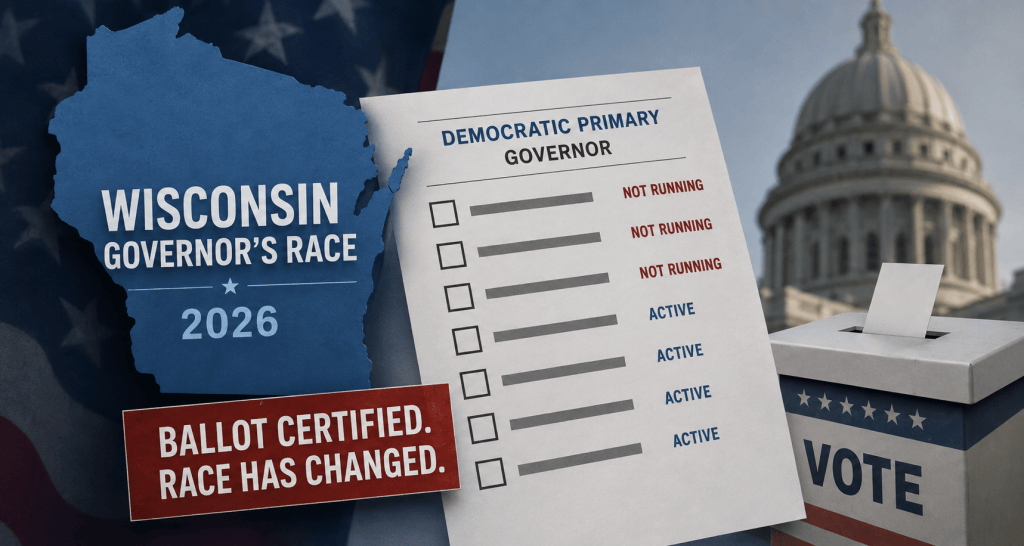
Wisconsin voters go to the polls August 11 to choose party nominees for governor, but the ballot they’re handed won’t reflect the race as it stands today. Of the seven Democrats certified for the primary ballot in June, three have since permanently ended their campaigns, and a fourth dropped out and then re-entered — yet all seven names remain on the printed ballot, a consequence of how Wisconsin’s ballot-certification timeline interacts with candidate withdrawals.
The scramble follows an unusually turbulent primary season — Milwaukee Magazine described the Democratic field as having gone through “head-spinning upheaval” — layered on top of an unusually consequential open seat. Democratic Gov. Tony Evers announced in July 2025 that he would not seek a third term, opening the state’s top office for the first time in 16 years. Wisconsin has split its recent statewide results: Donald Trump carried the state in the 2024 presidential election, while Evers won reelection in 2022. Both parties are treating the race as a top national priority.
“Wisconsin voters will cast ballots in a race that no longer matches the campaign they’re watching.”
How the ballot got frozen in place
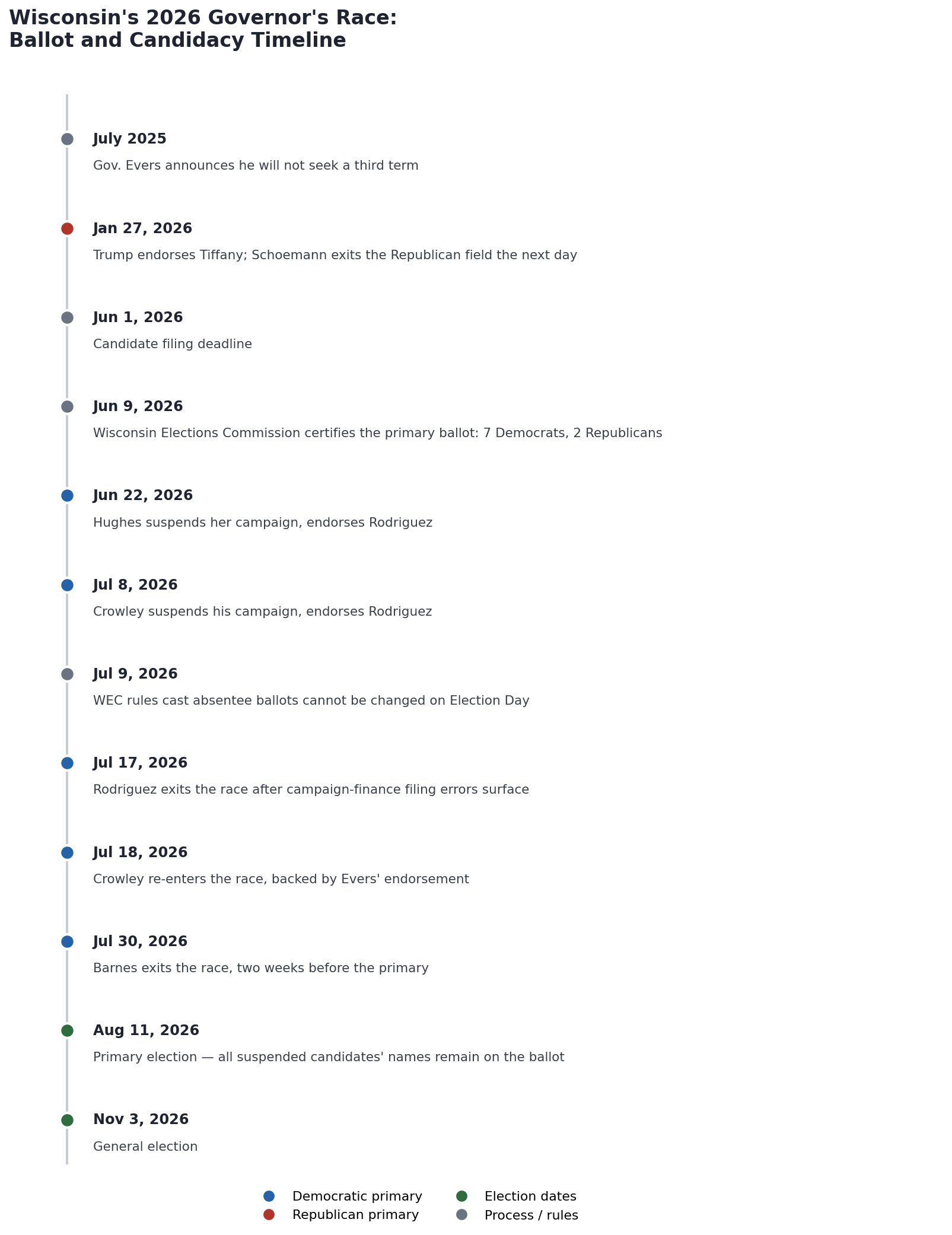
Wisconsin’s candidate filing deadline was June 1, and the state Elections Commission certified the primary ballot on June 9: seven Democrats and two Republicans. Under Wisconsin statutes, formally withdrawing a name from a certified ballot appears to require completing a notice process on a timeline tied to the certification date itself, rather than simply announcing an end to a campaign. Election Desk has not yet obtained confirmation directly from the Wisconsin Elections Commission on the precise mechanics of a live withdrawal after that point, but the practical outcome so far has been consistent: candidates who have suspended their campaigns since June 9 remain on the printed ballot.
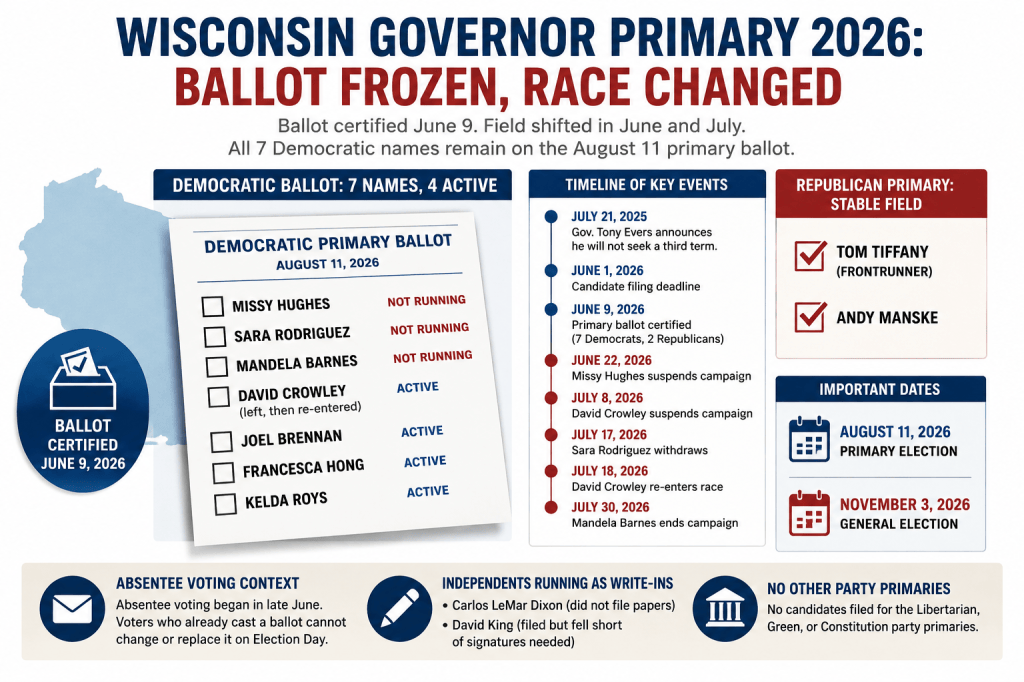
That mechanic has mattered more than usual this cycle. Since the ballot was set, three of the seven certified Democrats have ended their campaigns for good, and a fourth left and then returned:
- Missy Hughes, a former state economic development official, suspended her bid June 22 and endorsed Lt. Gov. Sara Rodriguez.
- Sara Rodriguez, the sitting lieutenant governor, withdrew July 17 after her campaign disclosed significant errors in its finance filings, including duplicated contributions that had inflated its reported fundraising total; she said the issues had left her campaign with far less cash on hand than reported.
- Mandela Barnes, the former lieutenant governor and 2022 U.S. Senate nominee, ended his campaign July 30, less than two weeks before the primary, as the state’s largest newspaper prepared to report that the state Democratic Party had reviewed anonymous allegations concerning his conduct with women. Barnes has not been charged with a crime; a campaign spokesman said, “There are no allegations of misconduct or wrongdoing against Mandela.”
- David Crowley, the Milwaukee County executive, suspended his campaign July 8 and endorsed Rodriguez — then reversed course and re-entered the race July 18, this time with an endorsement from the outgoing governor, after Rodriguez’s own campaign collapsed. Crowley is actively campaigning again as of this writing.
“Three candidates left for good. One exited and returned. All seven names still appear on the ballot.”
Hughes, Rodriguez, and Barnes will all still appear on the August 11 Democratic ballot alongside the four candidates still actively campaigning: Joel Brennan, a former secretary of the state Department of Administration; Crowley; Francesca Hong, a state representative and member of the Democratic Socialists of America caucus; and Kelda Roys, a state senator who also ran for governor in 2018.
A related timing issue has drawn its own attention: the bipartisan Elections Commission ruled July 9 that voters who had already cast an absentee ballot could not change or replace it on Election Day, even as the candidate field kept shifting through late July. Wisconsin’s absentee voting period began in late June, meaning some voters may have already cast ballots for candidates — Hughes, Crowley (in his first exit), Rodriguez, or Barnes — who were no longer running by the time polls opened.
“The printed ballot became a snapshot of the race in early June—even as the campaign changed dramatically afterward.”
The Republican field, by contrast, has been stable
“While Democrats saw weeks of upheaval, Republicans reached August with essentially the same field they certified in June.”
Republicans certified a smaller, calmer field. U.S. Rep. Tom Tiffany was already considered the frontrunner when President Trump endorsed him in late January; Washington County Executive Josh Schoemann dropped out the next day and Bill Berrien, a Whitefish Bay businessman, had already exited in September. That left Tiffany facing only Andy Manske, a medical service technician, who has continued campaigning despite reporting only a small fraction of Tiffany’s fundraising.
What the primary is likely to decide
Recent public polling — a Marquette University Law School survey released July 29 — showed Hong leading the Democratic field with 38% support, with Barnes (before his exit) at 16% and Crowley at 7%; roughly a third of respondents were undecided with two weeks left before the primary. Election Desk does not handicap races, and a single poll two weeks out is not a result — but the mechanics of the ballot itself, rather than who is ahead, are what will shape how the primary is administered: seven names for Democratic voters to choose among, only four of whom are actively campaigning.
The winners of the August 11 primaries advance to the November 3 general election. Two independent candidates have said they’ll pursue write-in campaigns instead of appearing on the printed ballot: Milwaukee real estate agent Carlos LeMar Dixon did not file nomination papers at all, while perennial candidate David King filed but fell short of the roughly 2,000 signatures required to qualify. No candidates filed for the Libertarian, Green, or Constitution party primaries.
“The story isn’t simply who’s leading—it’s how election procedures can preserve a candidate list long after campaigns have changed.”
Election Desk will continue tracking the certified candidate list, absentee and Election Day procedures, and any post-primary developments as Wisconsin moves toward November.
For background on the full initial candidate field, see Election Desk’s January 2026 overview of the race.
Reporting drew on coverage from the Associated Press (via PBS NewsHour), the Washington Post, NBC News, The Hill, CBS News, ABC News, and Wisconsin Public Radio, along with Wisconsin-specific outlets including the Wisconsin Examiner, PBS Wisconsin, WBAY, WKOW, Milwaukee Magazine, and FOX6 Milwaukee. Candidate-field and filing details were cross-checked against Ballotpedia’s 2026 Wisconsin gubernatorial election page and Wikipedia’s corresponding entry. Polling figures come from the Marquette University Law School Poll released July 29, 2026. Statutory language on ballot withdrawal and vacancy procedures was pulled directly from the Wisconsin Legislature’s online statutes (Wis. Stat. §§ 7.50, 7.51, 8.35), though as flagged in the fact-check, that reading has not yet been confirmed directly with the Wisconsin Elections Commission and should be verified before publication if the piece leans further on that mechanism.


Leave a comment