
Nevada’s 2026 governor’s race is rated a toss-up by most independent handicappers — one of only a handful of governorships nationally, and the only one where a Republican incumbent is defending the seat. That closeness gives extra weight to two features of Nevada election law found in few or no other states: a fully closed primary system that locks out nearly a third of registered voters, and a “None of These Candidates” ballot line that lets voters formally reject every named candidate.
The primary recap
Nevada held primaries on June 9. Gov. Joe Lombardo, seeking a second term, easily turned back six lesser-known Republican challengers, taking 91% of the vote. On the Democratic side, Attorney General Aaron Ford defeated Washoe County Commissioner Alexis Hill, winning about 63% of the vote to Hill’s 24%. Ford, who has the backing of Nevada’s Democratic congressional delegation, is seeking to become the state’s first Black governor.
Lombardo won his first term in 2022 by defeating incumbent Gov. Steve Sisolak by 1.5 percentage points — at the time, the only successful challenge to a sitting governor anywhere in the country that cycle. That result made him an immediate target for 2026, and Cook Political Report and other national handicappers currently rate the rematch-in-spirit against Ford as one of the closest governor’s races in the country.
A closed primary that excludes a third of voters
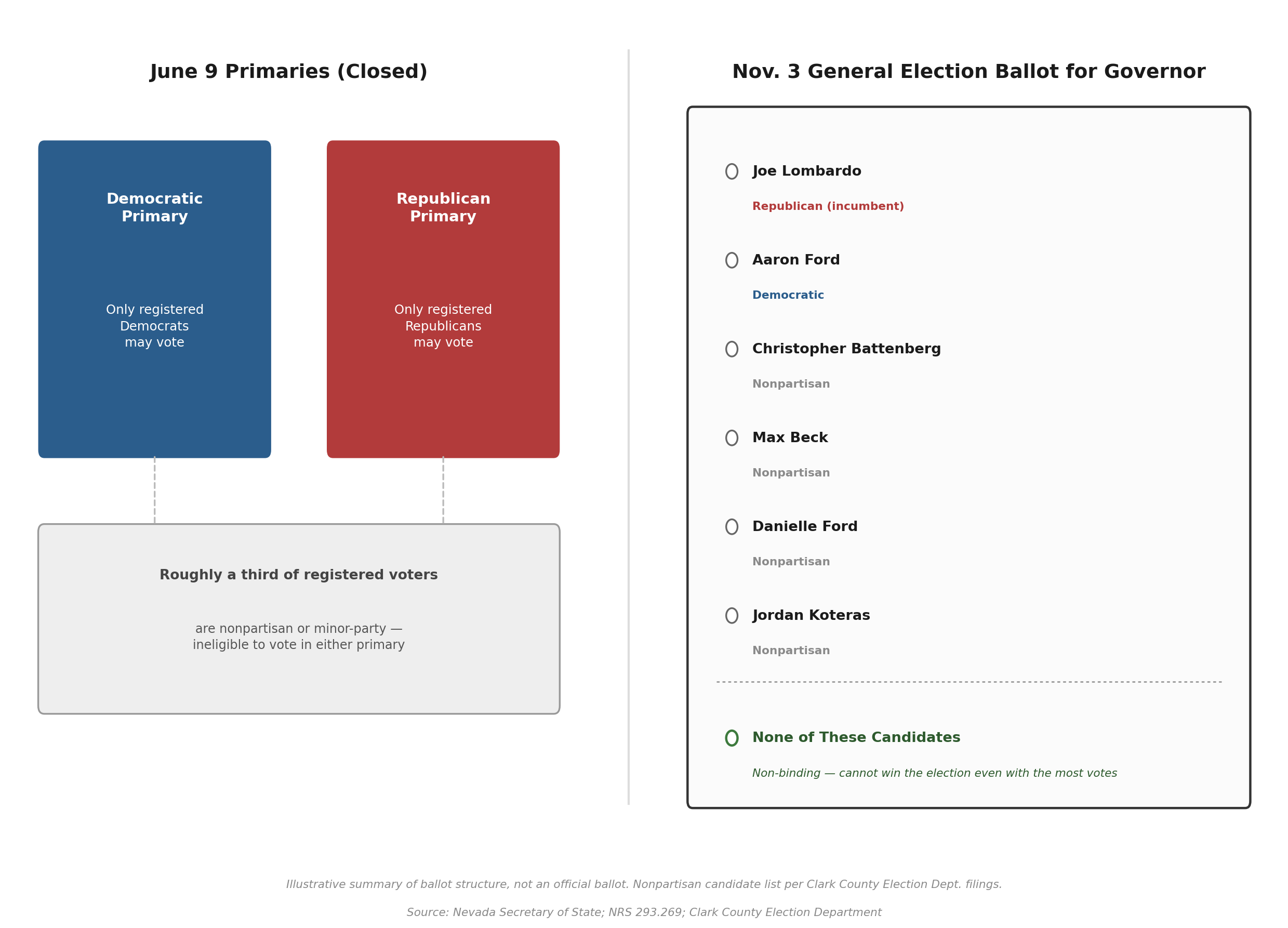
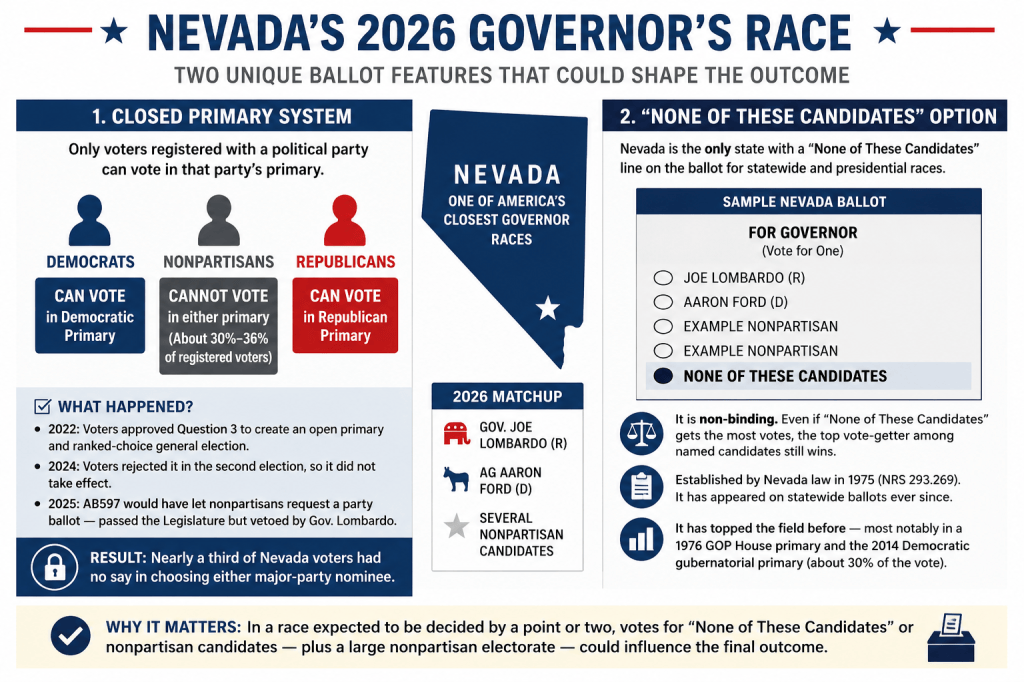
Nevada law permits only voters registered with a political party to vote in that party’s primary; registered nonpartisans and minor-party voters cannot participate in either the Democratic or Republican primary. Nonpartisan voters make up roughly a third of Nevada’s registered electorate — estimates in recent reporting range from about 30% to 36% — a share that has grown steadily since the state adopted automatic voter registration in 2021, which defaults new registrants to nonpartisan status.
“Nearly a third of Nevada’s registered voters had no say in choosing either major-party nominee.”
Voters have twice weighed in on changing this. A 2022 ballot initiative, Question 3, would have replaced the closed primary with a nonpartisan open primary in which the top five finishers advance to a ranked-choice general election. Because it proposed a state constitutional amendment, Nevada law required it to pass in two consecutive general elections; voters approved it in 2022 by about 6 points but rejected it in 2024 by roughly 9 points, and it did not take effect. In 2025, Democratic Assembly Speaker Steve Yeager introduced a narrower bill, AB597, that would have let nonpartisan voters request a party’s primary ballot without formally re-registering with that party. It passed the Legislature but was vetoed by Gov. Lombardo. Nevada’s primary system therefore remains closed heading into 2026, with nonpartisan voters shut out of both parties’ gubernatorial primaries and able to participate only in the November general election.
“Nevada voters rejected changing the primary system in 2024, leaving the state’s unique election rules intact for another high-stakes governor’s race.”
“None of These Candidates”: a Nevada original
Nevada is the only state that places a “None of These Candidates” line on its ballot for statewide and presidential races, a product of a 1975 law (Nevada Revised Statutes 293.269) originally sponsored by two rural Democratic lawmakers. The option is non-binding: even if “None of These Candidates” receives the most votes in a given race, the actual candidate with the highest vote total among named candidates still wins. A Republican-led lawsuit sought to eliminate the option ahead of the 2012 election, arguing it effectively discarded protest votes; a federal district court agreed and blocked it, but the 9th U.S. Circuit Court of Appeals reinstated the option before that year’s election, and it has appeared on statewide Nevada ballots ever since.
The line has topped the field outright on a small number of occasions, most notably in a 1976 Republican U.S. House primary and in the 2014 Democratic gubernatorial primary, when it drew about 30% of the vote against a field of little-known candidates challenging a popular incumbent. Because the option is limited to statewide and presidential contests, it will appear on Nevada’s November ballot for governor alongside Lombardo, Ford, and several candidates running without party affiliation.
“Nevada is the only state that gives voters a statewide option to reject every named candidate while still electing one of them.”
Why both features matter more in a close race
In a race expected to be decided by a point or two, even protest votes can become part of the story.”
In a governor’s race that multiple pollsters and race-raters describe as within single digits — a Noble Predictive Insights survey in October 2025 showed Lombardo leading Ford 40% to 37% with 23% undecided, while a follow-up survey in March 2026 showed the race at 39% to 38% with 17% undecided and 6% supporting third-party or nonpartisan candidates — a percentage point or two pulled toward “None of These Candidates” or toward one of the nonpartisan candidates on the ballot could plausibly affect the outcome. Because Nevada’s nonpartisan voters cannot help select either major-party nominee in the primary, some may be more inclined to use the general-election NOTC option as a protest vote in November, though there is no way to measure that effect in advance.
“Nevada’s ballot doesn’t just ask who should govern—it also lets voters say none of the listed choices deserve the job.”
What to watch
Nevada mails a ballot to every active registered voter for the general election, meaning most votes will be cast well before November 3. Ford has challenged Lombardo to a series of post-Labor Day debates, including a cost-of-living-focused town hall and at least one Spanish-language debate; how those unfold could move a race both sides expect to be decided by the number of undecided and nonpartisan voters. Election Desk will publish an updated look at the closed-primary and NOTC dynamics once more recent, independently verified general-election polling becomes available.
Sources: Nevada Secretary of State’s Office; Nevada Revised Statutes 293.269; Ballotpedia; Clark County Election Department; The Nevada Independent; Nevada Current; Las Vegas Review-Journal; Associated Press via PBS NewsHour; Cook Political Report; Noble Predictive Insights (NVPOP).


Leave a comment