

South Carolina voters will return to the polls on August 11 to select the Republican nominee for a U.S. Senate seat that became vacant after the death of Sen. Lindsey Graham. The special primary is governed by a distinct legal process separate from the state’s regular June primary cycle, and understanding that process — not the candidates’ polling numbers — is the focus of this piece.
How the vacancy arose
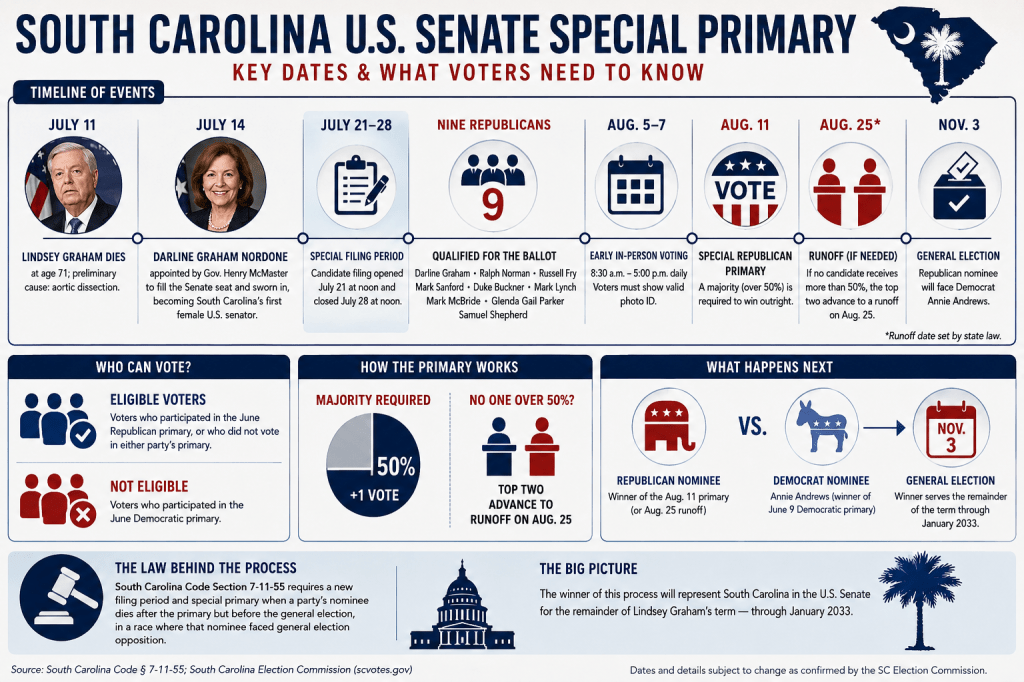
Graham, who was seeking a fifth term, died on July 11 at age 71; a preliminary finding from the D.C. medical examiner attributed the cause to an aortic dissection. Because Graham had already secured the Republican nomination in the state’s June 9 primary, his death created a vacancy in the party’s ballot line for the November general election, not simply a vacancy in the Senate seat itself.
Gov. Henry McMaster addressed the two vacancies separately. For the immediate Senate seat, he appointed Graham’s sister, Darline Graham Nordone, to serve out the remainder of the term; she was sworn in on July 14, becoming the state’s first female U.S. senator. For the ballot vacancy, state law required a new special candidate filing period and primary to determine who would carry the Republican nomination into the general election.
“Graham’s death created a vacancy in the party’s ballot line—not just a vacancy in the Senate seat itself.”
The legal basis for the special primary
South Carolina Code Section 7-11-55 governs what happens when a party’s nominee dies after winning a primary but before the general election, in a race where the nominee already faced opposition on the general election ballot. The statute triggers a new, standalone filing period and primary open only to the affected party — in this case, Republicans. Voters who cast ballots in the Democratic primary in June are not eligible to participate in this special Republican primary; voters who participated in the June Republican primary, or who sat out both primaries, are eligible.
“State law triggered a new, standalone Republican primary rather than simply naming a replacement nominee.”
Filing period and the candidate field
Candidate filing opened at noon on July 21 and closed at noon on July 28. Nine candidates qualified for the ballot: appointed Sen. Darline Graham, U.S. Reps. Ralph Norman and Russell Fry, former Gov. Mark Sanford, Duke Buckner, Mark Lynch, Mark McBride, Glenda Gail Parker, and Samuel Shepherd.
“Nine Republicans qualified during a one-week special filing period created specifically for this election.”
Voting mechanics
“South Carolina requires a majority—not merely a plurality—to win a party nomination outright.”
Early in-person voting runs August 5 through August 7, with polls open 8:30 a.m. to 5 p.m. Voters must present valid photo identification, and polling locations can be confirmed through the South Carolina Election Commission’s site, scvotes.gov. Primary day itself is August 11.
South Carolina does not require a candidate to win a plurality alone to claim the nomination outright — state law requires a majority. If no candidate clears 50 percent of the vote on August 11, the top two finishers advance to a runoff scheduled for August 25.
“If no candidate tops 50 percent on Aug. 11, the race continues with an Aug. 25 runoff.”
What happens next
Whoever wins the Republican nomination — either outright on August 11 or in the August 25 runoff — will appear on the November 3 general election ballot against Democrat Annie Andrews, who won her party’s nomination in the regular June primary. The winner of that general election will serve the remainder of the six-year term Graham was elected to in 2020, through January 2033.
FAQ
Why is South Carolina holding a special Senate primary?
Because Sen. Lindsey Graham died after winning the Republican primary, state law requires a new Republican primary to select a replacement nominee.
Who can vote in the Republican special primary?
Voters who participated in the June Republican primary—or who did not vote in either party’s primary—are eligible. Those who voted in the June Democratic primary are not.
How many Republican candidates are running?
Nine Republican candidates qualified during the special filing period.
Will there be a runoff?
Yes. If no candidate wins more than 50% of the vote on Aug. 11, the top two candidates advance to an Aug. 25 runoff.
Who will face the Republican nominee in November?
The Republican nominee will face Democratic nominee Annie Andrews in the Nov. 3 general election.
Election Desk will continue tracking procedural developments in this race, including certification timelines and any runoff logistics, as they are confirmed by the South Carolina Election Commission.


Leave a comment