
Michigan voters went to the polls Tuesday, August 4, to narrow crowded fields in the state’s most consequential election cycle in years. With Gov. Gretchen Whitmer term-limited and Sen. Gary Peters retiring, both of the state’s top offices were open, and the results reshuffled Michigan’s congressional delegation as well. Polls closed at 8 p.m. local time — 9 p.m. Eastern for the four Upper Peninsula counties on Central Time — and the Associated Press began calling races as soon as the last polls shut down statewide.
Most of the results below were called on election night or by Wednesday morning; final counts remain unofficial until each county, and then the state Board of Canvassers, certifies the results in the coming weeks.
“With Gov. Gretchen Whitmer term-limited and Sen. Gary Peters retiring, Michigan voters reshaped the state’s political landscape in a single primary.”
Governor: Benson and James advance
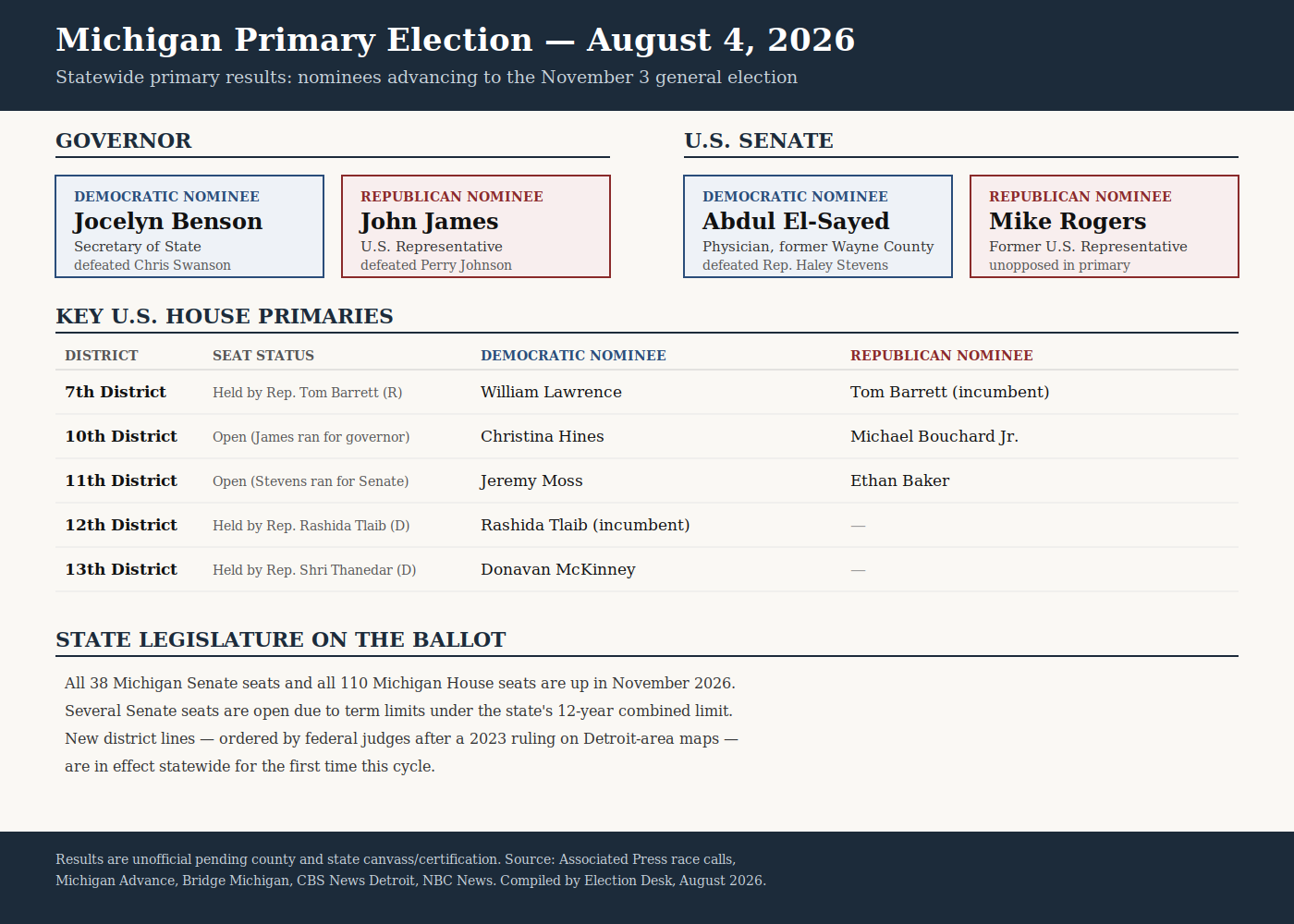
Democratic Secretary of State Jocelyn Benson won her party’s nomination for governor over Genesee County Sheriff Chris Swanson. The Associated Press called the race for Benson at 9 p.m., immediately after polls closed, and by Wednesday morning, with most votes counted, she led Swanson by roughly 85 points. Benson significantly outraised Swanson over the course of the campaign, entering the general election with more cash on hand.
On the Republican side, U.S. Rep. John James, who holds Michigan’s 10th Congressional District, won his party’s nomination over businessman Perry Johnson. James had the backing of President Trump heading into the primary.
Benson and James will meet in the November 3 general election to succeed Whitmer, who cannot seek a third nonconsecutive term under Michigan’s term-limit rules.

U.S. Senate: El-Sayed wins a contested Democratic primary; Rogers unopposed
The Democratic Senate primary was among the most closely watched in the country. Abdul El-Sayed, a physician and former Wayne County health official running with backing from progressive figures including Sen. Bernie Sanders, defeated U.S. Rep. Haley Stevens, who had support from much of the Democratic establishment. State Sen. Mallory McMorrow, an earlier candidate in the race, suspended her campaign in July — after primary ballots had already been printed and sent to absentee voters, so her name still appeared on Tuesday’s ballot even though she was no longer actively running. Stevens conceded Wednesday, and McMorrow endorsed El-Sayed after the race was called.
“The Democratic Senate primary became one of the nation’s marquee contests, ending with Abdul El-Sayed defeating Haley Stevens.”
Former U.S. Rep. Mike Rogers, who narrowly lost Michigan’s 2024 Senate race to Sen. Elissa Slotkin, ran unopposed for the Republican nomination this cycle. The Cook Political Report and Sabato’s Crystal Ball both rate the general election as a toss-up — one of only a handful of Senate races nationally to carry that rating — making it a race both parties see as central to control of the chamber.
U.S. House: an open-seat scramble and one incumbent ousted
Michigan’s congressional map produced several competitive primaries, particularly in districts left open by candidates running for governor or Senate.
- 7th District (currently held by Republican Rep. Tom Barrett): Progressive organizer William Lawrence won a three-way Democratic primary, leading with roughly 43% of the vote over the two more moderate candidates in the race, Brink (29%) and Maasdam (28%), according to vote counts reported Wednesday morning. Lawrence, who was backed by Sanders and Rep. Alexandria Ocasio-Cortez, campaigned heavily against data-center development in the district and will face Barrett in November. Some national Democrats had urged one of the moderate candidates to drop out and consolidate the anti-Lawrence vote; that didn’t happen.
- 10th District (open — Rep. John James ran for governor): Army Capt. Michael Bouchard Jr., endorsed by President Trump and the son of Oakland County Sheriff Mike Bouchard, won the Republican primary over Justin Kirk and Steffan Demetropoulos. On the Democratic side, former prosecutor Christina Hines won a three-way primary over former Pontiac Mayor Tim Greimel and attorney Eric Chung. Cook Political Report currently rates the seat “lean Republican,” though it remains a top Democratic target.
- 11th District (open — Rep. Haley Stevens ran for Senate): State Senate President Pro Tempore Jeremy Moss won the Democratic primary with backing from Whitmer and other establishment figures. He will face Troy Mayor Ethan Baker, the Republican nominee, in a district Democrats are favored to hold.
- 12th District: Incumbent Rep. Rashida Tlaib won her Democratic primary and is on track to seek a further term representing the district.
- 13th District (Detroit): In one of the night’s bigger upsets, state Rep. Donavan McKinney, backed by Sanders, defeated incumbent Rep. Shri Thanedar. Unofficial results from Wayne County showed McKinney winning by about 4,200 votes out of roughly 112,000 cast — a margin of about four percentage points, in a heavily Democratic district where the primary winner is the de facto favorite in November.
“One of the night’s biggest surprises came in Detroit, where Donavan McKinney unseated incumbent Rep. Shri Thanedar.”
State legislature: all 148 seats on the ballot in November
Tuesday’s primary also set the field for Michigan’s state legislative elections. All 38 Michigan Senate seats and all 110 Michigan House seats are up in 2026, and several Senate seats are open because of the state’s 12-year combined term-limit rule — among the strictest in the country. This is also the first election cycle to use new Senate district lines, which a federal court ordered redrawn in 2023 after ruling that several Detroit-area districts had been improperly drawn along racial lines; a revised map was adopted in mid-2024.
Down-ballot results were still being finalized in many districts as of Wednesday, but several contested primaries were resolved on election night, including a Democratic rematch in the 82nd state House District, where incumbent Rep. Kristian Grant turned back a challenge from Kent County Commissioner Robert Womack. Term limits also opened up several state Senate seats, including a contested three-way Republican primary in the 20th District and contested primaries in both parties in the 31st District, where Chris Kleinjans won the Democratic nomination over Keagan Host.

Process notes
“Michigan’s open primary lets voters choose either party’s ballot—but once selected, they must remain within that party’s column.”
A few mechanical points worth keeping in mind heading into November:
- Michigan runs an open primary system. Voters do not register by party and may choose either party’s ballot at the polls, but once they do, they must vote within that party’s column for partisan races — no crossing over between parties on the same ballot. That restriction does not apply to the November general election, where voters can split their ticket freely.
- Two statewide races were not on Tuesday’s ballot. Democratic and Republican nominees for attorney general (Eli Savit vs. Doug Lloyd) and secretary of state (Garlin Gilchrist vs. Anthony Forlini) were selected at party endorsement conventions earlier this year rather than in the primary.
- Certification is still pending. All results in this article are drawn from AP race calls and unofficial county tallies reported by news organizations on election night and the following morning. Michigan’s county boards of canvassers and, subsequently, the state Board of State Canvassers must certify results before they are final.
“Certification remains the final step before Michigan’s unofficial primary results become official.”
This article will be updated as county and state canvassing boards certify results in the coming weeks.
Sources consulted: Associated Press race calls as reported by CBS News Detroit, NBC News, ABC News, and MSNBC/ms.now’s live-results pages; Michigan Advance and Bridge Michigan for district-level vote counts and campaign context (including the McMorrow withdrawal reporting from Michigan Advance, Bridge Michigan, NBC News, and Axios); Votebeat Michigan for polling-hours and results-timing mechanics; the Michigan Secretary of State’s elections page and Ballotpedia for primary-type and election-calendar confirmation; and Wikipedia’s 2026 Michigan Senate election and 2026 U.S. Senate election in Michigan pages for term-limit and redistricting background. All results should be treated as unofficial pending county and state canvass certification.


Leave a comment