
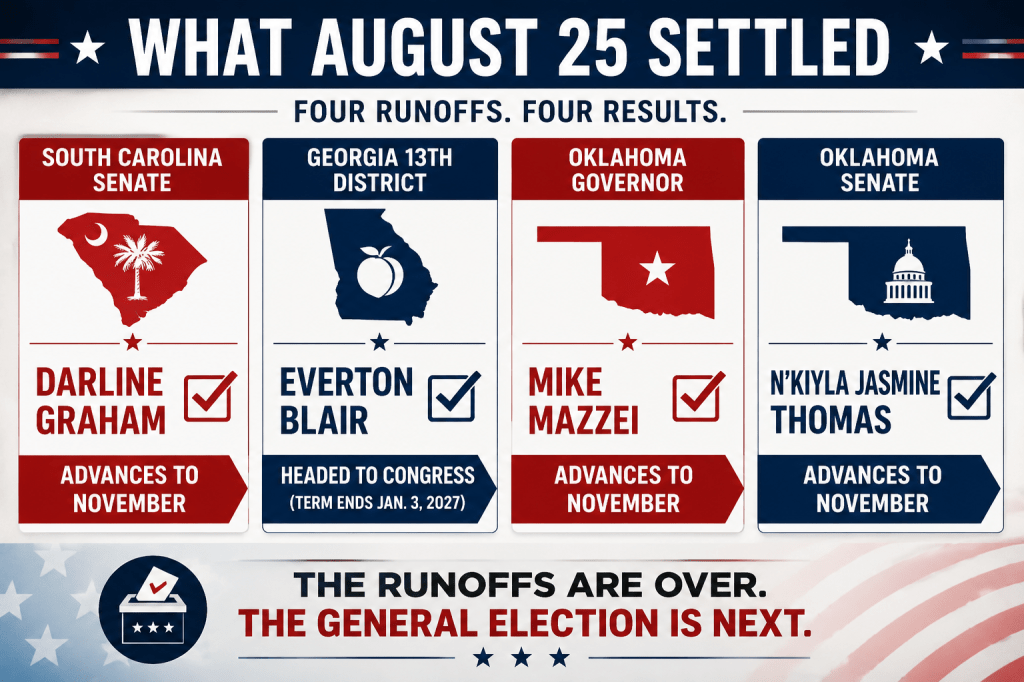
Voters in three states returned to the polls on August 25 to settle primary runoffs and special elections that could not be decided in earlier rounds of voting. The night’s marquee contest was South Carolina’s special Republican Senate primary, where Sen. Darline Graham defeated Rep. Ralph Norman to become the GOP nominee for the seat her late brother, Sen. Lindsey Graham, held for nearly a quarter-century. But three other races — a Georgia special election that will seat a new House member within days, and two Oklahoma runoffs for governor and Senate — also reached their conclusions Tuesday night.
“Four races across three states produced four very different kinds of victories — from a Senate succession fight to a gubernatorial runoff decided by roughly 2,000 votes.”
South Carolina: Darline Graham wins the GOP nomination
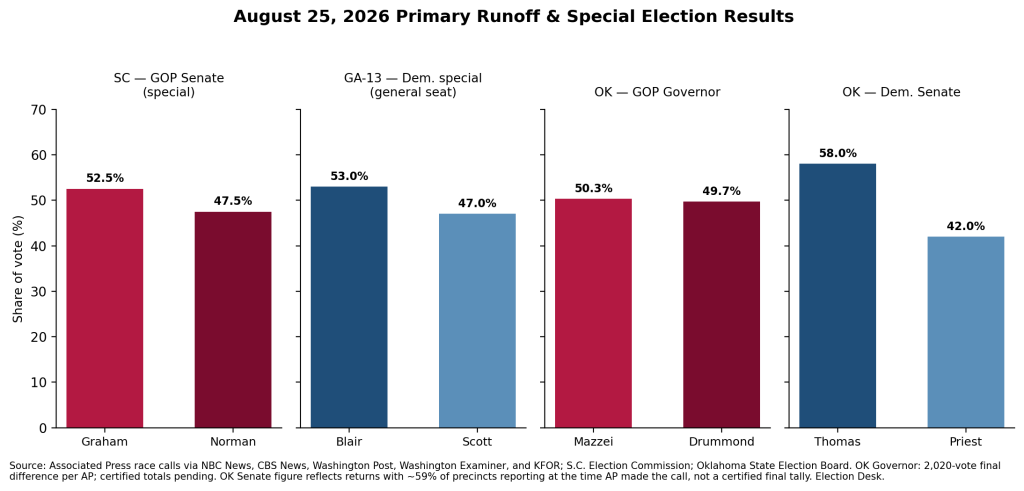
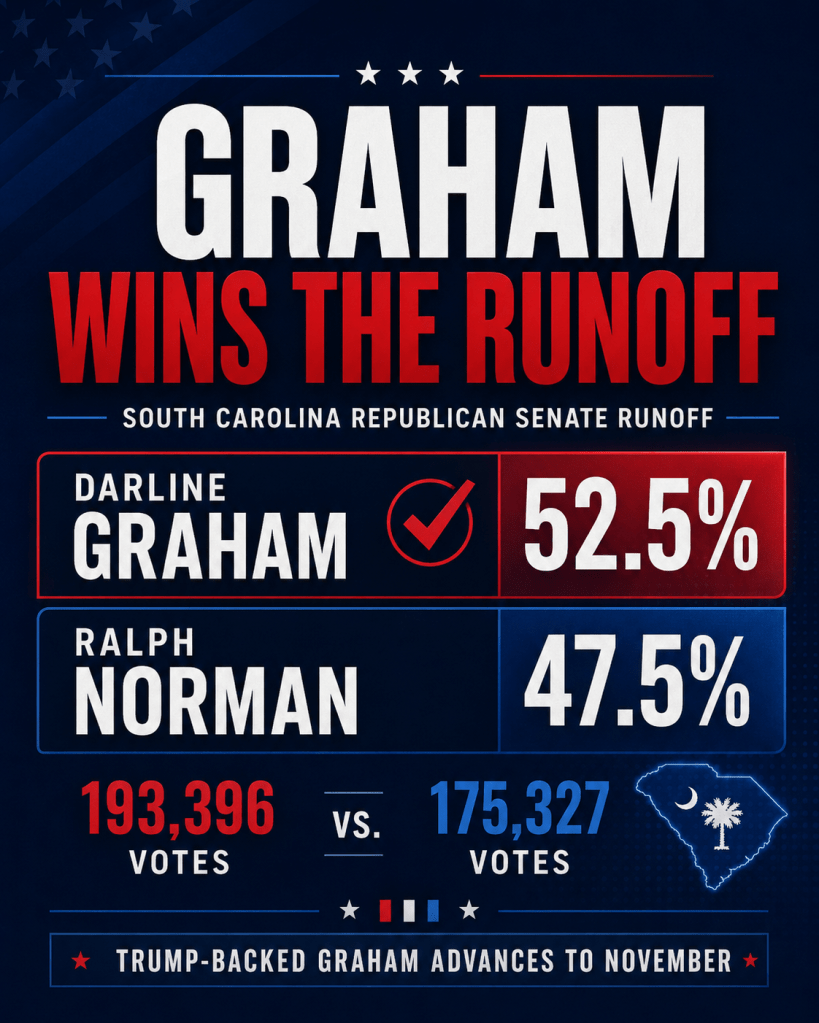
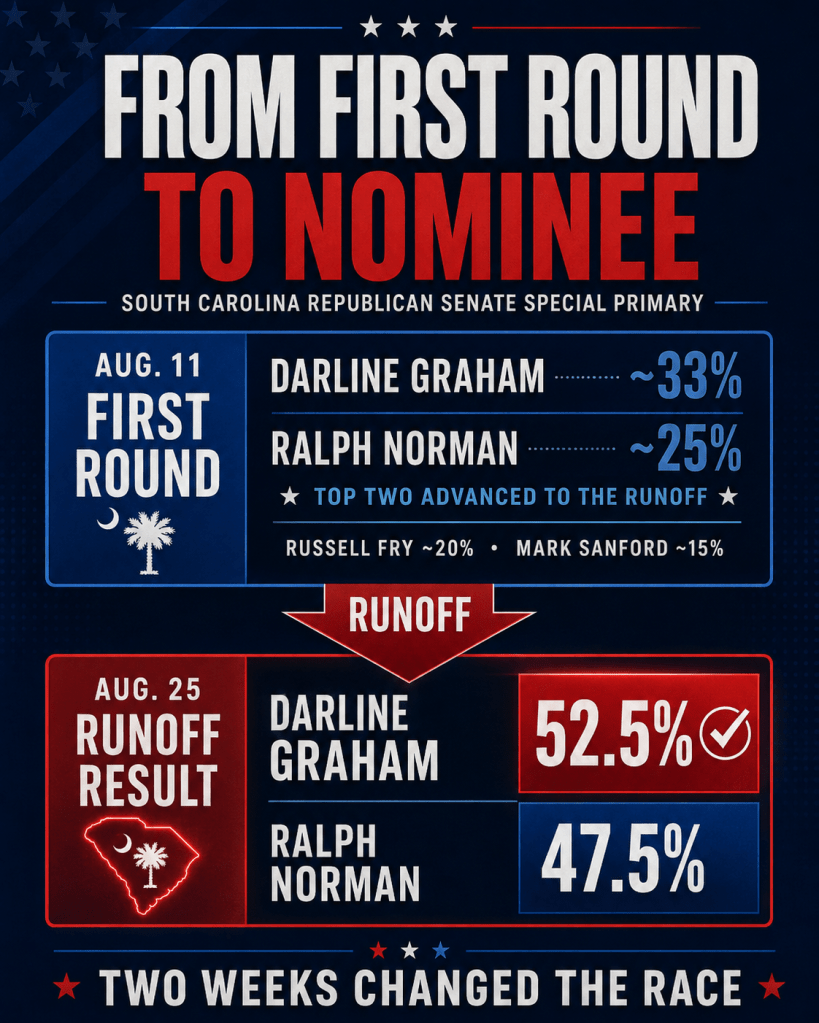
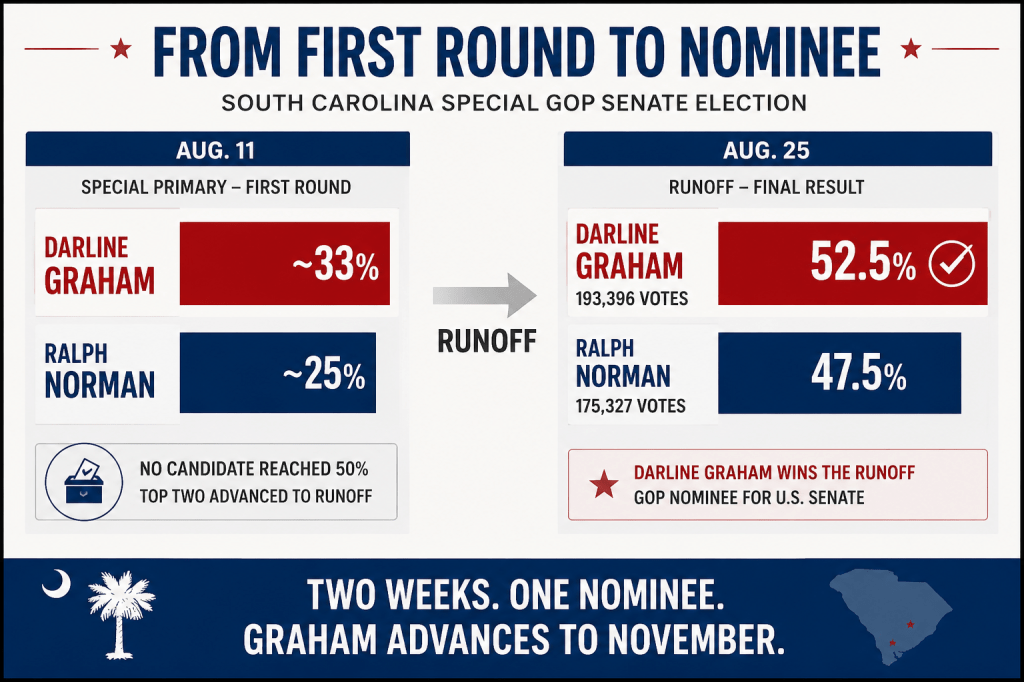
Sen. Darline Graham defeated U.S. Rep. Ralph Norman 52.5% to 47.5%, according to the South Carolina Election Commission, with Graham drawing 193,396 votes to Norman’s 175,327. The Associated Press called the race once Graham cleared a majority.
The special election was triggered by the sudden death of Sen. Lindsey Graham in July, which left state and local election officials with a compressed timeline to organize a replacement race ahead of November. Gov. Henry McMaster appointed Darline Graham, the late senator’s sister, to the seat on an interim basis; she then entered the special primary to seek a full term.
Neither Graham nor Norman cleared 50% in the initial special primary held Aug. 11, when Graham won just under 33% of the vote to Norman’s just under 25%. Rep. Russell Fry took nearly 20% and former Gov. Mark Sanford about 15% in that first round, sending the top two finishers to Tuesday’s runoff.
President Trump’s endorsement was a central factor in the campaign’s final stretch. The pro-Trump super PAC MAGA Inc. spent roughly $827,000 in the race on its final day, and a late Trafalgar poll had shown the contest essentially tied heading into Tuesday before Graham’s win came in above that margin. Norman, a House Freedom Caucus member who has served nearly a decade in Congress, emphasized foreign-policy experience during the campaign; Graham countered by framing herself around kitchen-table economic concerns, a contrast both she and Trump highlighted in the campaign’s closing days.
Graham, 62, had never held or run for elected office before this year, though she previously led South Carolina’s roughly 130-person Commission for the Blind, and she faced attacks from Republican rivals over nepotism and inexperience during the runoff. She now advances to the Nov. 3 general election as the heavy favorite against Democratic nominee Dr. Annie Andrews in a state her brother represented in the Senate for four terms.
“Darline Graham went from never having run for office to becoming the Republican nominee for a U.S. Senate term in a matter of weeks.”
Georgia’s 13th District: an upset finishes David Scott’s term
In suburban Atlanta, former Gwinnett County school board chair Everton Blair defeated Marcye Scott — daughter of the late Rep. David Scott — in the runoff to complete the remainder of Scott’s term representing Georgia’s 13th Congressional District. Blair led 53% to 47% as most of the expected vote was tallied, an outcome several outlets characterized as an upset: Blair had trailed Scott by a wide margin, 46% to 38%, in the first round of voting the previous month.
David Scott, who had represented the district since 2003 and served 12 terms in Congress, died April 22, 2026, at age 80. In the five-way July special election, Scott placed first with about 46% of the vote to Blair’s roughly 37%-38% (accounts vary slightly by outlet); because no candidate reached a majority, the top two advanced to Tuesday’s runoff. Blair’s win fills a Democratic-leaning seat that had sat vacant since the spring, narrowing the current partisan gap in the U.S. House in the interim.
“Everton Blair didn’t just win the runoff. He reversed the order of a first round in which Marcye Scott had finished comfortably ahead.”
Unlike South Carolina’s contest, this race will have almost no bearing on November: neither Blair nor Scott will appear on the general election ballot, since a separate candidate already won the Democratic nomination for a full term in the district in the regularly scheduled primary. Blair will serve out the balance of Scott’s term, which runs through Jan. 3, 2027, and is expected to be sworn in within days.
Oklahoma: a razor-thin governor’s race and a progressive Senate nominee
Oklahoma held two statewide runoffs Tuesday, both to fill offices left open by term limits or resignation.
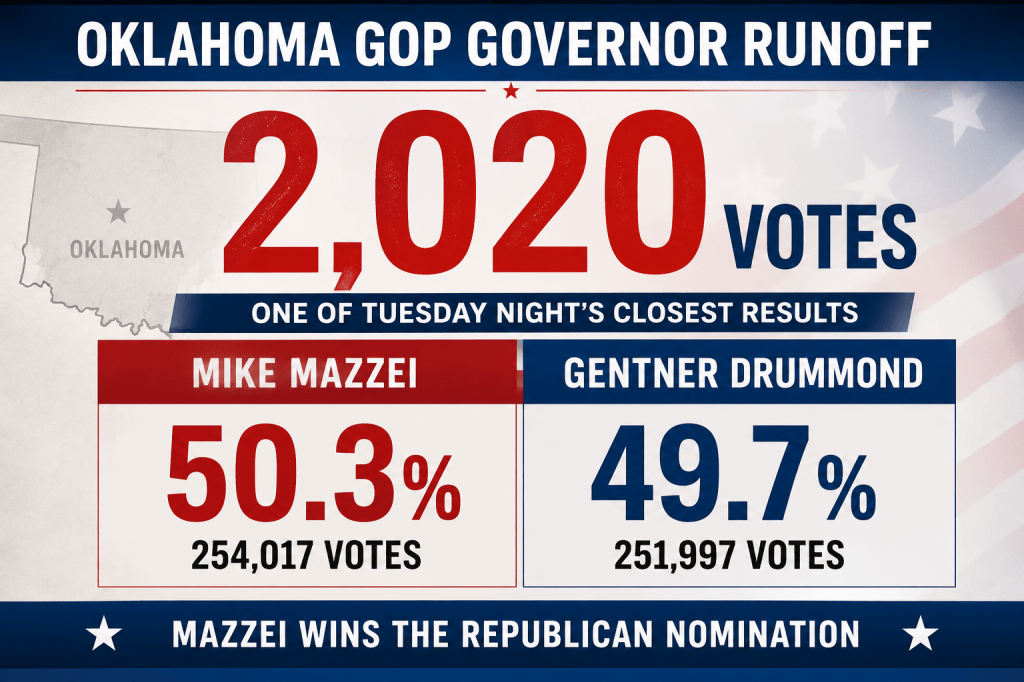
In the Republican gubernatorial runoff, businessman and former state Sen. Mike Mazzei defeated Attorney General Gentner Drummond by a final margin the Associated Press put at 50.3% to 49.7% — a difference of 2,020 votes. Trump had endorsed Mazzei, and prediction markets had consistently favored him by wide margins heading into the runoff, even as the count itself proved close. Mazzei will face Democratic state House Minority Leader Cyndi Munson in November for the seat being vacated by term-limited Gov. Kevin Stitt. Oklahoma has not elected a non-Republican candidate to statewide office in two decades, making Mazzei the clear general-election favorite despite Tuesday’s narrow margin.
“Prediction markets expected Mazzei to win. The voters made him earn it.”
On the Democratic side, nurse N’Kiyla Jasmine Thomas won the party’s U.S. Senate nomination over attorney and minister Jim Priest. With about 59% of precincts reporting, Thomas held more than 58% support in the runoff. Thomas, 31, a Chickasaw Nation citizen from Ardmore, had led the initial June primary, and her runoff win came despite being drastically outspent — her campaign had put out roughly $57,000 to Priest’s $315,000. National outlets flagged the result as another primary win this cycle for the party’s democratic-socialist wing. Thomas will face GOP Rep. Kevin Hern in November for the seat vacated when Sen. Markwayne Mullin left to become secretary of homeland security. Trump carried Oklahoma by 34 points in 2024, and Hern enters the general election as a heavy favorite regardless of Tuesday’s outcome.
“Thomas won despite a major spending disadvantage, giving the Democratic Party’s progressive wing another high-profile primary victory.”
Ahead
“Tuesday settled the nominees. November will test whether the forces that produced them travel beyond their primary electorates.”
South Carolina’s result sets up a marquee November matchup between Graham and Andrews for a seat Republicans are expected to retain comfortably, while the Georgia and Oklahoma runoffs largely confirm the partisan lean already baked into those contests. The bigger test for both parties’ primary electorates — Trump’s continued sway over closely fought GOP nominations, and the growing visibility of democratic-socialist candidates in Democratic primaries — will next be visible in the remaining primary calendar and in how each nominee performs in the general election this fall.
Sourcing note: Vote totals and percentages are drawn from Associated Press race calls as reported by NBC News, CBS News, Washington Post, Washington Examiner, and KFOR election-results coverage, along with the South Carolina Election Commission and the Oklahoma State Election Board. The Oklahoma governor’s race (50.3%–49.7%, a 2,020-vote difference) and Oklahoma Senate runoff (58%–42%, based on roughly 59% of precincts reporting at the time AP made the call) reflect the most recent reported figures; all Tuesday results remain unofficial pending certification by state election authorities. The Georgia 13th District’s July first-round vote share for Everton Blair is reported as 37% by the Atlanta Journal-Constitution and 38% by NBC News — a minor discrepancy between outlets that has not been resolved against a primary vote-count source. Additional context on candidate backgrounds and earlier primary rounds is drawn from contemporaneous reporting by NBC News, CBS News, the Atlanta Journal-Constitution, Georgia Public Broadcasting, NonDoc, and Ballotpedia/Wikipedia election pages.


Leave a Reply