
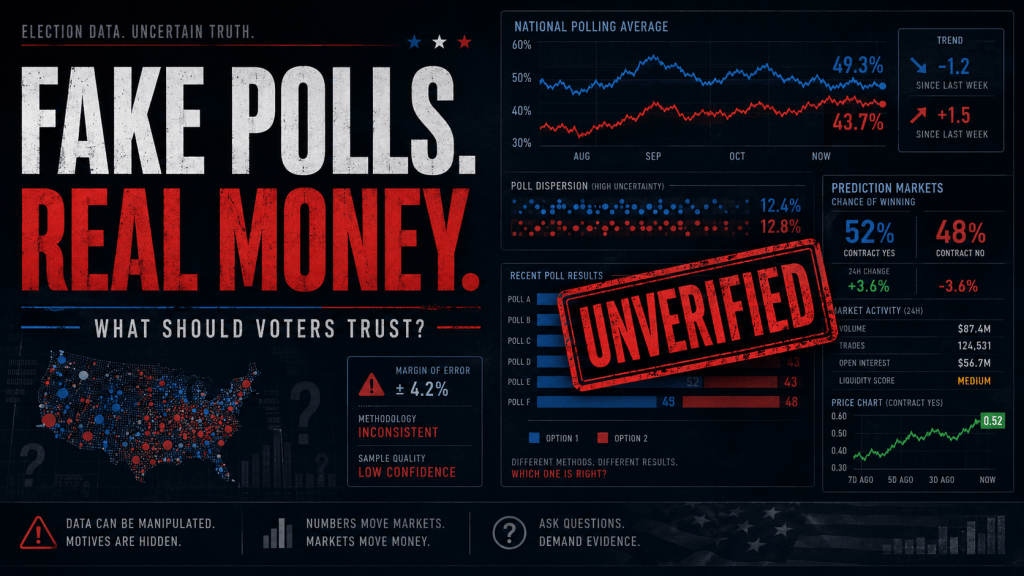
The information ecosystem around the 2026 midterms has developed a credibility problem. In the past two weeks, a previously unknown outfit called Median Strategies admitted that “polls” it published on races in three states — including one showing Los Angeles Mayor Karen Bass with a wide lead in her reelection bid — were fabricated outright. Days later, a second firm, The Public Sentiment Institute, was dropped by a leading poll-tracking site over allegations that it altered survey responses in a Florida primary without disclosing it had been paid by one of the candidates — allegations the firm disputes. And on primary night in Wisconsin, prediction markets that had given Milwaukee County Executive David Crowley as little as a 4 percent chance of winning his own party’s gubernatorial nomination watched him win it anyway.
None of this means polling or prediction markets are worthless. It means both are being stress-tested this cycle by financial incentives, cheap fabrication tools, and a public appetite for constant certainty that the underlying data can’t always support. Here’s what’s driving the confusion, and how to read the numbers between now and November.
“Both polling and prediction markets are being stress-tested by financial incentives, cheap fabrication tools and a public appetite for certainty the underlying data can’t always support.”
Fabricated polls — and a second, disputed episode — are entering the bloodstream
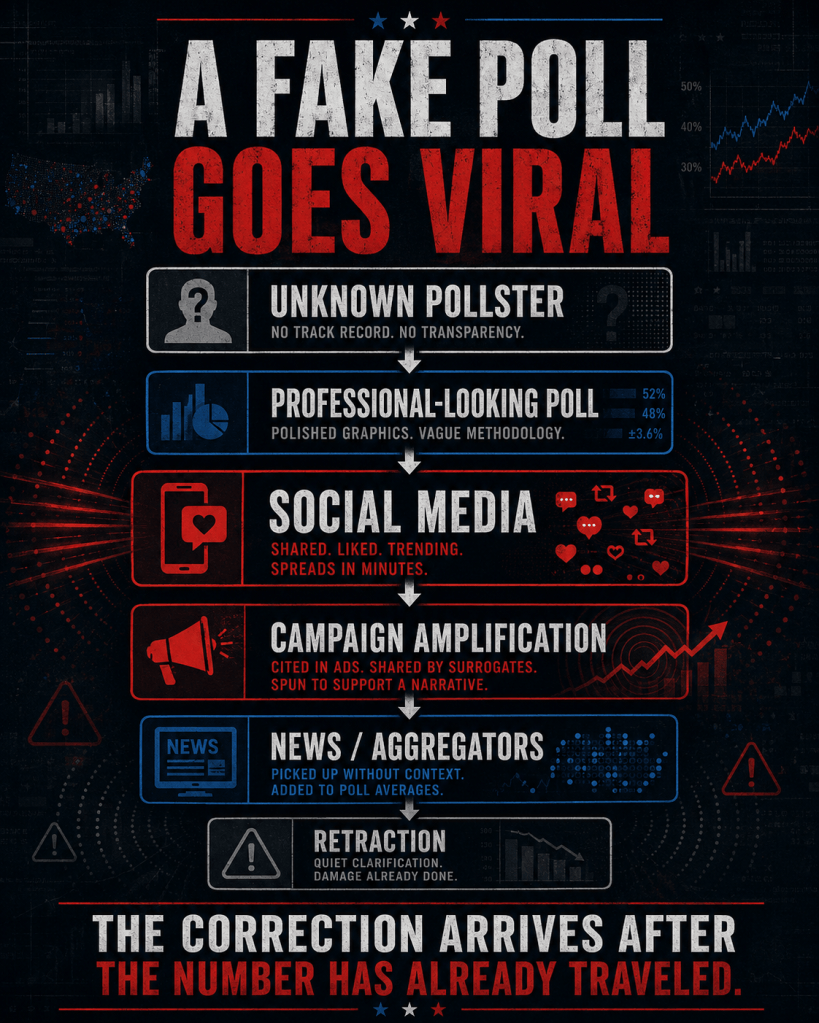
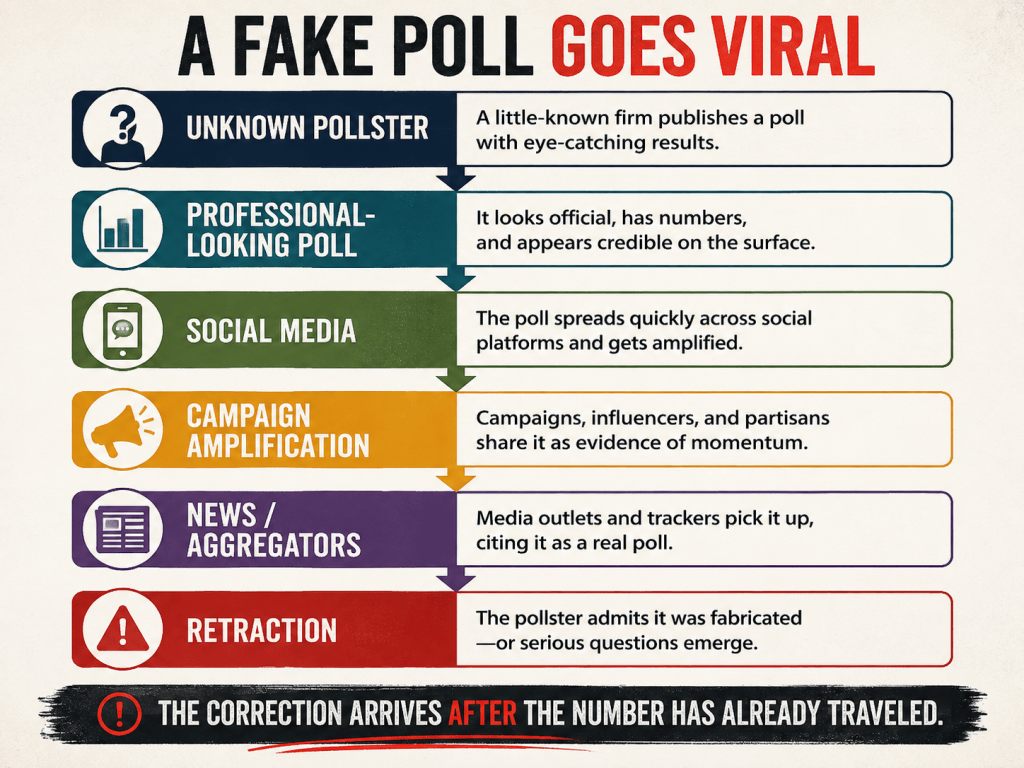
Median Strategies’ fake surveys — on races in California, Michigan and Wisconsin — were picked up by campaigns and, in at least one case, cited publicly by a candidate as evidence of “momentum.” The Los Angeles Times later reported the company, run by a 21-year-old, acknowledged the results were invented entirely, describing the operation as a test of how quickly fabricated data could spread through the political information ecosystem without independent verification.
“It now takes remarkably little to manufacture a plausible-looking poll release and get it amplified before anyone checks it.”
A second, separate episode is less clear-cut and worth stating carefully. The poll-tracking site FiftyPlusOne announced it was permanently dropping The Public Sentiment Institute (TPSI) after finding that Republican Florida gubernatorial candidate James Fishback’s campaign had paid the firm $1,575 in June for polling services, which TPSI then published without disclosing the sponsorship. FiftyPlusOne further alleged that TPSI altered some respondents’ recorded answers to favor Fishback. TPSI disputes that characterization. In a statement to The Hill, the firm said “no respondent was removed, no response was altered, and no data was fabricated,” attributing the discrepancy to an “unvalidated adjustment layer” applied during processing that it failed to catch before publishing. TPSI did acknowledge it should have disclosed the funding relationship. As of this writing, that dispute is unresolved.
Neither firm is accredited by mainstream pollster trackers, and reputable outlets that follow industry disclosure standards — transparent methodology, sample size, mode of interview, sponsor — generally excluded both from polling averages once questions arose. But the episodes illustrate how little it now takes to manufacture, or at minimum mishandle, a plausible-looking poll release and get it amplified before it can be checked.
Campaigns have long selectively released friendly numbers
“A campaign poll isn’t necessarily wrong. But who paid for it is part of the data.”
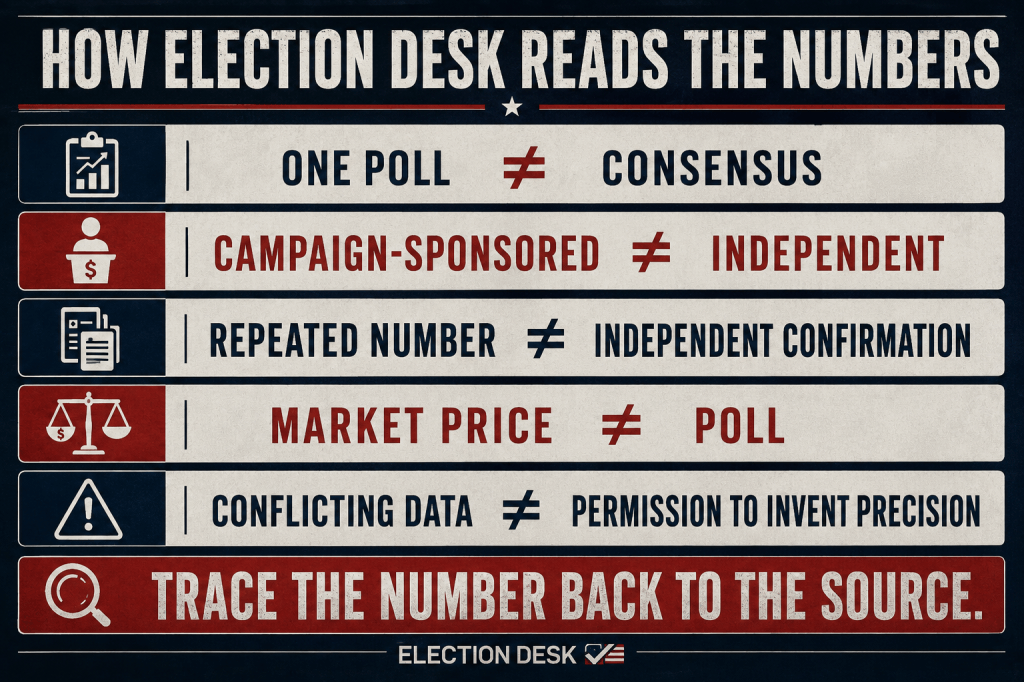
Manufactured polls are a new wrinkle on an old practice: campaigns releasing internal polling that favors their own candidate, without disclosing methodology, while withholding less favorable numbers. That’s why Election Desk’s house practice is to disclose pollster and sponsor affiliation by name and exclude campaign-commissioned surveys from any blended average — a standard many independent poll trackers also follow, though not all label sponsor ties as consistently.
Prediction markets aren’t polls, and they’ve had a rough month
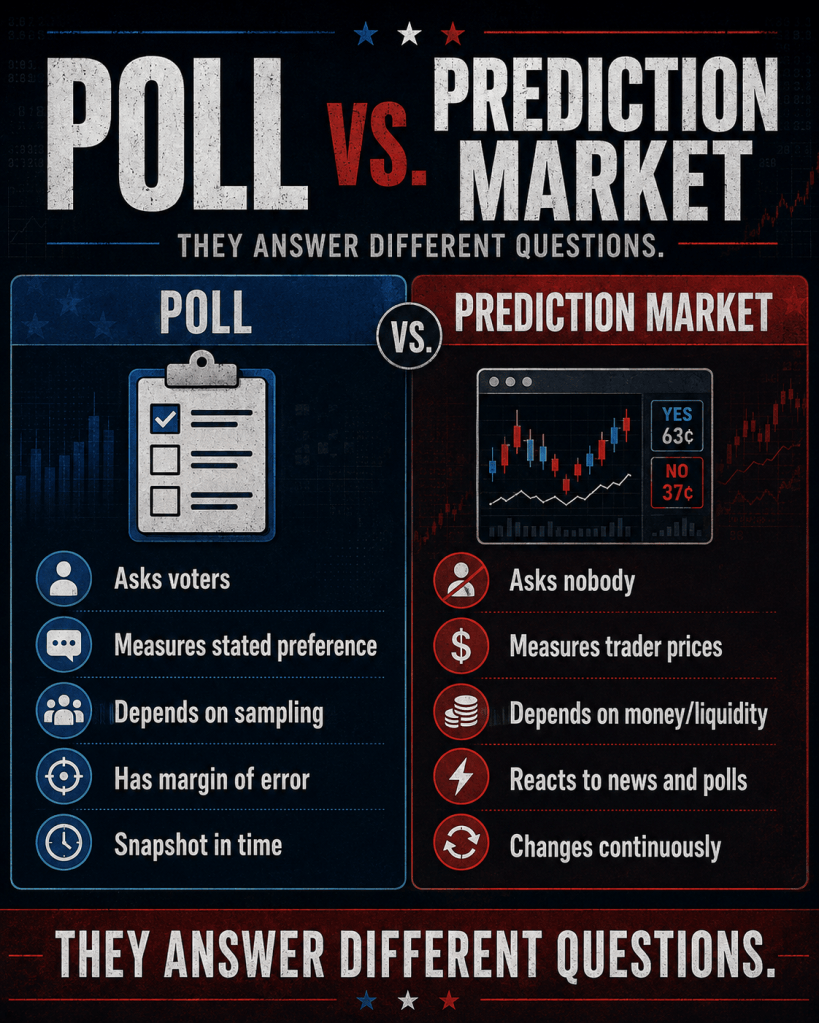
Prediction markets like Kalshi and Polymarket let traders bet real money on election outcomes, with prices meant to reflect the crowd’s collective probability estimate. They are not surveys of voters; they’re a real-time gauge of what traders think will happen, and traders react to — among other things — the same polls now under scrutiny.
The pattern has repeated twice in high-profile primaries. In New York City’s 2025 Democratic mayoral primary, Kalshi and Polymarket had Andrew Cuomo as a 57 percent favorite over Zohran Mamdani heading into Election Day; Mamdani won comfortably. In Wisconsin’s August 2026 Democratic gubernatorial primary, both markets had state Rep. Francesca Hong above 94 percent on the morning voters went to the polls; Crowley won by roughly half a percentage point. In both cases, a single late poll — not a broad shift in the electorate — moved market prices sharply shortly before results came in, and the markets settled on the wrong candidate anyway.
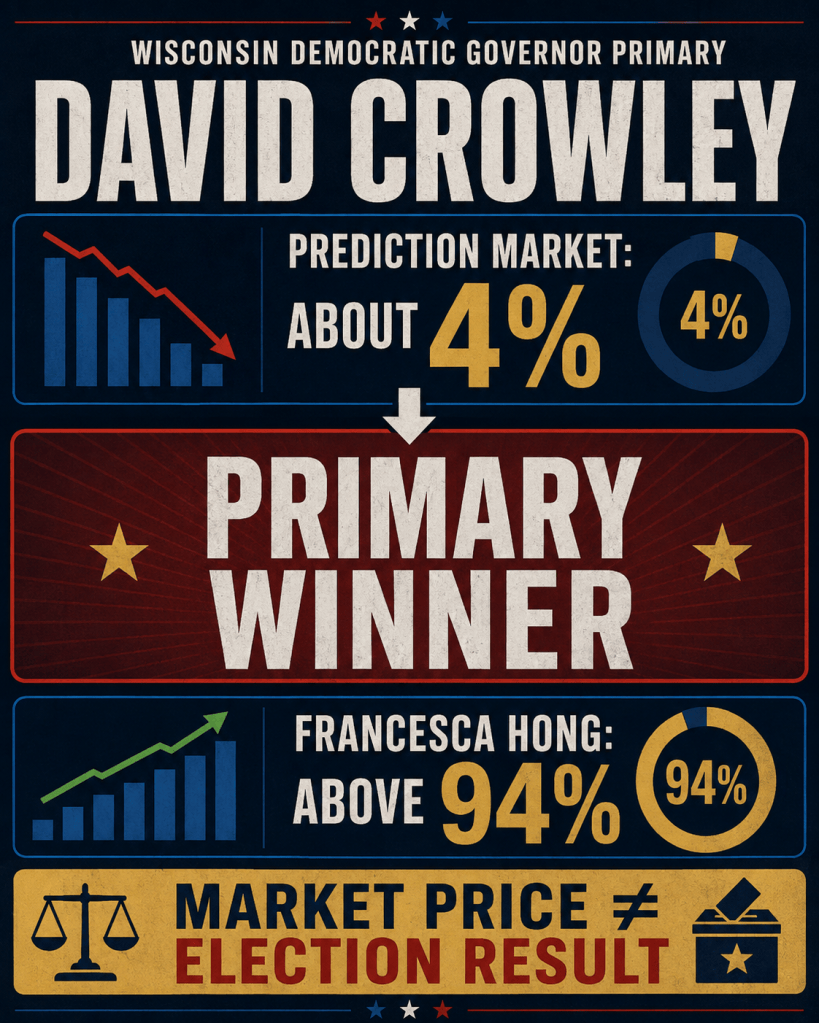
“Prediction markets aren’t surveys of voters. They’re markets measuring what traders think voters will do.”
Markets don’t always miss. In Michigan’s August Senate primary, both platforms correctly favored Abdul El-Sayed over Rep. Haley Stevens throughout the final stretch — though early election-night vote drops briefly pushed his implied odds above 99 percent before the race tightened to the roughly one-point margin that ultimately decided it.
Analysts are also flagging possible systematic patterns in market pricing, though none of this is settled. Pollster Patrick Ruffini has cited outside analysis finding markets tend to favor incumbents regardless of party, and to underprice female candidates specifically in Democratic primaries — both described as preliminary findings, not established conclusions. Separately, Ruffini has pointed to his own observation of election-night trading in California’s and Wisconsin’s 2026 primaries, where he says unsophisticated traders overreacted to early, favorable-looking vote drops and temporarily pushed odds for progressive-aligned candidates higher than final results ultimately supported — the opposite problem from underrating them. Markets also create a direct financial incentive that plain polling doesn’t: a single thinly-sourced “poll” can move real money on a market before it can be verified, which Ruffini has suggested as a plausible motive for some fabricated releases this cycle.
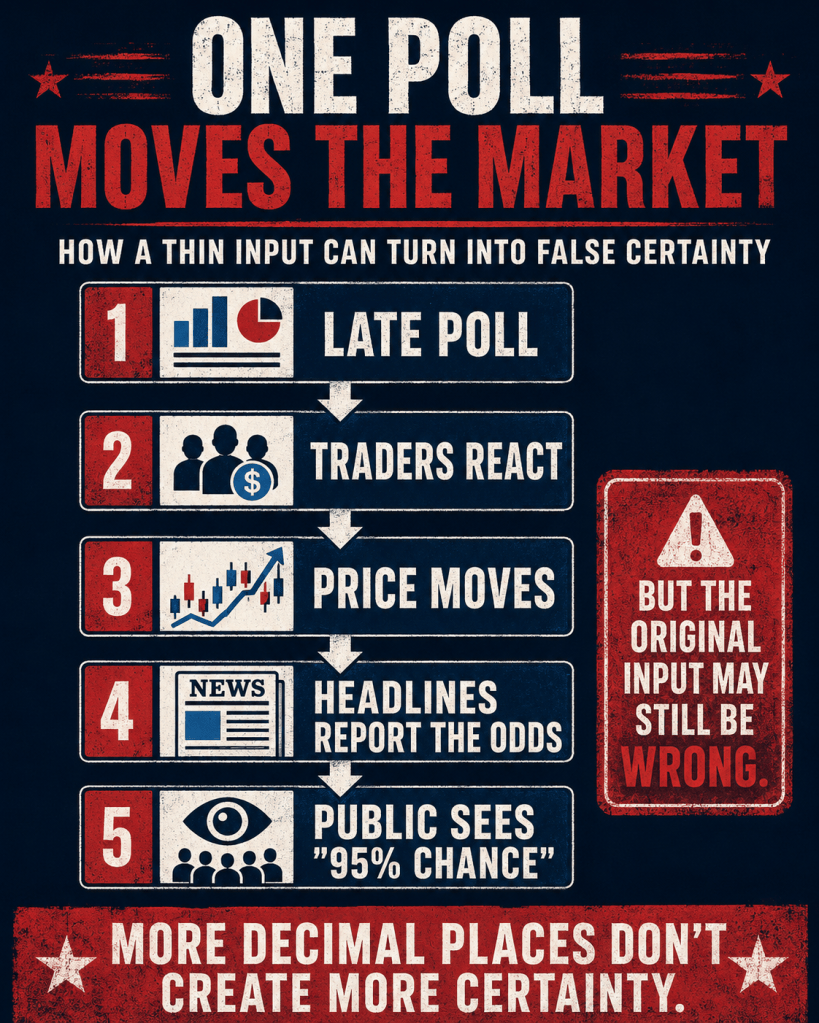
“A number becoming a market price doesn’t make the underlying information more reliable.”
What Election Desk does with this data
Consistent with our standing sourcing rules, Election Desk does not treat any single poll or market price as a definitive predictor. Partisan and campaign-sponsored polls are named and excluded from blended figures. When outlets or trackers repeat identical numbers, that’s treated as a sign of syndication, not independent confirmation — the original source is what matters. Where credible surveys conflict and can’t be reconciled, we widen the range we report or note the disagreement explicitly rather than asserting a false precision.
Ahead
Fake-polling operations gained enough attention this month that mainstream poll aggregators say they’re re-examining intake standards for including new or unaccredited pollsters. Prediction markets face their own scrutiny: multiple state regulators and the CFTC have ongoing disputes with Kalshi over its legal status for offering election contracts, a separate process question Election Desk has covered and will continue to track as it develops. Neither fight is likely to resolve before November.
“When credible data conflicts, uncertainty is information too.”
Sourcing note: Reporting on Median Strategies is drawn from Associated Press and Poynter coverage and the firm’s statement to the Los Angeles Times. Reporting on The Public Sentiment Institute reflects both FiftyPlusOne’s public findings and TPSI’s on-record denial to The Hill; because the two accounts conflict, both are presented and neither is asserted as fact. Prediction-market figures for the Wisconsin and Michigan primaries come from Newsweek’s reporting citing Kalshi and Polymarket data and from Polymarket’s own resolved-market pages; the New York City figure is drawn from contemporaneous market-tracking coverage of that primary and has not been independently verified against Kalshi’s or Polymarket’s own archived pricing. Commentary on market bias patterns is attributed to pollster Patrick Ruffini and the analysts he cites, and is presented as preliminary analysis, not as an established finding. All primary election results cited are based on official or AP-projected outcomes.
For more process-focused coverage of the 2026 midterms, visit the Election Desk overview page.


Leave a Reply