

Massachusetts voters went to the polls September 1 to set the field for November’s general election, headlined by a closely watched Democratic Senate primary between longtime incumbent Ed Markey and U.S. Rep. Seth Moulton. Markey won decisively. Down-ballot, Republicans picked a self-funded gubernatorial nominee to challenge Gov. Maura Healey, and Democrats sorted through crowded fields for an open U.S. House seat and two county district attorney posts. Polls closed at 8 p.m. ET, and the Associated Press had called most contested races by late evening — with the exception of a closely fought Norfolk County DA primary, not projected until the following morning.
U.S. Senate: Markey defeats Moulton
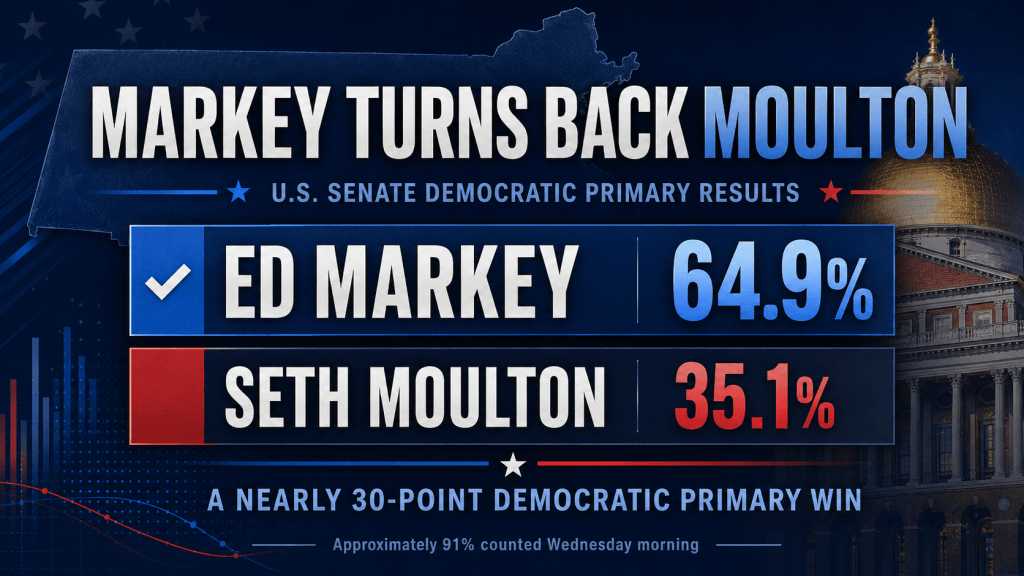
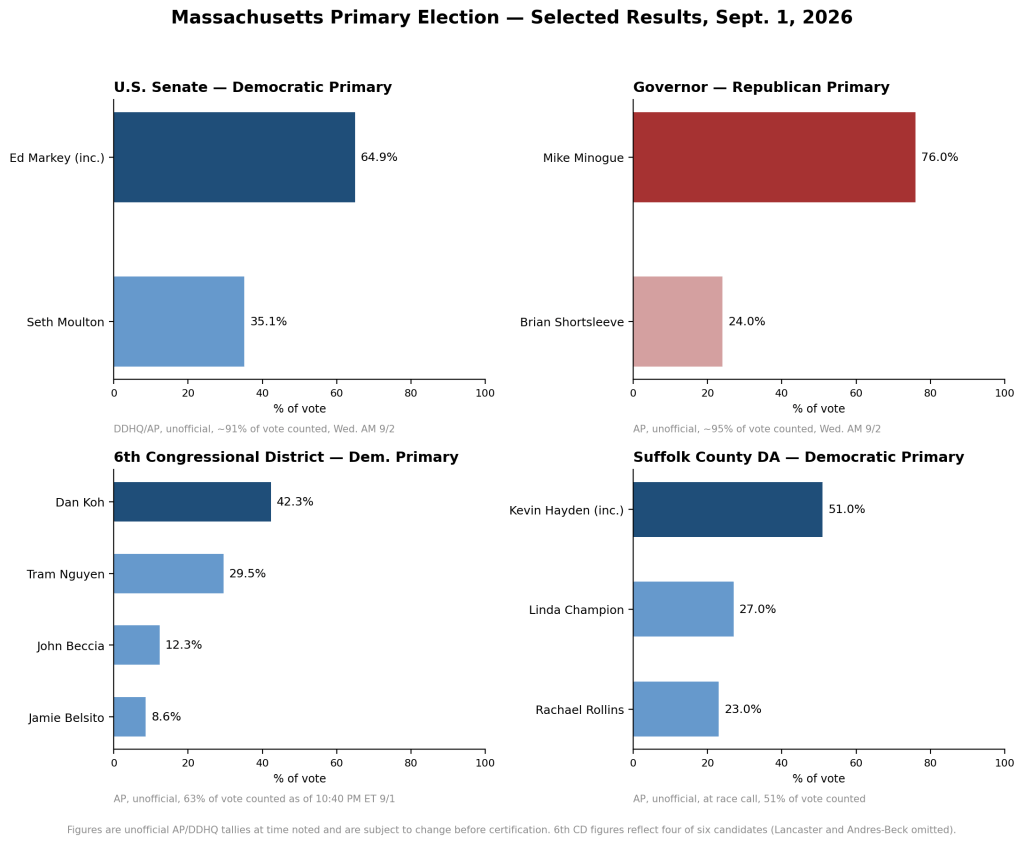
The Associated Press called the Democratic Senate primary for Sen. Ed Markey at 8:31 p.m., just after polls closed, based on pre-election and early vote data. Markey’s margin held steady through the night: he led 65%-35% with about a third of the vote counted around 9:45 p.m., and with roughly 91% of the vote counted by Wednesday morning, Decision Desk HQ figures showed him at 64.9% to Moulton’s 35.1% — a nearly 30-point win.
Moulton, a six-term congressman from the 6th District, built his campaign around generational change, arguing that the 80-year-old Markey was no longer suited to the job. Markey countered by emphasizing his seniority on the Commerce, Health, and Environment and Public Works committees and his record on climate policy, including his role co-authoring the Green New Deal resolution. Pre-election polling — including a final Emerson College survey putting Markey ahead 60%-33%, and an August UMass Amherst survey that showed him leading 60%-32% among likely Democratic primary voters, with 82% of Democrats approving of his job performance — had signaled a wide margin, and the result tracked closely with those numbers.
Speaking to supporters in downtown Boston, Markey framed the win as validation from the party’s younger and more progressive wing. Moulton conceded shortly after the race was called, telling supporters gathered in Dorchester that he had called Markey to congratulate him and pledging support “this November to protect our democracy.”
Markey advances to face Republican John Deaton, an attorney who ran unopposed in the GOP primary, in the general election.
“Markey’s nearly 30-point victory closely tracked the polling that had shown Moulton’s generational-change argument failing to break through.”
Governor: Minogue wins Republican nomination
Gov. Maura Healey, seeking a second term, ran unopposed in the Democratic primary and advances to November alongside Lt. Gov. Kim Driscoll, who also ran unopposed.
On the Republican side, Mike Minogue — a former medical device company executive who has put more than $15 million of his own money into the race — defeated Brian Shortsleeve, a former top official in Gov. Charlie Baker’s administration and at the MBTA. Minogue had been the front-runner since winning about 70% support at the state GOP convention in April, and he declined to debate Shortsleeve during the primary. The AP called the race for Minogue at 8:44 p.m.; with about 95% of the vote counted by Wednesday morning, unofficial results showed him leading 76%-24%.
Shortsleeve conceded and endorsed Minogue, saying in a statement that “now is the time to come together.” The two had clashed over abortion policy — Shortsleeve has described himself as a “pro-choice Republican,” while Minogue opposes abortion rights — though both said they voted for President Trump in 2024 and share positions on taxes and immigration enforcement.
Minogue will face Healey in November. Massachusetts Republicans have won the governor’s office more often than not in recent decades — including Baker, Mitt Romney, Paul Cellucci and William Weld — but have not won a U.S. Senate race in the state since 2010, and Healey enters the general election as the favorite.
“Minogue spent heavily, dominated the state GOP convention and emerged from the primary with roughly three-quarters of the Republican vote.”

6th Congressional District: Koh wins crowded Democratic field
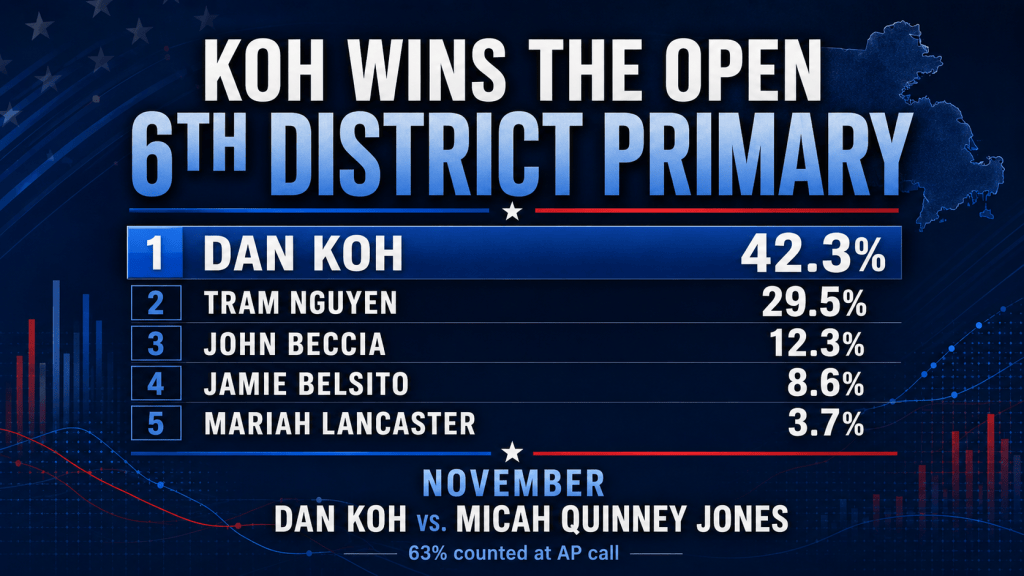
With Moulton vacating his 6th District seat to run for Senate, six Democrats competed for the open nomination. Dan Koh, a former chief of staff to Boston Mayor Marty Walsh and a Biden White House aide, led the field with primary-night endorsements from several nationally known Democrats. The AP called the race for Koh at 10:27 p.m. With 63% of the vote counted, unofficial results showed Koh at 42.3%, followed by state Rep. Tram Nguyen at 29.5%, financial-technology executive John Beccia at 12.3%, former state Rep. Jamie Belsito at 8.6%, and Mariah Lancaster (who ended her campaign three days before the primary and endorsed Nguyen but remained on the ballot) at 3.7%; software engineer Bethany Andres-Beck rounded out the field. Nguyen conceded Tuesday night.
Koh’s campaign was the best-funded in the field. Nguyen drew support from Democratic Reps. Lori Trahan and Ayanna Pressley, and an endorsement from the Boston Globe editorial board. Koh will face Republican Micah Quinney Jones in November in the district, which covers Massachusetts’ northeastern corner from Salem to Amesbury.
“With Seth Moulton leaving Congress to challenge Markey, Dan Koh turned a six-way Democratic primary into a decisive win.”
Other U.S. House primaries
Two other Massachusetts Democratic incumbents faced primary challengers Tuesday, both framed in national coverage as tests of intra-party sentiment on seniority and generational change.
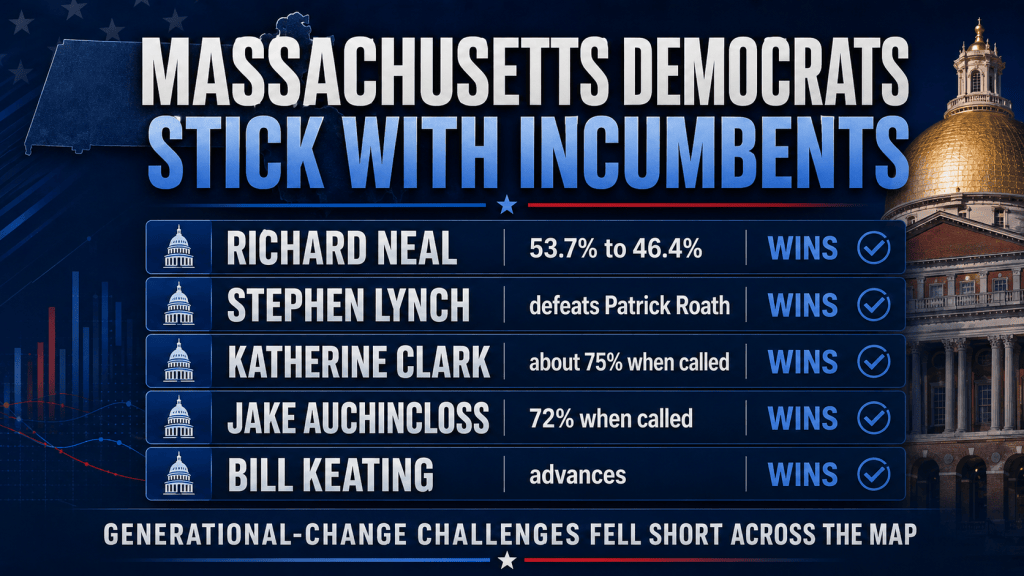
In the 1st District, Rep. Richard Neal — first elected in 1988 — defeated challenger Jeromie Whalen, a high school teacher, 53.7% to 46.4%, according to results reported by the AP. Neal will face two independent candidates in November; no Republican is on the ballot.
In the 8th District, Rep. Stephen Lynch defeated progressive challenger Patrick Roath, a former aide to Gov. Deval Patrick who campaigned on the argument that a changing district needed different representation. The AP called the race for Lynch, the third-longest-tenured member of the Massachusetts delegation behind Neal and Rep. Jim McGovern (who ran unopposed).
“Massachusetts Democrats heard multiple arguments for generational change Tuesday — and repeatedly chose incumbency instead.”
Three other Massachusetts Democratic incumbents turned back primary challengers Tuesday. House Minority Whip Katherine Clark won a three-way primary against Tarik Samman and Jonathan Paz; the AP called the race around 9:30 p.m., with Clark carrying about 75% of the vote as it was called. Rep. Jake Auchincloss defeated challenger Jason Poulos, leading 72% of the vote as the AP called that race with 37% counted. Rep. Bill Keating also advanced to November, where he’ll face Republican R. Tyler MacAllister; the AP called his race at 9:50 p.m.
District attorney races: Hayden holds on in Suffolk, Perkins wins closely fought Norfolk race
Suffolk County: Incumbent District Attorney Kevin Hayden defeated two challengers — attorney Linda Champion and former Suffolk DA and U.S. Attorney Rachael Rollins — in the Democratic primary. The AP called the race at 11:52 p.m. with 51% of the vote counted, showing Hayden at 51%, Champion at 27% and Rollins at 23%. No Republican is running, making Hayden the heavy favorite in November.
“The night’s closest major contest was not for Congress or statewide office, but for Norfolk County district attorney.”
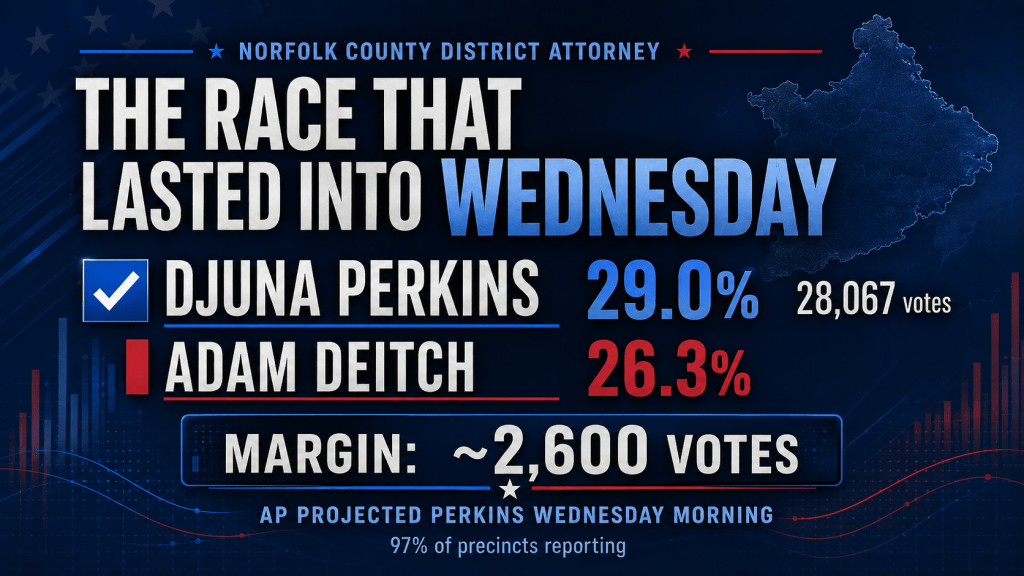
Norfolk County: The seven-way Democratic primary to succeed retiring DA Michael Morrissey stayed too close to call for most of election night before the AP projected attorney Djuna Perkins the winner Wednesday morning. With 97% of precincts reporting, Perkins led with 29% of the vote (28,067 votes) to former federal prosecutor Adam Deitch’s 26.3% — a margin of roughly 2,600 votes. Gregory Connor, a top deputy to Morrissey, ran third at 14.8%, followed by Macy Lee, Robert Jubinville, Jim Barakat and Craig MacLellan. Deitch conceded and congratulated Perkins Wednesday morning.
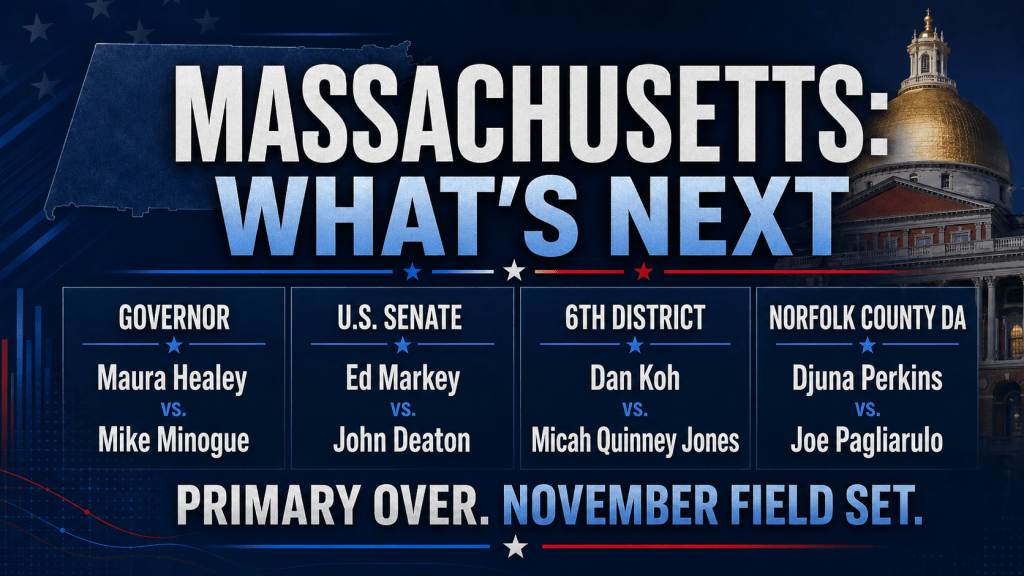
The race drew unusual attention over candidates’ positions on the Karen Read prosecution: Deitch, who led the federal investigation into the case, was backed by Read and her legal team, while Connor was endorsed by members of victim John O’Keefe’s family. Perkins, a former assistant attorney general and assistant DA in Suffolk County, launched her campaign in 2024 shortly after the arrest of former Stoughton police detective Matthew Farwell in the death of Sandra Birchmore. She will face independent candidate Joe Pagliarulo in November; no Republican is running.
Ahead
November’s general election will pit Healey against Minogue for governor and Markey against Deaton for Senate, alongside contested U.S. House races — including the 6th District, where Koh will face Republican Micah Quinney Jones — and both district attorney contests, where Hayden and Perkins enter as heavy favorites in the absence of Republican opponents. Tuesday’s results remain unofficial pending certification by the Secretary of the Commonwealth’s office.
Sourcing note
Vote totals and percentages in this article are unofficial figures reported by the Associated Press or Decision Desk HQ and are subject to change before state certification. Because primary-night tallies shift as precincts report, this article uses the most complete count available as of Wednesday morning, September 2 (generally 91%–97% of expected votes) rather than earlier election-night snapshots, except where an earlier figure is cited specifically to show how a count moved over the course of the night (for example, the Senate primary’s 65%-35% margin at roughly a third of the vote counted, ahead of its near-final 64.9%-35.1% split). Norfolk County DA figures reflect the AP’s projection and count as of Wednesday morning; that race remained too close to call for most of election night. This piece will be updated if certified results differ materially from the figures reported here.


Leave a Reply