
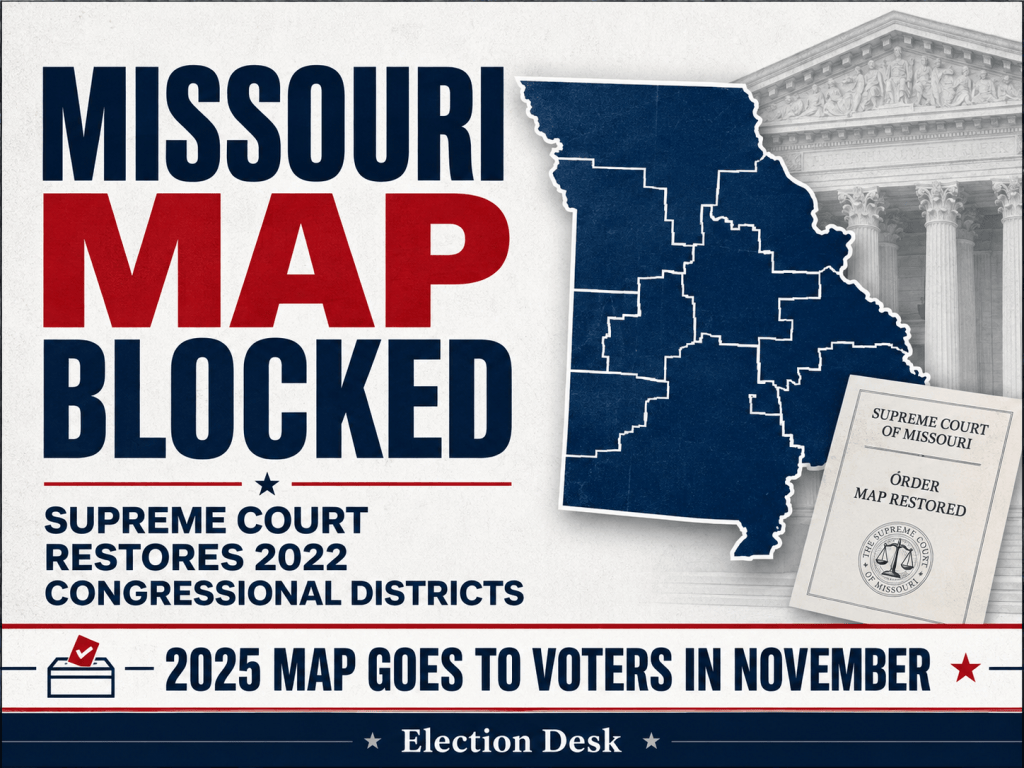
The Supreme Court of Missouri ruled unanimously on September 3 that the state’s 2025 congressional redistricting plan cannot be used in this year’s general election, ordering Secretary of State Denny Hoskins to revert to the district lines Missouri has used since 2022 while a voter referendum on the new map proceeds to the November ballot.
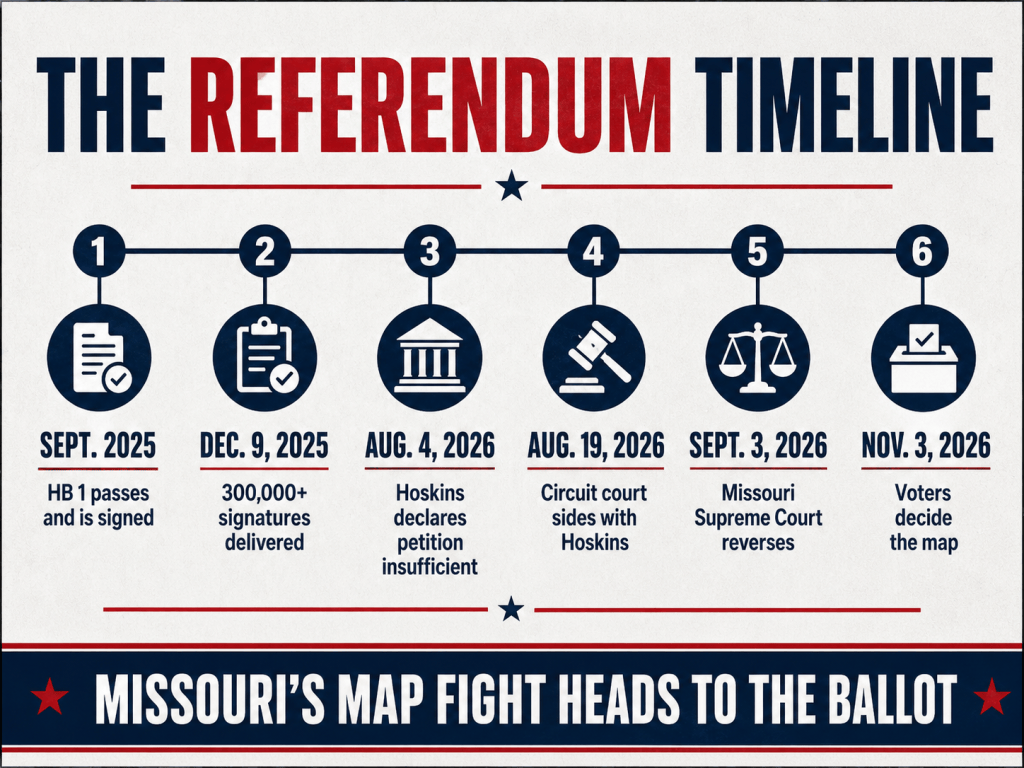
The decision, written by Judge Ginger Gooch in Von Glahn v. Hoskins (No. SC101805), reverses an August 19 ruling from Cole County Circuit Judge Daniel Green, who had upheld Secretary of State Denny Hoskins’s certification that the referendum petition was insufficient. The Supreme Court disagreed, holding that the Missouri Constitution’s referendum provision applies to “any act of the general assembly” and contains no carve-out for congressional maps. The opinion states “all concur,” and the court barred further motions for rehearing, making the ruling final immediately.
Background
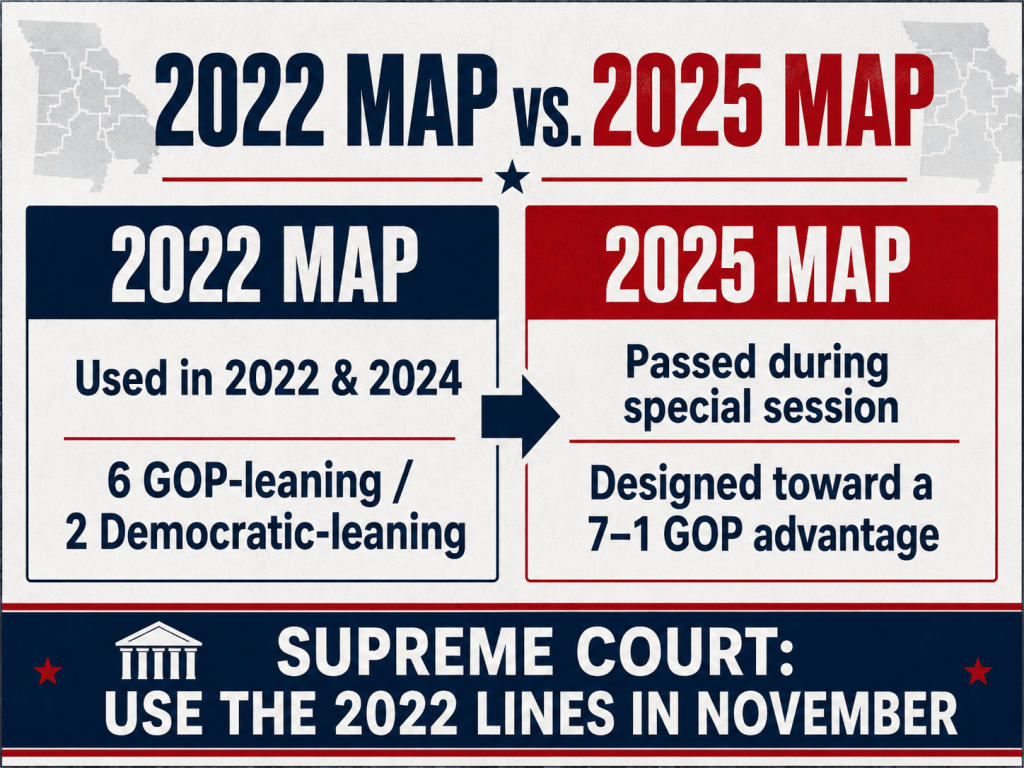
Missouri lawmakers passed the new map, House Bill 1, during a second extraordinary legislative session, with the General Assembly giving final passage on September 12, 2025, and Gov. Mike Kehoe signing it into law on September 28. The map redrew the state’s eight congressional districts to create a 7-1 Republican-leaning delegation in place of the previous 6-2 split. The remap targeted Kansas City-area Democratic Rep. Emanuel Cleaver’s 5th District, redrawing it so that Donald Trump would have carried it by more than 17 points based on 2024 results; Cleaver won his current district by nearly 24 points that same year.
Organizers led by Richard von Glahn, executive director of the group People Not Politicians, submitted a referendum petition for circulation in late September 2025 and, on December 9, 2025, delivered 691 boxes of signatures to the Secretary of State’s office — more than 300,000 in total, roughly three times the number required. Under state law, Hoskins had until August 4, 2026 — the same day as Missouri’s primary election — to certify whether the petition was sufficient. He waited until about an hour before that deadline to act, issuing a “Certificate of Insufficiency” stating that the Missouri Constitution does not authorize a referendum on congressional redistricting passed by the General Assembly. Von Glahn sued the same day, and the Supreme Court later transferred the case to itself on its own motion, bypassing the Court of Appeals, “because of the general interest and importance of the legal issue involved.”
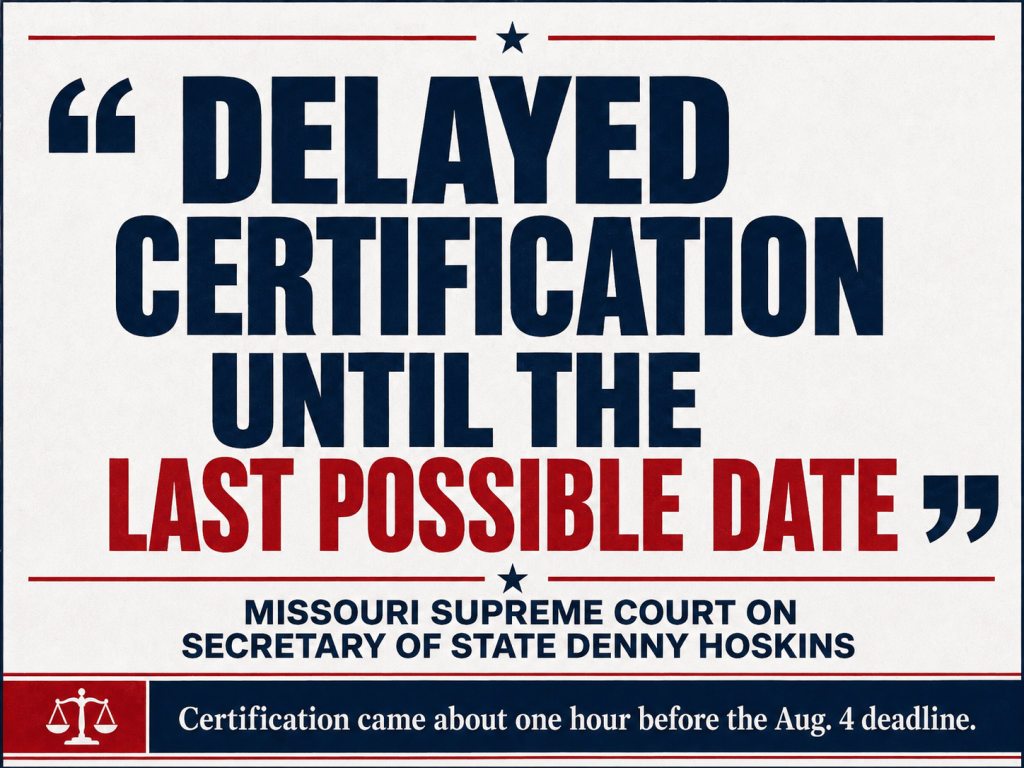
“Hoskins ‘delayed certification until the last possible date.’”
What the court decided
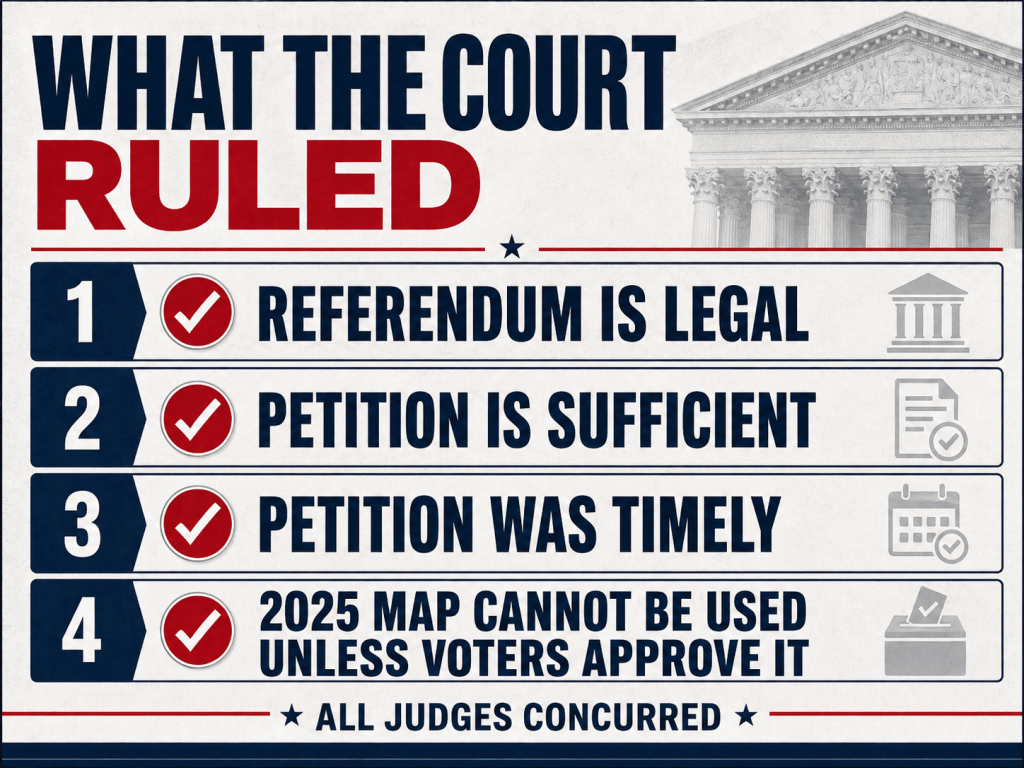
Writing for a unanimous court, Gooch held that the referendum petition was “legal, sufficient, and timely” because the state constitution’s default referendum language covers redistricting legislation absent an explicit exception, and none exists in the text. The court also noted that Hoskins’s certificate cited only the Missouri Constitution as grounds for rejecting the petition; any additional arguments he raised elsewhere, including under federal law, were “waived and abandoned” because they weren’t included in the certificate itself. The ruling reverses Green’s judgment and orders Hoskins and “all of those acting in concert with him” not to implement HB 1’s map for the November 2026 general election, or at any point thereafter, unless voters approve it at that election.
The opinion is notably pointed about Hoskins’s timing. The court wrote that a federal district judge had told Hoskins as early as December 2025 that he had the authority to declare the petition insufficient on the same legal theory he ultimately used, and that the Missouri Supreme Court itself had twice indicated in May that HB 1’s status would remain unresolved until Hoskins certified the petition. Despite that, the opinion states, Hoskins “delayed certification until the last possible date” — about an hour before the statutory deadline, which fell on primary day — while continuing to use the 2025 map in the interim. The court called his subsequent arguments about resulting voter confusion and election costs “wholly unpersuasive” given that his own delay caused them.
The court called Hoskins’ arguments about voter confusion and election costs “wholly unpersuasive.”
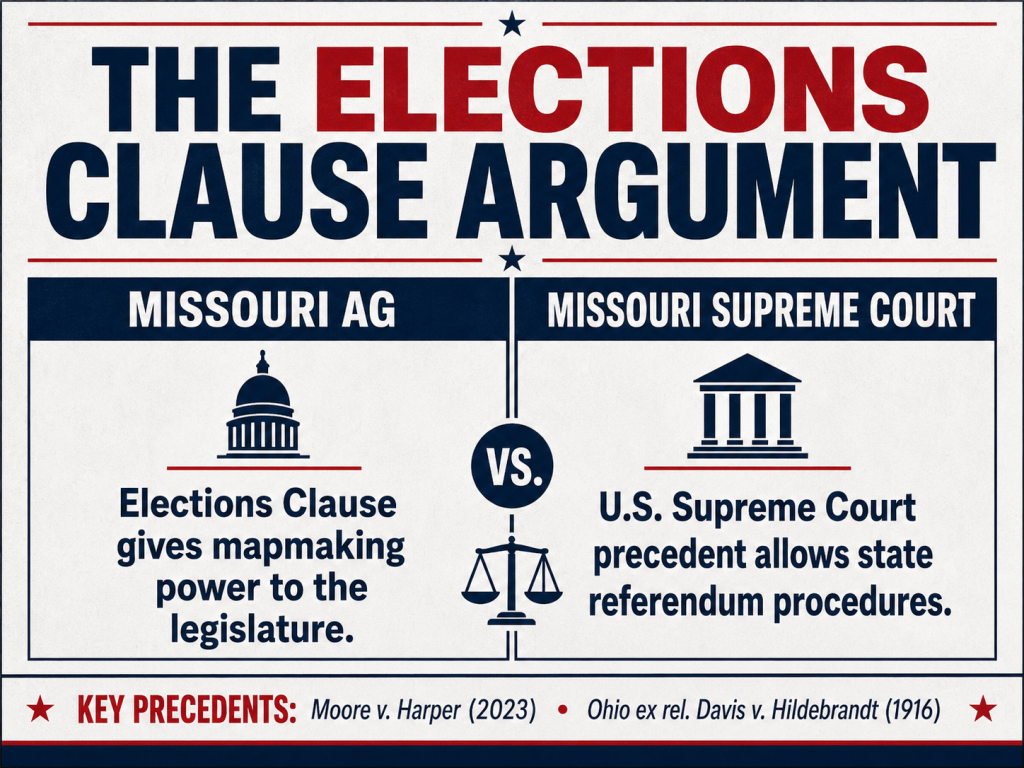
The opinion also anticipates the federal argument Missouri’s attorney general has said she will bring to the U.S. Supreme Court. Citing the Supreme Court’s 2023 ruling in Moore v. Harper and a 1916 precedent, Ohio ex rel. Davis v. Hildebrandt, the court noted the U.S. Supreme Court has repeatedly held that the federal Elections Clause does not bar states from subjecting congressional maps to a referendum.
The Elections Clause does not give state legislatures an unchecked power to shield congressional maps from state referendum procedures.
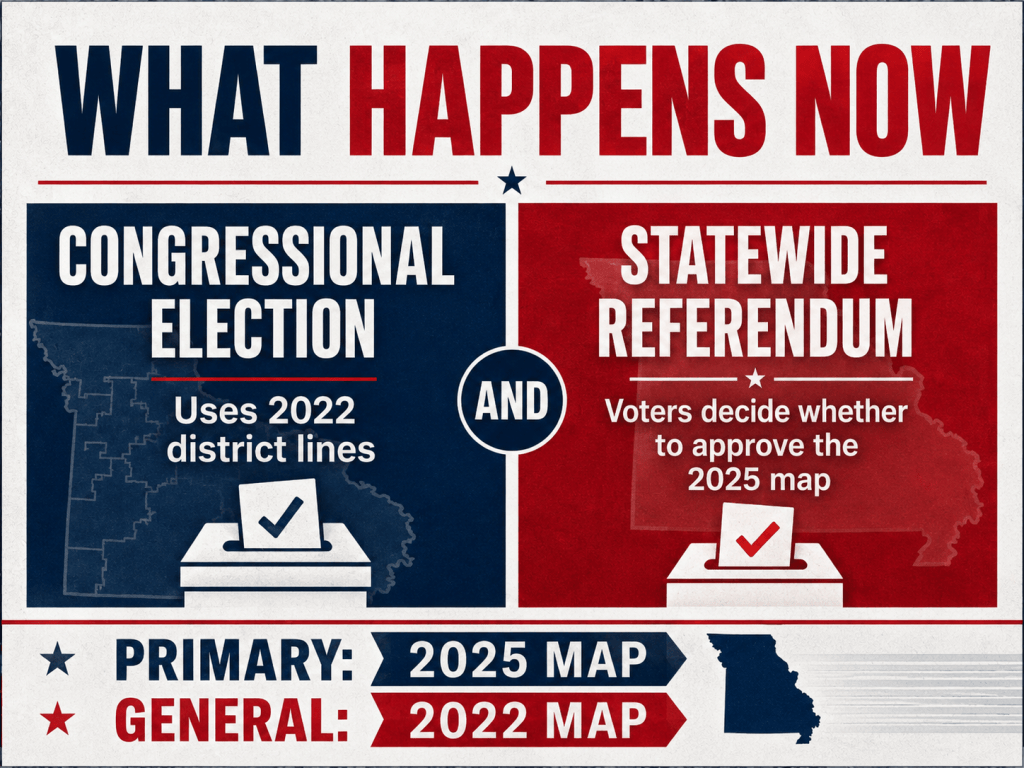
That means Missouri’s congressional elections this fall will proceed under the boundaries in place since 2022, affecting Districts 1 through 6, with the most significant shift back involving Cleaver’s district. The opinion itself notes, in a citation to a colleague’s dissent in a related case, that Missouri last used the referendum process on congressional redistricting in 1922 — making this the first time since then that a Missouri congressional map has gone before voters this way.
The ruling does not disturb the results of the August 4 primary, which was conducted under the now-suspended 2025 map. It will fall to the nominated candidates to decide how to respond to the restored district lines heading into November.
“The referendum petition was ‘legal, sufficient, and timely.’”
Reaction and next steps
Missouri Attorney General Catherine Hanaway said her office would seek emergency relief from the U.S. Supreme Court, arguing the ruling conflicts with the U.S. Constitution’s Elections Clause, which she contends assigns congressional map-drawing authority to state legislatures. Von Glahn, in a statement following the ruling, called the decision a validation of the referendum campaign and said it would be watched by redistricting fights in other states.
Missouri will vote in November on congressional lines while simultaneously electing members of Congress under the restored 2022 map.
The ruling caps a series of related cases before the Missouri Supreme Court this year. Earlier decisions upheld the governor’s authority to call a special legislative session for mid-decade redistricting and affirmed the legislature’s authority to revise congressional lines outside the normal decennial cycle. Thursday’s ruling addressed the remaining question of whether the resulting map could be subject to a referendum — and found that it could.
Sourcing note
This article is drawn directly from the Missouri Supreme Court’s opinion in Von Glahn v. Hoskins, No. SC101805 (Mo. banc, decided Sept. 3, 2026, Gooch, J., all concur), reviewed in full. All quotations, the procedural history (petition circulation, the December 9, 2025 signature filing, the August 4, 2026 certification and lawsuit, the August 19 circuit court ruling, and the discretionary transfer to the Supreme Court), the court’s characterization of Hoskins’s certified rationale and the timing of his certification, and the citations to Moore v. Harper and Ohio ex rel. Davis v. Hildebrandt come from the opinion itself. The September 12, 2025 passage date and the reference to Missouri’s 1922 use of the referendum process on redistricting are also drawn from the opinion’s text and footnotes.


Leave a comment