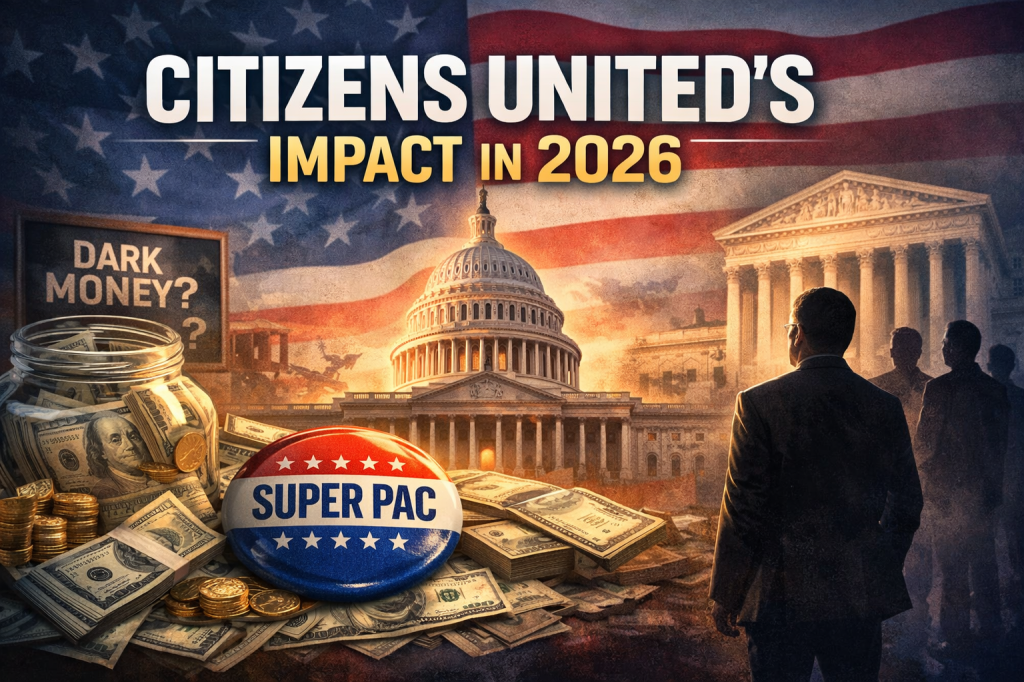
On January 21, 2010, a deeply consequential Supreme Court decision fundamentally altered the landscape of campaign finance in the United States. In Citizens United v. Federal Election Commission (FEC), the Court held that restrictions on corporate independent political expenditures violated the First Amendment, effectively permitting corporations, unions, and other groups to spend unlimited funds to influence federal elections. More than 15 years later, the ruling continues to reverberate through the 2026 election cycle, reshaping political power, campaign finance dynamics, and the very meaning of democratic participation.
The Core of Citizens United
The Supreme Court’s 5–4 majority concluded that government limits on independent political spending by corporations and other entities were unconstitutional. The ruling overturned decades of campaign finance restrictions, including portions of the Bipartisan Campaign Reform Act, and rejected the idea that such expenditures posed a grave risk of corruption if disclosed promptly.
Proponents argued that the decision expanded free speech, allowing more voices into the political discourse. Critics warned that it would concentrate political influence among wealthy interests and diminish ordinary voters’ voices. In the years since, many of the assumptions underpinning the decision—particularly the belief that spending would remain “independent” and transparent—have been challenged by real-world developments.
Super PACs and Unlimited Spending
One of the most significant outcomes of Citizens United was the rise of super PACs—independent political committees that can raise and spend unlimited contributions from corporations, unions, and wealthy donors to influence elections. These entities cannot coordinate directly with candidates, in theory, but in practice have become key components of modern campaigns.
By the 2024 campaign, outside spending through super PACs and related groups reached record levels. Wealthy special interests poured hundreds of millions of dollars into advertising, ground operations, and voter outreach efforts, in some cases substituting for traditional campaign activities previously handled by the candidates themselves.
The Shadow of Dark Money
Although super PACs are required to disclose their donors, dark money organizations operate with little to no transparency. These nonprofit groups can funnel political spending through intermediaries, obscuring the original sources of funds. In 2024, dark money played a significant role in federal elections, with hundreds of millions of dollars funneled into political messaging without clear disclosure of the true donors behind it.
Campaign Legal Center highlights how dark money can undermine voters’ ability to make informed choices, noting that contributions reported by super PACs often originate from closely affiliated shadow groups whose backers remain hidden.
Coordination and Enforcement Challenges
Although Citizens United reaffirmed the importance of disclosure and forbidden coordination between outside groups and candidates, enforcement has been inconsistent. Investigations have identified schemes—such as “straw donor” arrangements and alleged illegal coordination—that exploit legal and regulatory gaps to conceal actual sources of influence.
At the same time, the Federal Election Commission (FEC), the agency charged with enforcing campaign finance laws, has been criticized for weakened oversight and partisan gridlock that hamper effective regulation. According to CLC, the agency’s inaction often allows coordinated activity or covert spending to go unchecked.
Contemporary Debates and 2026 Context
As the United States moves through the 2026 midterm cycle, the legacy of Citizens United intersects with ongoing legal and political debates. The Supreme Court is considering a separate case that could eliminate limits on coordinated party spending, a development that would further expand avenues for large donors and party committees to influence elections—potentially compounding the effects of Citizens United.
Meanwhile, lawmakers, advocates, and civil society groups continue to push for legislative reforms such as the DISCLOSE Act, aimed at expanding disclosure requirements, and measures to strengthen enforcement mechanisms. These efforts reflect enduring concerns that without structural changes, the influence of mega-donors and undisclosed political spending will continue to deepen.
Why Citizens United Still Matters
Today, Citizens United stands as more than a legal precedent; it represents the pivot point for modern campaign finance. By dismantling longstanding limits on independent expenditures, the Supreme Court empowered a new era of political spending dominated by wealthy individuals, corporations, and opaque funding channels. The effects are clear: escalating costs for political communication, increased influence for a narrow segment of society, and persistent challenges for transparency and electoral accountability.
In 2026, the conversation around Citizens United isn’t merely historical—it is a defining feature of how political power operates and how democracy responds under the pressures of money and influence.
 Election Desk
Leave a comment