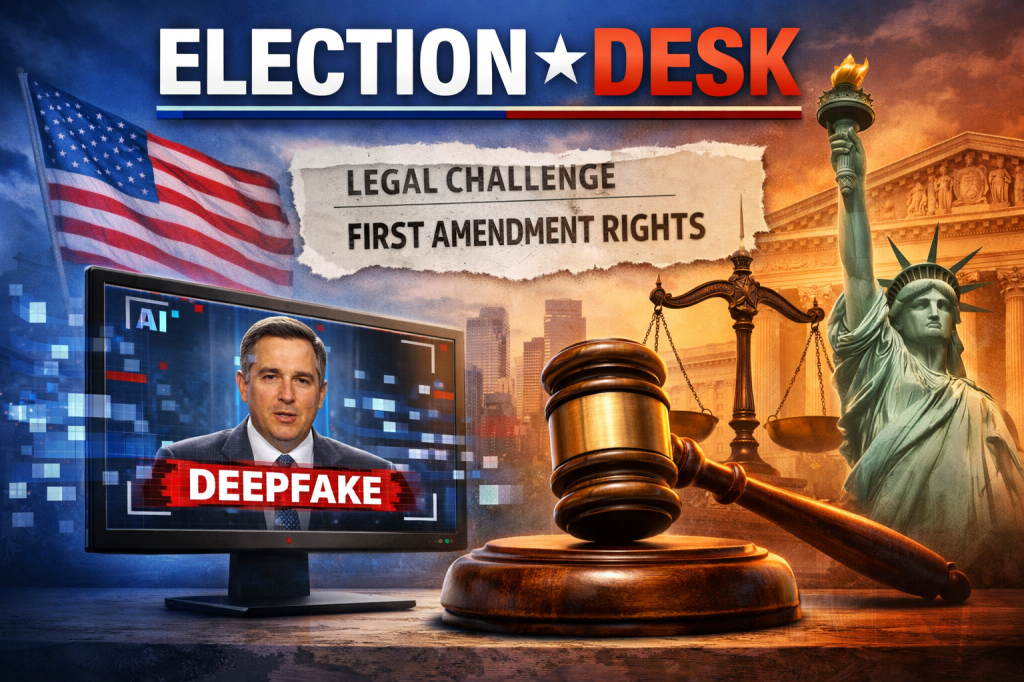
In a major decision with implications for election law and free speech in the digital age, a federal judge in Honolulu has ruled that Hawaii’s statute regulating AI-driven “deepfake” content in the context of elections is unconstitutional. The ruling, issued on January 30, 2026, permanently blocks enforcement of the law known as Act 191 and underscores the challenge of balancing legislative efforts to curb deceptive political content with fundamental First Amendment protections.
Background: Hawaii’s Deepfake Law
Act 191 was enacted in 2024 with the goal of limiting the spread of AI-generated or digitally altered media that could mislead voters during election seasons. The statute targeted what it defined as “materially deceptive media” involving candidates or ballot issues — content that might lead a reasonable person to believe that an individual said or did something that, in fact, did not occur. Under the law, distributing such content “recklessly” could expose individuals to criminal penalties. A safe harbor was provided for content that included specific disclaimers, and certain media outlets and service providers were exempted.
Supporters of Act 191 argued that it was a necessary response to the rapid evolution of artificial intelligence tools capable of generating realistic but fabricated audio, video, and imagery which could distort public perception and influence elections.
Court’s Decision: First Amendment Violations
In The Babylon Bee LLC v. Lopez, U.S. District Judge Shanlyn A.S. Park, a Biden appointee, concluded that the law infringed on core political speech protected by the First Amendment. The lawsuit was brought by The Babylon Bee, a widely read satirical publication, together with a Hawaii resident.
Judge Park held that Act 191 was “presumptively invalid” because it imposed content-based restrictions on speech tied to electoral topics — a category at the heart of First Amendment protection. She found that the statute discriminated based on both subject matter and speaker, thereby triggering the highest level of constitutional scrutiny (“strict scrutiny”).
Importantly, the court rejected the state’s argument that required disclaimers could cure constitutional issues. The judge noted that forced disclaimers would fundamentally alter the meaning and impact of expressive content, especially satire or parody, undermining its expressive purpose.
Vagueness and Enforcement Concerns
Beyond content discrimination, the ruling emphasized that Act 191’s definition of prohibited conduct was impermissibly vague. By focusing on the “risk of harm” to a candidate’s reputation or electoral prospects rather than actual falsehoods or demonstrable harm, the statute placed enforcement decisions in the hands of prosecutors and agencies without clear, objective standards. This ambiguity, Judge Park wrote, risked arbitrary or discriminatory enforcement and could have a chilling effect on political speech.
State’s Interests Versus Free Speech
While acknowledging Hawaii’s legitimate interest in safeguarding election integrity against sophisticated disinformation, the court concluded that Act 191 was not narrowly tailored to serve that interest. The state had alternative means available, including counter-speech strategies, public education initiatives to improve digital media literacy, and enforcement of existing laws — such as those governing fraud or defamation — that do not curtail protected expression.
Broader Implications
The decision leaves Hawaii without a specialized legal tool to address deepfake content ahead of the 2026 election cycle and may influence other states considering similar measures. It follows comparable litigation in California, where an anti-deepfake statute also faced judicial challenges.
Legal scholars and advocates will likely view this ruling as a critical test of how traditional free speech doctrines apply to emerging technologies. As generative AI continues to evolve, courts will play a pivotal role in determining how to confront the risks of digitally fabricated media without undermining constitutional liberties.
Conclusion
The Hawaii deepfake law ruling reinforces the strength of First Amendment protections, even as policymakers wrestle with the novel challenges posed by AI and disinformation. It highlights the delicate balance between preventing deception in the political sphere and preserving the open exchange of ideas that is central to American democracy.


Leave a comment