
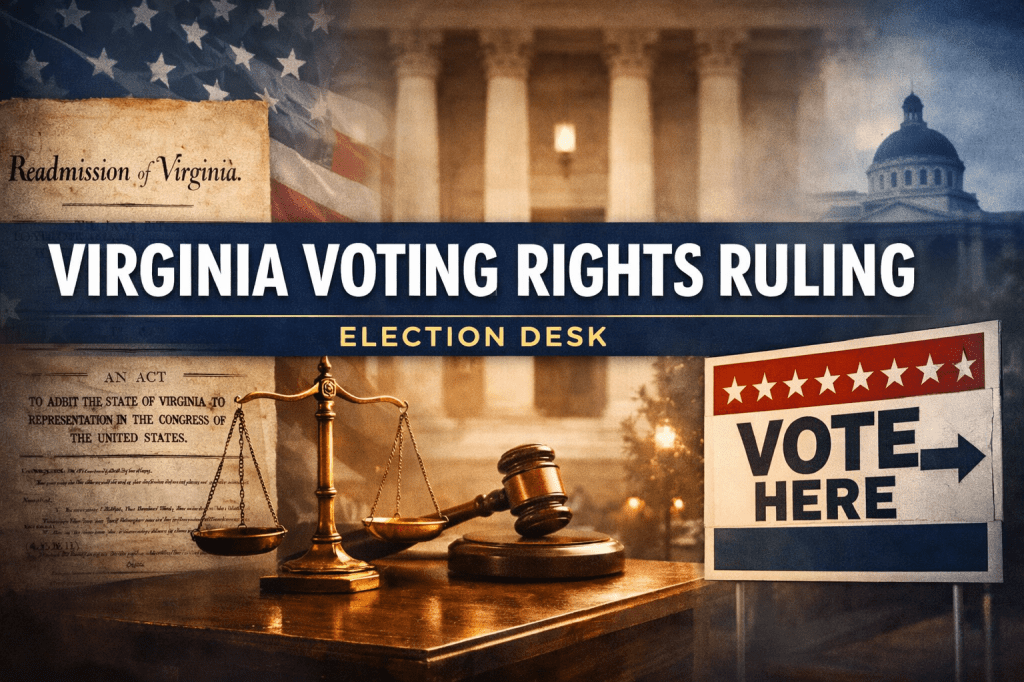
A federal judge has blocked key elements of Virginia’s recent voting restrictions, ruling that the state likely violated federal law by imposing new barriers on voter eligibility and participation. In doing so, the court revived a rarely cited Reconstruction-era statute—the Virginia Readmission Act of 1870—underscoring how unresolved post-Civil War protections continue to shape modern election law.
The decision marks a significant development in the ongoing legal battles over voting access ahead of the 2026 election cycle.
The Ruling
U.S. District Judge Henry E. Hudson ruled in favor of plaintiffs challenging Virginia’s enforcement of new voter eligibility restrictions that disproportionately affected individuals with past felony convictions. The case was brought by civil rights groups including the American Civil Liberties Union, arguing that Virginia’s policies conflicted with federal law governing the state’s readmission to the Union after the Civil War.
Judge Hudson found that the plaintiffs were likely to succeed on the merits and granted injunctive relief, temporarily blocking enforcement of the challenged provisions.
Why the 1870 Readmission Act Matters
Virginia, like other former Confederate states, was readmitted to Congress under specific conditions following the Civil War. The Virginia Readmission Act of 1870 required the state to comply with federal protections for voting rights, particularly for formerly enslaved individuals and their descendants.
While many states have argued that such conditions are obsolete or superseded, the court rejected that view—at least at this stage of the litigation—holding that Congress never repealed those requirements.
In short: the obligations imposed on Virginia in 1870 may still be legally binding today.
A Rare but Powerful Legal Argument
Courts seldom rely on Reconstruction-era readmission statutes, but when they do, the implications are serious. Unlike constitutional amendments or modern voting laws, these acts function as conditional contracts between Congress and the states.
If upheld, the ruling suggests that states cannot unilaterally impose voting restrictions that undermine conditions attached to their original readmission—particularly where those conditions were designed to protect minority voting rights.
Broader Implications for Election Law
The case could have ripple effects beyond Virginia:
- Precedent risk: Other formerly Confederate states were readmitted under similar terms.
- Felony disenfranchisement challenges: States with restrictive restoration processes may face renewed scrutiny.
- Federal authority: The ruling reinforces Congress’s long-standing power to condition state participation in federal elections.
Election law experts note that while the case is likely to be appealed, the court’s willingness to revive Reconstruction-era protections signals a broader judicial openness to historical voting rights guarantees.
What Happens Next
Virginia officials are expected to appeal the ruling to the Fourth Circuit. In the meantime, the injunction remains in effect, potentially impacting voter eligibility determinations ahead of upcoming elections.
For voters and election administrators alike, the case highlights an often-forgotten truth: America’s voting rules are not only shaped by modern statutes and court decisions—but by unfinished legal business from the 19th century.
Legal Context: What Are Readmission Acts and Why They Matter
Readmission Acts were a set of Reconstruction-era federal statutes that governed how former Confederate states could be readmitted to representation in the U.S. Congress after the Civil War. For Virginia, Congress passed the Virginia Readmission Act of 1870, signed by President Ulysses S. Grant, allowing the state’s senators and representatives to take their seats only after it adopted a new constitution and met specific conditions. One key requirement was that Virginia’s constitution “shall **never be so amended or changed as to deprive any citizen or class of citizens of the right to vote” except for punishment for crimes that were “felonies at common law” as understood in 1870.
That 1870 language effectively limits the state’s ability to disenfranchise voters: modern crimes not classified as non-common-law felonies at that time — such as many drug offenses — cannot be used today as a basis for removing voting rights under the federal statute. This means a state constitutional provision like Virginia’s lifetime felony voting ban may conflict with a condition of Virginia’s historic readmission to Congress.
Readmission Acts are separate from but complementary to constitutional protections such as the Fifteenth Amendment, ratified in 1870, which prohibits denial of the vote based on race, color, or previous condition of servitude.
Why This Matters for the 2026 Elections
• Voting-rights restoration this cycle: If the court decision stands on appeal, hundreds of thousands of Virginians with past felony convictions may have their voting rights restored before the November 2026 election, reshaping turnout in competitive local and statewide races.
• Policy ahead of constitutional amendment vote: Virginians are scheduled to decide in 2026 on a constitutional amendment that would automatically restore voting rights to people after completion of their sentence and any related supervision, without requiring individual action.
• Broader legal precedent: A high-court affirmation of the Readmission Act argument could embolden similar challenges in other states with restrictive felony disenfranchisement laws, affecting national debates on voting rights ahead of the midterms.


Leave a comment