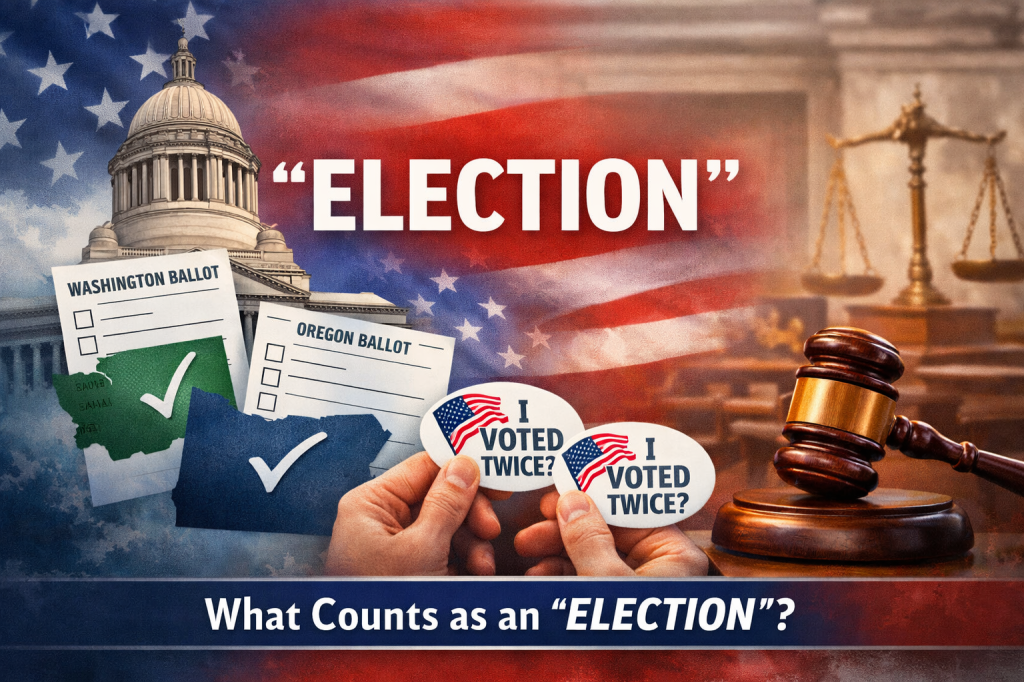
Washington state lawmakers are advancing legislation to define more precisely what constitutes an “election” under state law after an appellate court ruling raised questions about whether casting two ballots on the same day in different jurisdictions violates state voting prohibitions.
The issue emerged from a Lewis County case involving a voter who cast ballots in both Washington and neighboring Oregon during the November 2022 election. Prosecutors charged the man with voting twice — once in each state — but a Washington State Court of Appeals threw out the felony conviction. The majority held that because the ballots contained different candidates and issues, they represented distinct elections rather than a single election day.
Under current Washington law, it is a felony to vote more than once in any state election or to vote in a Washington election and in another state’s election. But the statute did not clearly define whether separate ballots with different candidates or measures on the same calendar date count as the same election. The appeals court said the statutory language was ambiguous, something one judge dissenting in the case disagreed with.
In response, legislators and Secretary of State Steve Hobbs have proposed Senate Bill 6084, aimed at eliminating ambiguity by explicitly defining “election” in Washington. Sponsored by Sen. Adrian Cortes (D-Battle Ground), the bill would clarify that a general, primary, or special election is considered the same election if it takes place on the same date — regardless of the particular offices, candidates or ballot measures at stake.
“If you live here, you vote here. You don’t get to vote anywhere else,” Cortes told lawmakers during a hearing, expressing surprise at the appellate ruling. The bill’s language would ensure that a ballot cast in Washington and one cast in another state on the same election day are treated as parts of the same election for purposes of prohibiting double voting.
If the legislation becomes law, its provisions would take effect promptly to provide clarity ahead of the 2026 general election cycle, which includes statewide, legislative and federal contests like the U.S. House and State Senate races scheduled for November 3, 2026.
Supporters argue that the change is necessary to uphold the integrity of Washington’s election statutes and to prevent loopholes that could undermine public confidence in the voting system. Critics — including some civil liberties advocates — may raise concerns about how broadly an election is defined and the potential for criminal penalties in ambiguous contexts, though no organized opposition has yet emerged publicly.
Under the proposal, casting more than one ballot in what is defined as the same election — including voting in Washington and another state on the same date — would remain a felony, punishable by up to five years in prison and a fine of up to $10,000.
Lawmakers are seeking to address the issue now rather than risk legal uncertainty during a high-turnout midterm year in which voter confidence and election administration are already under scrutiny nationwide.


Leave a comment