What is Section 2 of the Voting Rights Act?
Section 2 of the Voting Rights Act of 1965 is a federal law that makes it illegal for any state or local election practice to deny or abridge a person’s right to vote on account of race or color. Unlike other parts of the Act, Section 2 applies everywhere in the United States and has no expiration date. It lets voters challenge laws or voting maps in court if they have the effect of diluting minority voting strength.
Why is Section 2 important for elections?
Section 2 has been one of the primary tools for fighting discriminatory election laws since the Supreme Court’s 2013 decision in Shelby County v. Holder, which eliminated the pre-approval system that used to stop certain laws before they were put into effect. With that system weakened, voter advocates and communities have relied on Section 2 to challenge things like at-large election systems and unfair redistricting plans that minimize minority voters’ influence.
What is Louisiana v. Callais?
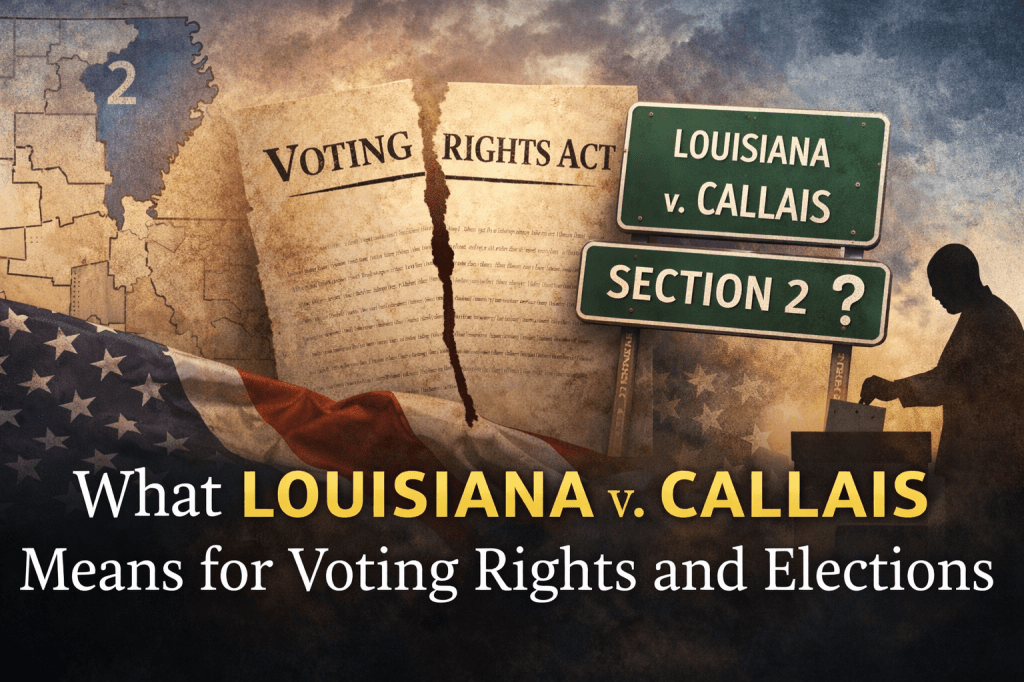
Louisiana v. Callais is a case currently before the U.S. Supreme Court over Louisiana’s congressional map. A federal court initially found that the map diluted the voting power of Black Louisianans and required creation of a second majority-Black district under Section 2. Louisiana adopted a new map with two majority-Black districts, but opponents challenged it as an unconstitutional racial gerrymander under the Constitution’s Equal Protection Clause. The Supreme Court heard this case twice and asked the parties to brief whether Section 2 itself, as applied, might conflict with the Constitution.
Why is the case a big deal for elections?
Although Callais started as a dispute over a specific map, the Supreme Court’s questions signal it is willing to revisit how Section 2 operates. If the Court rules that states cannot create districts to comply with Section 2 when race plays a role, or otherwise limits the scope of Section 2, that would weaken one of the key federal protections against racially discriminatory voting practices. That in turn could reshape redistricting rules nationwide, affect minority voters’ ability to elect preferred candidates, and limit federal enforcement options.
What happens next?
The Supreme Court has not yet issued its decision. Observers say the Court’s conservative majority seems open to limiting how Section 2 is used in redistricting cases, although it is unclear whether the statute itself will be struck down or simply narrowed in scope. Either outcome could change how election maps are drawn and challenged in federal courts.
State-by-State Summary: Section 2 Application in Election Map Litigation
Alabama
Federal courts found that Alabama’s 2021 congressional map diluted Black voting strength because it provided only one majority-Black district despite a sizable Black population. After successful litigation, a three-judge federal panel ordered the map redrawn to include a second majority-Black district. The Supreme Court upheld the use of the Section 2 framework from Thornburg v. Gingles (requiring showing racially polarized voting and denial of equal opportunity) in Allen v. Milligan.
Mississippi
A federal district judge ruled in 2025 that Mississippi’s existing election map for Supreme Court districts violated Section 2 because Black voters, despite making up about 40 % of the population, were systematically prevented from electing candidates of their choice under the current district design. The judge ordered the state to redraw the map.
Louisiana
Lower federal courts applying Section 2 found that Louisiana’s congressional map diluted Black voting power relative to the state’s roughly one-third Black population. The court ordered a second majority-Black district, leading to legislative changes and subsequent litigation now before the Supreme Court in Louisiana v. Callais about the constitutional limits of race considerations in map drawing.
Texas
The U.S. Department of Justice has sued Texas under Section 2, challenging congressional and state House maps as discriminatory. Although Texas litigation includes multiple claims, Section 2 vote-dilution challenges argue that minority voters’ ability to elect representatives of choice is abridged under enacted plans; similar principles have guided Section 2 litigation in redistricting across the state.
North Carolina
Although not a fully resolved Supreme Court case on Section 2, North Carolina’s vote-dilution law has been discussed in federal opinions about how minority populations that are less than 50 % of a district can still state a claim if they can demonstrate they could elect their preferred candidates under Gingles criteria.
Other States
Across the country, Section 2 challenges have been brought in a variety of states—including Georgia, California, and Arizona—typically in federal district courts arguing that legislative maps either dilute minority voting strength or fail to give minority communities an equal opportunity to elect preferred candidates. Federal courts apply the same analytical framework in each jurisdiction, focusing on Gingles preconditions and totality-of-circumstances analysis.
Federal Circuits and Interpretive Differences
There is also some federal circuit court variation in how Section 2 is interpreted, particularly around whether claims by multiple racial or language minority groups may proceed jointly. Circuits like the Fifth and Sixth have held narrower views on multi-group claims, while others, such as the Eleventh, allow them, illustrating emerging splits that may reach higher courts.
How Courts Evaluate Section 2 in Redistricting Cases
When reviewing alleged vote-dilution under Section 2 in any state, courts generally follow this approach:
- Gingles Preconditions: Plaintiffs must show a minority group is sufficiently large and geographically compact to form a majority-minority district, is politically cohesive, and that the majority votes sufficiently as a bloc to usually defeat the minority’s preferred candidates.
- Totality of Circumstances: Courts then examine historical discrimination, socioeconomic disparities, racially polarized voting, and other evidence showing whether the challenged map denies minority voters an equal opportunity to participate in the political process.
- Remedy: If liability is found, courts may order states to redraw maps or adopt alternative plans that provide minority voters with an opportunity to elect their preferred candidates without subordinating traditional redistricting principles like compactness or contiguity unless justified.
What This Means for Elections
Because Section 2 is applied in federal court, its substantive standards are generally consistent across states, but specific outcomes depend on local demographics and voting patterns. In states with concentrated minority populations and polarized voting, Section 2 challenges have led to additional majority-minority districts. Conversely, in states without such conditions, courts often uphold maps absent compelling evidence of discriminatory effects.
Changes to how the Supreme Court interprets Section 2 in upcoming decisions—most notably in Louisiana v. Callais—could reshape the landscape of redistricting litigation and how these rules are enforced in states nationwide.


Leave a comment