Ohio is holding its first U.S. Senate special election since 1954 this fall, and the race has become one of the most closely watched contests in the country — not because a seat is open, but because the sitting senator has never faced Ohio’s voters for it. Republican Sen. Jon Husted was appointed to the seat in January 2025; this November is the first time voters get a say.
This November is the first time Ohio voters get a say in whether Jon Husted keeps the Senate seat he was appointed to hold.
How the vacancy happened
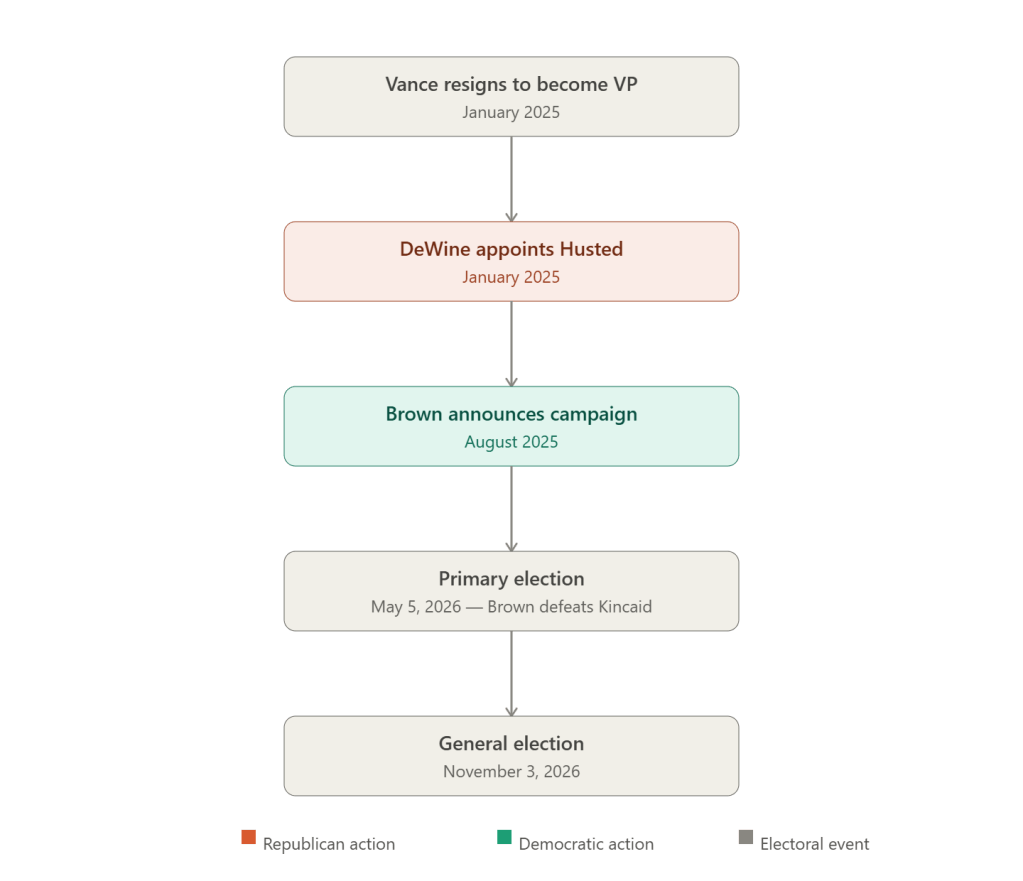
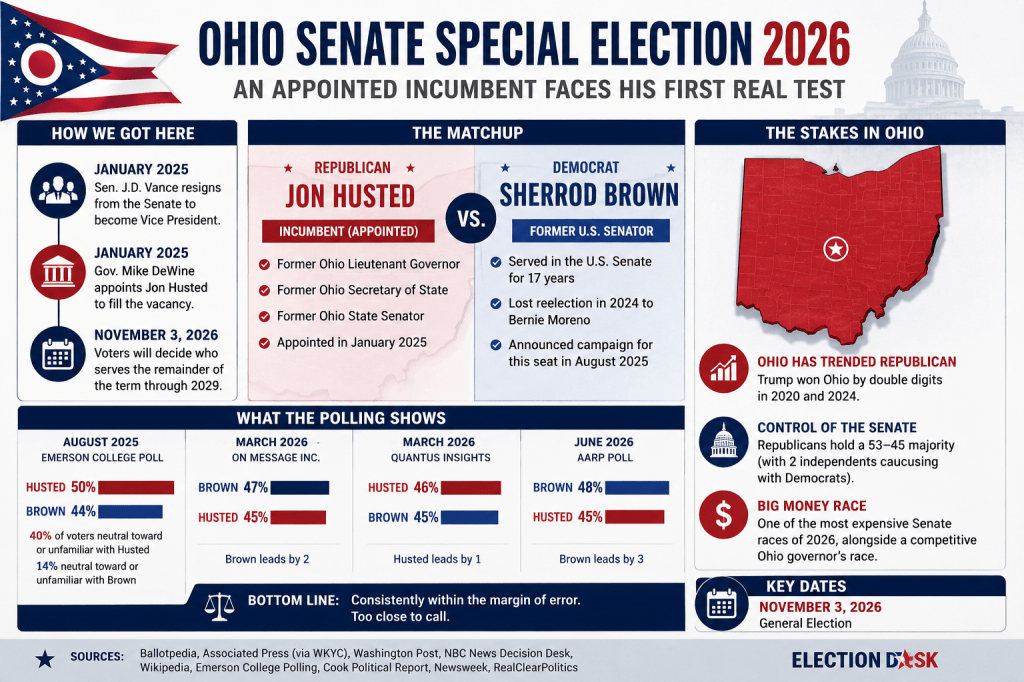
The seat became vacant when J.D. Vance resigned from the Senate in January 2025 to become vice president. Under Ohio law, the governor appoints a replacement to serve until a special election can be held, with the winner completing the remainder of the original six-year term — in this case, through 2029, when the seat next comes up for a regularly scheduled election. Gov. Mike DeWine appointed Husted, a former Ohio lieutenant governor, secretary of state, and state senator, to fill the vacancy.
That structure means Husted enters his first general election for this seat as an incumbent in name but a first-time statewide Senate candidate in practice — a distinction his opponent’s campaign has leaned on directly.
Ohio is holding its first U.S. Senate special election since 1954.
The matchup: a rematch of circumstance, not of opponents
Husted ran unopposed in the May 5 Republican primary and advanced automatically. On the Democratic side, former Sen. Sherrod Brown defeated IT professional and Special Olympics coach Ron Kincaid to win the nomination. Brown is a familiar name to Ohio voters: he held the state’s other Senate seat for 17 years before losing his 2024 reelection bid to Republican Bernie Moreno by roughly four points, the same year Donald Trump carried Ohio by 11. Brown announced his campaign for this separate seat in August 2025, effectively seeking a return to the Senate less than two years after leaving it.
Because Brown previously held Ohio’s other Senate seat, not this one, the race isn’t a rematch of the 2024 Brown-Moreno contest — it’s a new matchup between a well-known former senator and an appointed incumbent still introducing himself to much of the electorate. An Emerson College poll taken shortly after Brown entered the race found 40 percent of voters neutral toward or unfamiliar with Husted, compared with only 14 percent who said the same of Brown.
Public polling has moved considerably over the past year and remains close, with no candidate established as a clear favorite.
What the polling shows
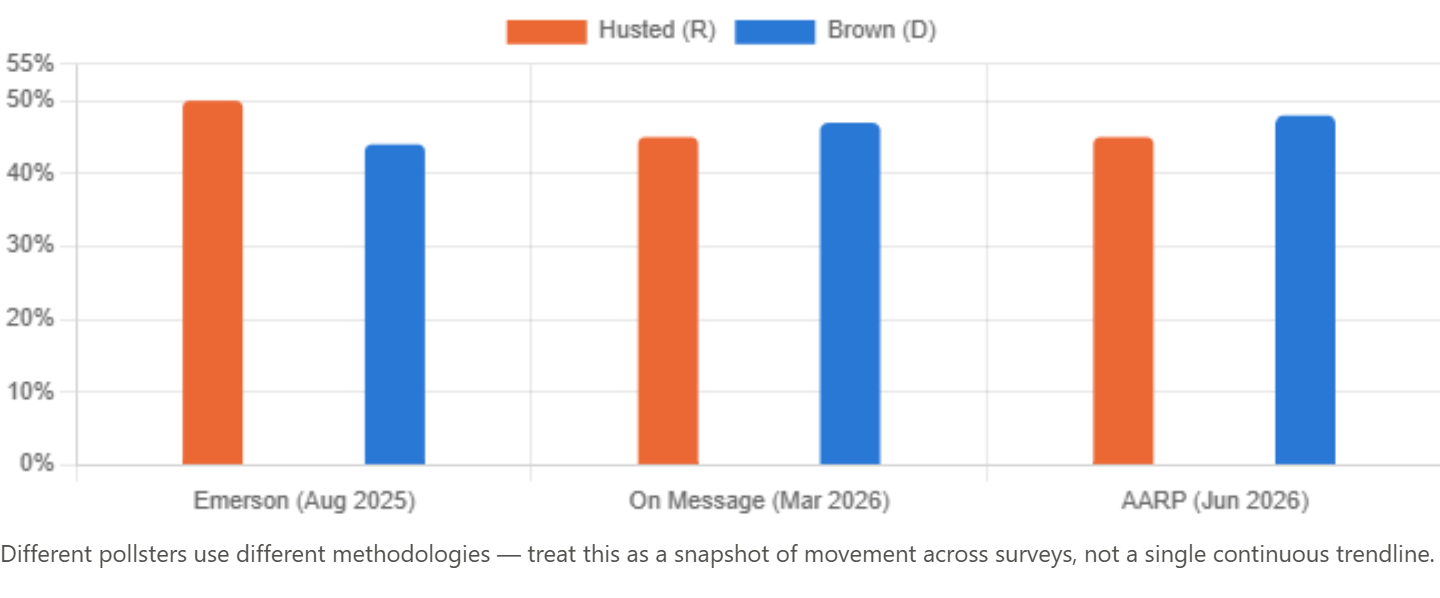
Public polling has moved considerably over the past year and remains close. Emerson’s first survey after Brown’s campaign launch, in August 2025, showed Husted leading 50–44. By March 2026, the race had tightened further, with one Republican-aligned pollster (On Message Inc.) showing Brown ahead 47–45 and another (Quantus Insights) showing Husted up by a single point. A mid-June AARP-commissioned poll of 800 likely voters found Brown leading 48–45. Political scientists tracking the race have described it as consistently within the margin of error, with no candidate established as a clear favorite as of this summer.
Why it matters beyond Ohio
The race is expected to be among the most expensive Senate contests in the country this cycle.
Ohio has trended Republican in recent cycles — Trump carried the state by double digits in both 2020 and 2024, and Republicans have controlled every other statewide office. A genuinely competitive Senate race there would mark a shift in the map Democrats have to work with nationally, and both parties are treating it accordingly: the race is expected to be among the most expensive in the country this cycle, compounded by Ohio also hosting a competitive, simultaneous open governor’s race between Republican Vivek Ramaswamy and Democrat Amy Acton.
For Senate control overall, Republicans currently hold a 53–45 majority (with two additional seats filled by independents caucusing with Democrats), and Ohio is one of several Trump-won states — alongside Maine, North Carolina, and others — where Democrats see a path to competitive contests despite the state’s recent Republican lean. Ohio’s is also not the only special election on the 2026 ballot: Florida is separately holding one to fill the remainder of Marco Rubio’s term, though that race has drawn less national attention than Ohio’s.
One of 2026’s most closely watched Senate races isn’t about an open seat—it’s about whether an appointed senator can earn a mandate from Ohio voters.
What’s next
The general election is November 3. Between now and then, expect continued heavy outside spending, and continued scrutiny of how Ohio voters respond to an appointed incumbent’s first appearance on their ballot for a seat he currently holds only by gubernatorial appointment.
Sources
This story draws on reporting and data from Ballotpedia’s tracker of the Ohio Senate special election; the Associated Press via WKYC; the Washington Post’s primary results coverage; NBC News’s Decision Desk; Wikipedia’s summary of the special election’s legal framework; Emerson College Polling; the Cook Political Report; Newsweek’s coverage of AARP-commissioned polling; and RealClearPolling’s aggregation of the race.
Election Desk will continue tracking Ohio’s Senate special election as polling and spending develop ahead of November.
 Election Desk
Leave a comment