Florida’s first open governor’s race in eight years has largely narrowed to a Byron Donalds–David Jolly showdown, even before primary voters have cast their ballots.
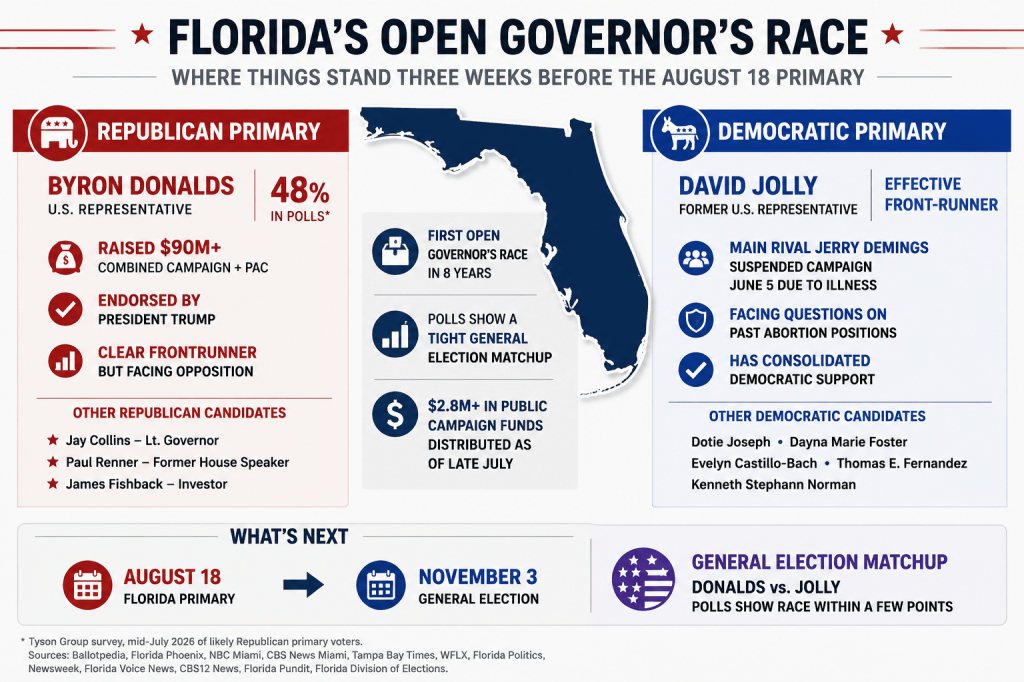
With Gov. Ron DeSantis term-limited, Florida is holding its first open governor’s race in eight years — and with the August 18 primary three weeks away, both parties’ contests have narrowed to clear frontrunners even as intraparty fights over debates, money, and party unity continue.
The Republican primary: Donalds’ race to lose, but not unopposed
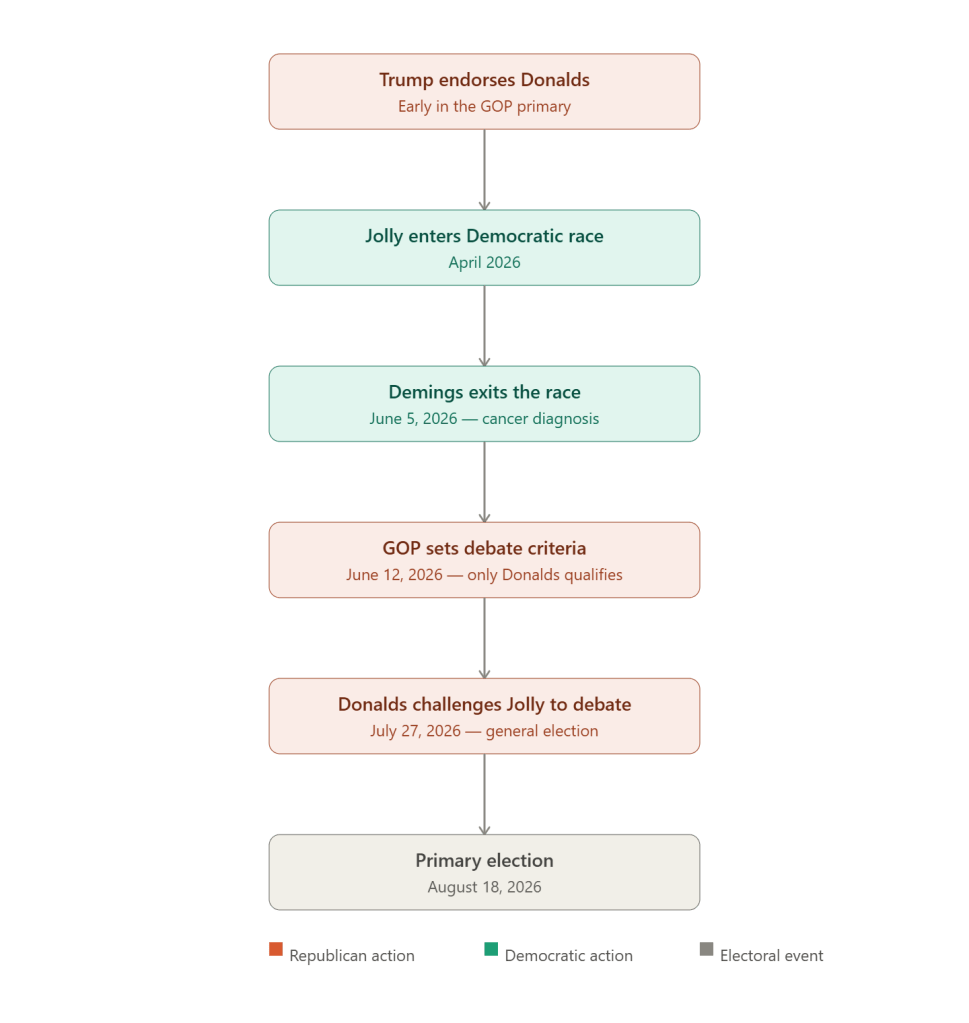
U.S. Rep. Byron Donalds of Naples has led the Republican field since entering the race, built on an early endorsement from President Trump and a financial advantage his rivals haven’t come close to matching — his campaign has reported raising more than $90 million combined across his campaign account and political committee, including $22.4 million in the first quarter alone. A mid-July Tyson Group survey placed him at 48% among likely Republican primary voters, roughly 39 points ahead of his nearest rival, with about a quarter of respondents still undecided.
Byron Donalds enters the final three weeks before the primary with a commanding polling lead, Trump’s endorsement, and a fundraising advantage no rival has matched.
Three other Republicans remain on the ballot: Lt. Gov. Jay Collins, whom DeSantis appointed to the position in 2025 and who has campaigned on his record as a wounded Army Special Forces veteran; former Florida House Speaker Paul Renner; and investor James Fishback. None has come close to Donalds in fundraising or polling, and DeSantis himself has stayed publicly neutral in the primary rather than endorsing a successor, saying in July that “having an open process” is preferable to the party “trying to engineer an outcome” — a comment widely read as friction with the state party over how it has handled the race.
That friction centers on debates. In June, the Republican Party of Florida adopted a “10/10/10” qualification threshold for its sanctioned primary debate, tied to polling, fundraising, and organizational benchmarks. Donalds was the only candidate who met it, and no full multi-candidate debate has been held. Collins, Renner, and Fishback have publicly criticized both the party and Donalds — who has said he’d rather focus on “party unity” than debate rivals he considers non-competitive — for what they call an effort to shut voters out of a real comparison between candidates before they vote.
The biggest Republican fight hasn’t been over ideology — it’s been over whether voters should see the candidates debate at all.
The Democratic primary: a two-candidate race that became a one-candidate race
Six Democrats qualified for the primary ballot, but the contest effectively resolved itself in June. Former U.S. Rep. David Jolly, a Republican-turned-independent-turned-Democrat, entered the race in April 2026 already positioned as the best-funded Democratic contender. His main rival, Orange County Mayor Jerry Demings, suspended his campaign on June 5 after disclosing a prostate cancer diagnosis, clearing the field for Jolly well ahead of the primary. The other four Democrats on the ballot — state Rep. Dotie Joseph, Dayna Marie Foster, Evelyn Castillo-Bach, Thomas E. Fernandez, and Kenneth Stephann Norman — have not mounted campaigns on a comparable scale.
Jerry Demings’ withdrawal transformed a competitive Democratic primary into one centered almost entirely on David Jolly.
Jolly, who represented Florida’s 13th Congressional District as a Republican from 2014 to 2017 before losing to Charlie Crist, has drawn scrutiny from within his own party over his evolution on abortion — he supported restrictions as a Republican and now says he supports abortion rights — but has otherwise consolidated Democratic support heading into the primary.
The general-election argument has already started
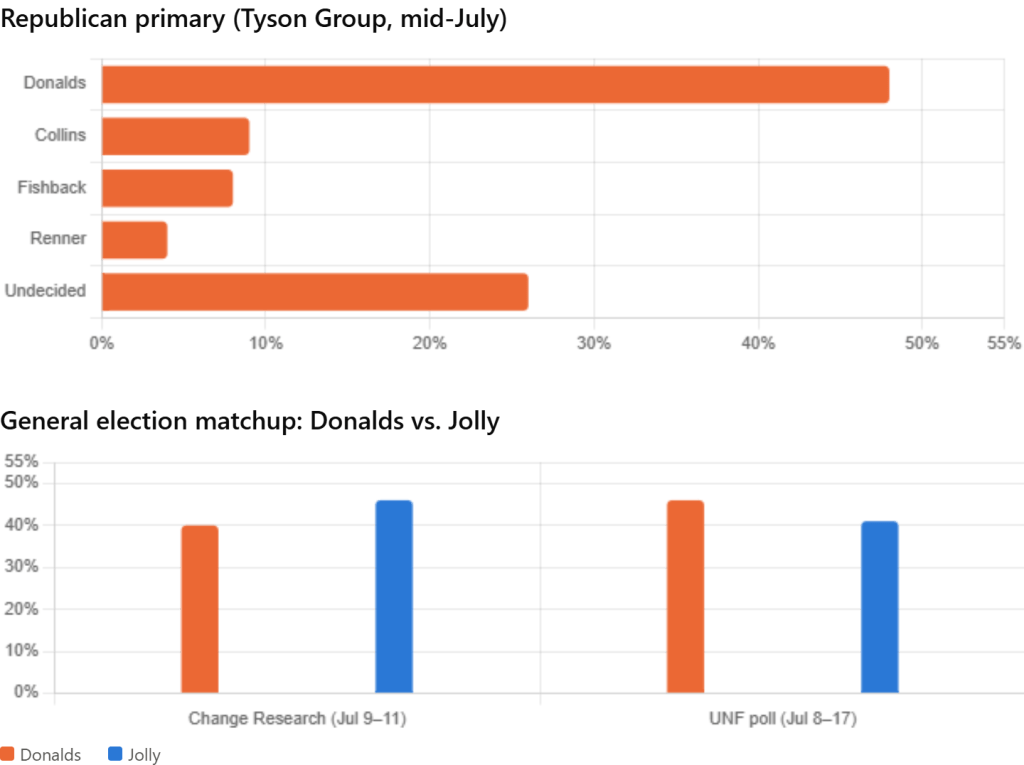
With both primaries effectively decided in substance if not yet in the vote count, Donalds and Jolly have spent recent weeks previewing a general-election matchup rather than focusing solely on their primaries. On July 27, Donalds challenged Jolly to three general-election debates this fall — a notable move given that Donalds has simultaneously declined to debate his own Republican primary rivals. Polling on the hypothetical Donalds-Jolly matchup has been unusually tight for a state that has trended Republican in recent statewide races: multiple surveys conducted in the first three weeks of July put the two within a few points of each other, with a Change Research poll (July 9–11) showing Jolly ahead and a University of North Florida poll (July 8–17) showing Donalds ahead, both within or near the margin of error.
Both parties have already shifted their attention from winning the primary to winning November.
Florida has not had a Democratic governor since Buddy MacKay left office in 1999, and Republicans currently hold every statewide office, both U.S. Senate seats, and supermajorities in the state legislature. Whether the closer-than-expected polling reflects a genuine opening for Democrats or is a function of Jolly’s relative lack of definition with voters this early is something both campaigns are still testing.
What’s next
Florida’s primary is August 18; the general election is November 3. Absent a late shift, the most likely outcome is a Donalds-Jolly general election, though the three trailing Republican candidates still have three weeks to attempt a breakthrough, and money and organization will matter over that period, with the state having distributed more than $2.8 million in public campaign matching funds to statewide candidates as of late July.
Sources
This story draws on reporting from Ballotpedia’s Florida gubernatorial election tracker; the Florida Phoenix; NBC Miami; CBS News Miami; the Tampa Bay Times; WFLX; Florida Politics; Newsweek; the Florida Voice News; CBS12 News; and the Florida Pundit’s 2026 election hub, along with primary source campaign finance data from the Florida Division of Elections.
Election Desk will continue tracking Florida’s gubernatorial primary as the August 18 vote approaches.
 Election Desk
Leave a comment