
Texas voters settled their primary field back in March. Incumbent Republican Governor Greg Abbott and Democratic state Representative Gina Hinojosa both won their nominations outright, setting up a November 3 rematch of red-state fundamentals against a Democratic challenge that’s polled closer than expected. Here’s where the race stands.
The primary is settled
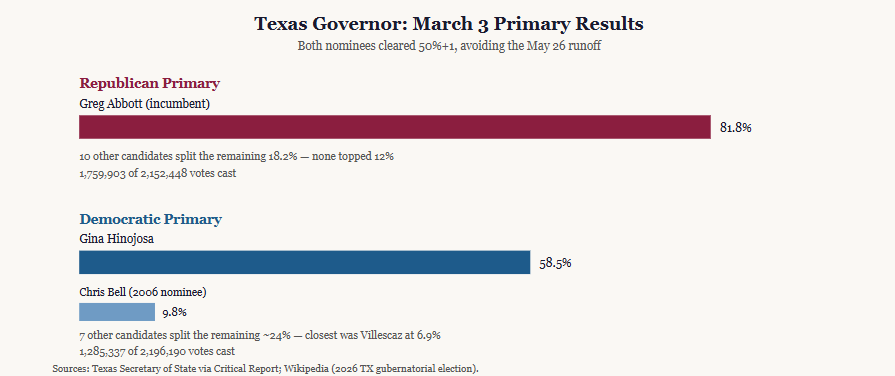
Both nominations were decided March 3, and neither needed the state’s May 26 runoff. Abbott won the Republican primary with 81.8% of the vote against 10 lesser-known challengers, none of whom topped 12%. Hinojosa won the Democratic primary with 58.5% against eight rivals, the closest of whom — 2006 nominee Chris Bell — took just under 10%. One notable name on the Democratic ballot, entrepreneur Andrew White (son of former Governor Mark White), had already dropped out and endorsed Hinojosa before the primary; his name remained on the ballot regardless, though Election Desk was not able to confirm the exact procedural reason.
If Abbott wins in November and completes a fourth term, he’ll surpass Rick Perry’s record as Texas’s longest-serving governor, reaching just under 16 years in office by January 2031.
Neither party needed a runoff—Texas voters settled both gubernatorial nominations outright in March.
The general election field
Beyond the two major-party nominees, Texas’s November ballot will include Libertarian nominee Pat Dixon, chosen at that party’s April convention — the standard nominating method for Texas’s minor parties, which file through a convention process rather than a primary, per the Texas Secretary of State’s own candidate guide — and independent candidate Jenn Mack Raphoon, who qualified for the general election ballot directly rather than through either primary. The Texas Green Party’s own 2026 convention listings show nominees for lieutenant governor, comptroller, and agriculture commissioner, but no governor candidate; Election Desk did not find evidence the party fielded one this cycle.
Where the race stands
Texas hasn’t elected a Democratic governor since Ann Richards left office in 1995, and Abbott enters the fall with a dramatic financial advantage — he reported $105.7 million on hand as of January, compared to roughly $1 million Hinojosa had raised in her campaign’s first ten weeks. Cook Political Report rates the race Solid Republican.
Every major general-election poll has shown Abbott ahead—but consistently by single digits.
That said, general-election polling has consistently shown a tighter contest than the state’s underlying partisan lean would suggest, with results depending substantially on the pollster. An April Texas Public Opinion Research survey had Abbott leading 48%–43%; a University of Houston poll around the same time found Abbott up 49%–42%; and a University of Texas at Tyler poll showed 49%–41%. By late June, a University of Texas/Texas Politics Project poll found the same 7-point gap (47%–40%), while a New York Times poll put Abbott’s lead at 7 points as well (51%–44%). The most recent survey, conducted in mid-July by Texas Public Opinion Research — a group whose founder, Luke Warford, is a former Democratic candidate for the Texas Railroad Commission, worth noting given the group describes itself as nonpartisan — found the race narrower still, at 45%–42%, with 10% undecided. Hinojosa has polled ahead of Abbott on personal favorability in multiple surveys and leads decisively among independents, moderates, and Latino voters, according to crosstabs from several of these polls, though Abbott’s advantage among the state’s larger Republican base has been enough to keep him ahead in every general-election poll released so far.
Hinojosa has campaigned chiefly on public education — she’s a vocal opponent of Abbott’s school voucher program — along with health care costs and general affordability. Abbott’s campaign has emphasized his record on the economy and border security; in at least one fundraising appeal, his campaign manager framed the race in terms of pushing back against “socialists” winning elections elsewhere, though Election Desk did not confirm that language as a recurring theme across his broader campaign messaging.
Texas remains a Republican-leaning state, but the 2026 campaign has produced a closer polling environment than many expected.
Sources: Texas Secretary of State, Ballotpedia, Critical Report (primary vote totals), Texas Public Opinion Research, University of Houston Hobby School of Public Affairs, University of Texas/Texas Politics Project, University of Texas at Tyler, Cook Political Report.
 Election Desk
Leave a comment