

Colorado’s 2026 governor’s race was always going to draw attention as the state’s first open contest for the office in eight years. What’s made it a genuine process story is how it played out: a Republican primary decided by a margin close enough to test the state’s automatic-recount law, followed by a formal campaign finance investigation into the winner that is still unresolved heading into the general election.
An open seat, a crowded field
Gov. Jared Polis is term-limited after two terms, and Colorado’s attorney general is term-limited as well, opening up two of the state’s highest offices at once. As many as 40 people had filed paperwork or expressed interest in running for governor as early as January 2026, according to local reporting at the time; most did not gather enough support to remain viable, and the field had narrowed to five candidates across the two major parties by the June 30 primary.
The Democratic primary
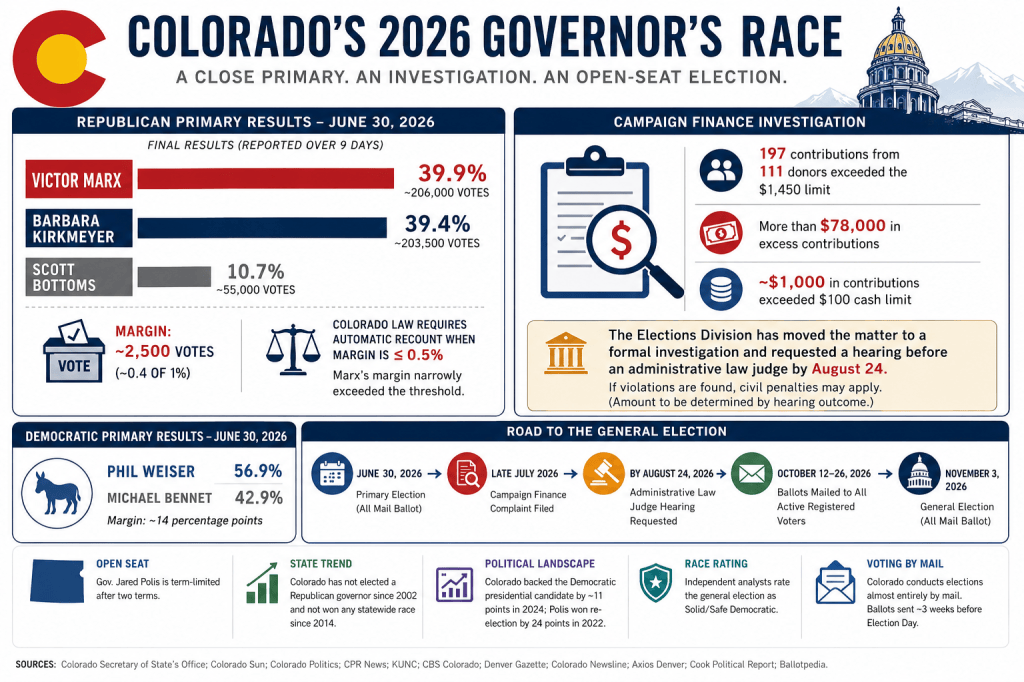
Colorado Attorney General Phil Weiser defeated U.S. Sen. Michael Bennet for the Democratic nomination by a margin of roughly 14 percentage points, a comfortable win that was called on primary night. Weiser, twice elected attorney general, will face the Republican nominee in November.
The Republican primary: a margin inside recount territory
The Republican race was far closer. State Sen. Barbara Kirkmeyer, the establishment favorite with endorsements from former Gov. Bill Owens and Rep. Gabe Evans, led on election night. Over the following nine days, as county clerks continued to report final ballot counts, ministry leader and first-time candidate Victor Marx overtook her and held on. The Associated Press did not call the race until July 9. State Rep. Scott Bottoms finished a distant third.
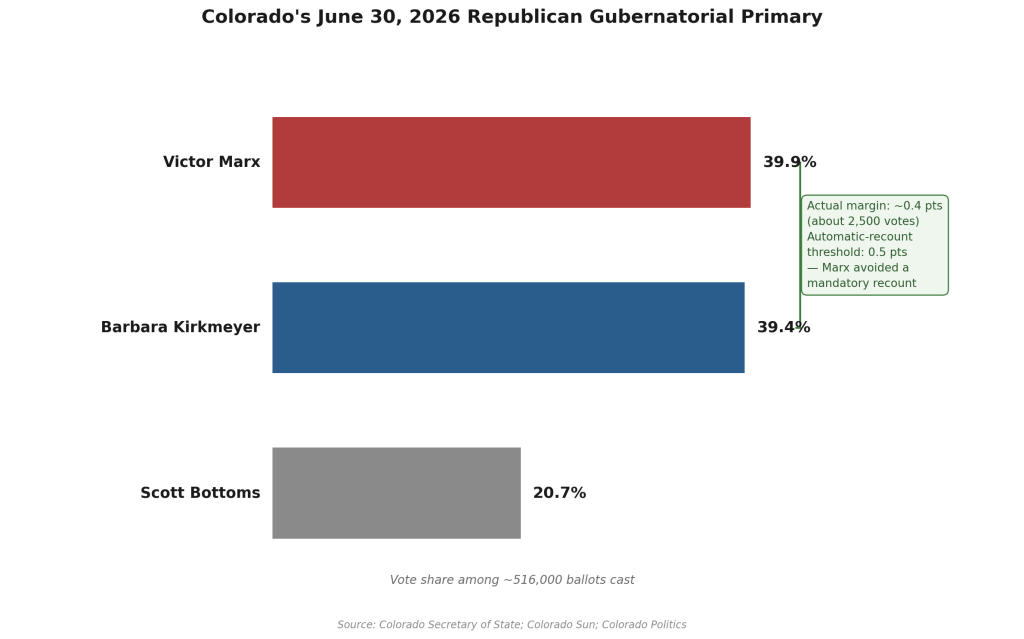
The final margin: Marx received 39.9% of the roughly 516,000 votes cast, to Kirkmeyer’s 39.4% — a gap of about 2,500 votes, or roughly four-tenths of one percent. Colorado law requires an automatic recount when the top two finishers are separated by no more than half of one percent of the leading candidate’s total; Marx’s margin came in just above that threshold, avoiding a mandatory recount by a narrow margin. Neither Kirkmeyer nor Bottoms endorsed Marx after the results were finalized.
A margin of roughly 2,500 votes proved just large enough to avoid Colorado’s automatic recount law.
A campaign finance investigation follows the win
In late July, the Colorado Secretary of State’s Elections Division filed a formal complaint alleging that Marx’s primary campaign accepted 197 contributions from 111 donors that exceeded the state’s $1,450 aggregate individual contribution limit, totaling more than $78,000 in excess funds, along with roughly $1,000 in contributions that violated the state’s $100 cap on cash donations. More than 140 individual complaints were filed against the campaign in total, most of them consolidated into the Elections Division’s formal filing; nearly all originated with a former Colorado Republican Party staffer.
The campaign finance investigation now follows the Republican nominee into the general election.
The Marx campaign has said it is cooperating with the Secretary of State’s office and, according to the state’s filing, has already refunded some excess contributions or reattributed them to donors’ spouses where applicable; the office determined those corrective steps did not bring the campaign into substantial compliance. The Elections Division has moved the matter to a formal investigation and sought a hearing before an administrative law judge, with a request that one be scheduled by August 24. If a judge ultimately finds violations occurred, Colorado law allows for civil penalties; Election Desk was unable to confirm a specific fine amount or formula at this stage of the proceeding, and will update this figure once a hearing produces a ruling.
Scrutiny of the nominee’s public claims
Separately from the campaign finance matter, Marx’s public account of his own background has drawn sustained scrutiny from Colorado reporters during and after the primary. In broadcast interviews, Marx has made a series of claims about his ministry work and personal history — including having killed a man as a child under duress, coordinating a foreign airstrike, and personally participating in the rescue of tens of thousands of trafficking victims — that he has declined to substantiate with documentation when asked directly by journalists. His campaign removed a specific rescue-count claim from its website after it drew public scrutiny. Marx has said the specifics “don’t matter” and has stood by the general truthfulness of his account.
Election Desk is not in a position to adjudicate the accuracy of Marx’s personal claims; we note the scrutiny here because it has become a defining feature of general-election coverage of the race, distinct from the campaign finance question, which is the subject of an active state administrative proceeding.
Election Desk is not in a position to adjudicate Marx’s personal claims—but the scrutiny itself has become part of the race.
The general election
Weiser enters the fall as the heavy favorite in a state that has not elected a Republican governor since 2002 and has not won a statewide race of any kind since 2014. Colorado backed the Democratic presidential candidate by roughly 11 points in 2024, and Polis was reelected by 24 points in 2022. Independent race ratings classify the contest as Solid or Safe Democratic. The general election is November 3; Colorado conducts its elections almost entirely by mail, with ballots sent to all active registered voters roughly three weeks beforehand.
What to watch
The legal questions surrounding the nominee may remain unresolved even as Colorado voters begin casting mail ballots.
The administrative hearing on the campaign finance complaint is expected to be scheduled around August 24, and its outcome — along with any fines — will land in the middle of the general election campaign. Whether the finance dispute or the disputed personal claims affect turnout or the final margin in a state this heavily favoring one party remains an open question for November.
Sources: Colorado Secretary of State’s Office; Colorado Sun; Colorado Politics; CPR News; KUNC; CBS Colorado; Denver Gazette; Colorado Newsline; Axios Denver; Cook Political Report; Ballotpedia.
 Election Desk
Leave a comment