
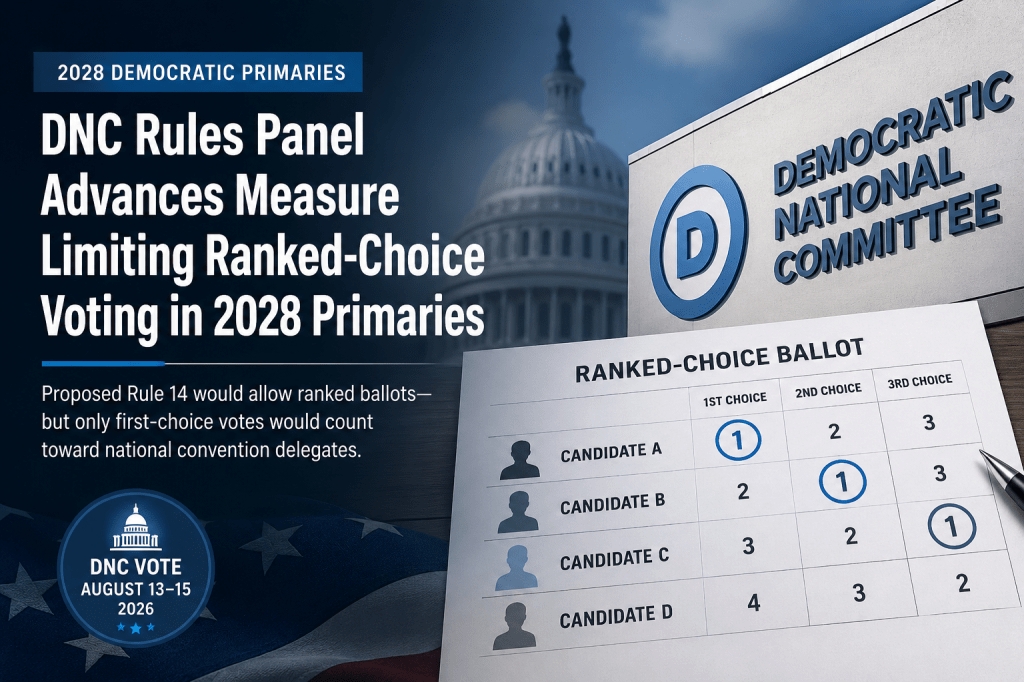
The Democratic National Committee’s Rules and Bylaws Committee (RBC) has advanced language that would stop ranked-choice ballots from determining how national convention delegates are allocated in the 2028 presidential primary, even in states where ranked-choice voting (RCV) is required by state law. The full DNC is expected to take up the party’s 2028 delegate selection rules at its meeting August 13-15, where the RBC’s recommendation will be considered for final adoption.

What the Rule Would Do
At a May meeting, the RBC voted 28-14 to add language to Rule 14, the section of the party’s delegate selection rules governing “Fair Reflection of Presidential Preference.” The new provision specifies that a ballot used to allocate delegates cannot let a voter express “more than one presidential preference.”
In practice, the rule would not prevent a state from printing or administering a ranked-choice ballot. It would instead instruct state parties to allocate national convention delegates based solely on each voter’s first choice, disregarding any second, third, or later rankings marked on the ballot. Delegate math in Democratic primaries is otherwise proportional: candidates who clear a 15 percent threshold of the vote share delegates in proportion to their support.
Two jurisdictions currently have state or local law requiring RCV in presidential primaries: Maine, which extended its ranked-choice system to presidential contests by statute in 2020, and Washington, D.C., where voters approved RCV for all local elections, including presidential primaries, in a 2024 ballot measure that first took effect this year. Several other states — including Alaska, Hawaii, Wyoming, and Kansas — have used RCV in past Democratic presidential nominating contests, though not under a state-law mandate.
“The proposal would not ban ranked-choice ballots—it would require delegate allocation to rely only on voters’ first choices.”
Competing Characterizations
RCV supporters, including the advocacy group FairVote and Maine Democratic Party officials, describe the measure as a de facto ban on ranked-choice voting in the primary. They argue that instructing state parties to ignore all but a voter’s first choice removes the mechanism that distinguishes RCV from a traditional single-choice ballot, even if voters are still permitted to rank candidates on paper.
RBC Co-Chair Jim Roosevelt has offered a different rationale, telling Maine reporters that ranked-choice voting is not currently compatible with the party’s proportional delegate-allocation process because conventional RCV is designed to produce a single winner. Roosevelt said the committee respects states’ authority over their own election procedures and indicated the RBC intends to work with the Maine Democratic Party on the issue ahead of 2028.
“Supporters call it a de facto ban on ranked-choice voting. Committee leaders argue it preserves the party’s proportional delegate system.”
That rationale is contested by RCV proponents, who note that the ranked-choice method used in the 2020 Democratic primaries in states like Alaska, Hawaii, Wyoming, and Kansas already operated within the party’s proportional framework: rather than declaring a single majority winner, it used a “bottoms-up” elimination process, dropping the lowest-performing candidates in rounds (or all candidates below the 15 percent viability threshold) until every remaining candidate cleared the threshold for delegates. Reporting on the 2020 cycle found that RCV tabulation in the states that used it resulted in the overwhelming majority of ballots ultimately counting toward a delegate-earning candidate, including many cast for candidates who had withdrawn from the race before voting concluded.
Procedural Context
The RBC’s recommendation is not self-executing. Under DNC practice, the full 400-plus-member Democratic National Committee must approve the delegate selection rules package before it governs the 2028 primary calendar, and RBC recommendations — while rarely overturned — remain subject to that vote. The committee’s August 13-15 meeting is the next scheduled point at which the full DNC could adopt, amend, or reject the RBC’s Rule 14 language.
State parties in Maine and Washington, D.C. have said the change could complicate how their delegations are credentialed if the state-law-mandated ranked ballot and the DNC’s national rule diverge. The DNC’s rules give it authority over how delegates are allocated at the national level; it does not have authority to rewrite state election law, meaning any conflict would center on which rankings the party counts for delegate purposes rather than on how the ballot itself is administered.
“The Rules and Bylaws Committee’s recommendation is not final. The full Democratic National Committee still must approve the 2028 delegate rules.”
The RBC’s position on Rule 14 has not been static. After the May vote, the committee revisited the language at a subsequent meeting in Pittsburgh in late June, and election-law analysts who track the committee’s work note that the panel has left open the possibility of further changes before the rules are finalized in August.
Background
“The debate centers less on whether ranked-choice ballots can exist than on which rankings the Democratic Party will recognize when allocating delegates.”
Ranked-choice voting allows voters to rank candidates in order of preference rather than selecting only one. In single-winner elections, if no candidate wins a majority of first choices, the candidate with the fewest votes is eliminated and their votes are redistributed to those voters’ next choice, repeating until one candidate has a majority. The “bottoms-up” method used in some Democratic primaries adapts that logic to a proportional, multi-winner context: instead of running until one candidate has a majority, eliminations continue only until all remaining candidates clear the delegate-qualifying threshold.
RCV advocates have also drawn a parallel to a 2024 episode in which the Republican Party in the U.S. Virgin Islands used ranked-choice voting in its presidential caucus, a move that put the territorial party at odds with national Republican rules on nominating-contest procedure and timing; the Republican National Committee subsequently docked the territory’s delegate count. Advocates cite that episode as evidence of a broader two-party skepticism toward RCV in presidential nominating contests. DNC officials, for their part, frame their rationale specifically around delegate-allocation mechanics rather than a categorical objection to ranked-choice voting itself.

FAQ
Q: Is the DNC banning ranked-choice voting?
A: No. The proposal would allow ranked ballots to be used but would allocate delegates using only voters’ first-choice selections.
Q: Which states could be affected?
A: Maine and Washington, D.C., currently have laws requiring ranked-choice voting in presidential primaries.
Q: Has the rule taken effect?
A: No. The proposal still requires approval by the full Democratic National Committee at its August 13–15 meeting.
Q: Why is the DNC proposing the change?
A: Committee leaders say the proposal is intended to maintain compatibility with the party’s proportional delegate allocation system, while supporters of ranked-choice voting dispute that rationale.
Election Desk will continue to track the DNC’s Rules and Bylaws Committee proceedings and update this article following the August 13-15 DNC meeting.
Sources: DNC Rules and Bylaws Committee proposed Rule 14 language (May 2026 RBC meeting); Maine Morning Star / News From The States reporting on RBC proceedings and Jim Roosevelt statement; WABI-TV (Bangor, ME) coverage of Maine Democratic Party response; FairVote Action analysis of the proposed rule; FHQ (Frontloading HQ) procedural coverage of the RBC’s 2028 delegate selection rules process; IVN.us reporting.


Leave a comment