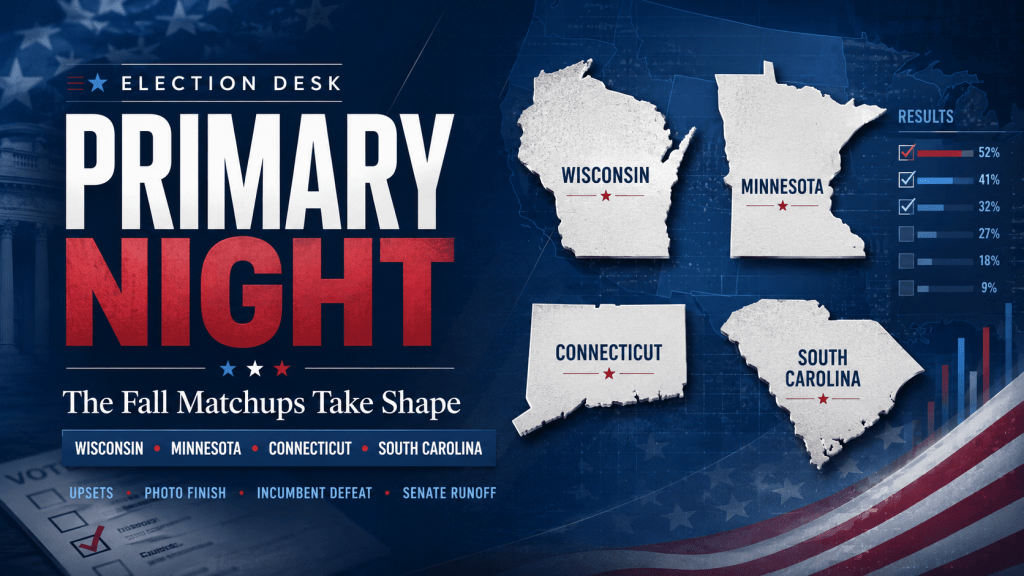
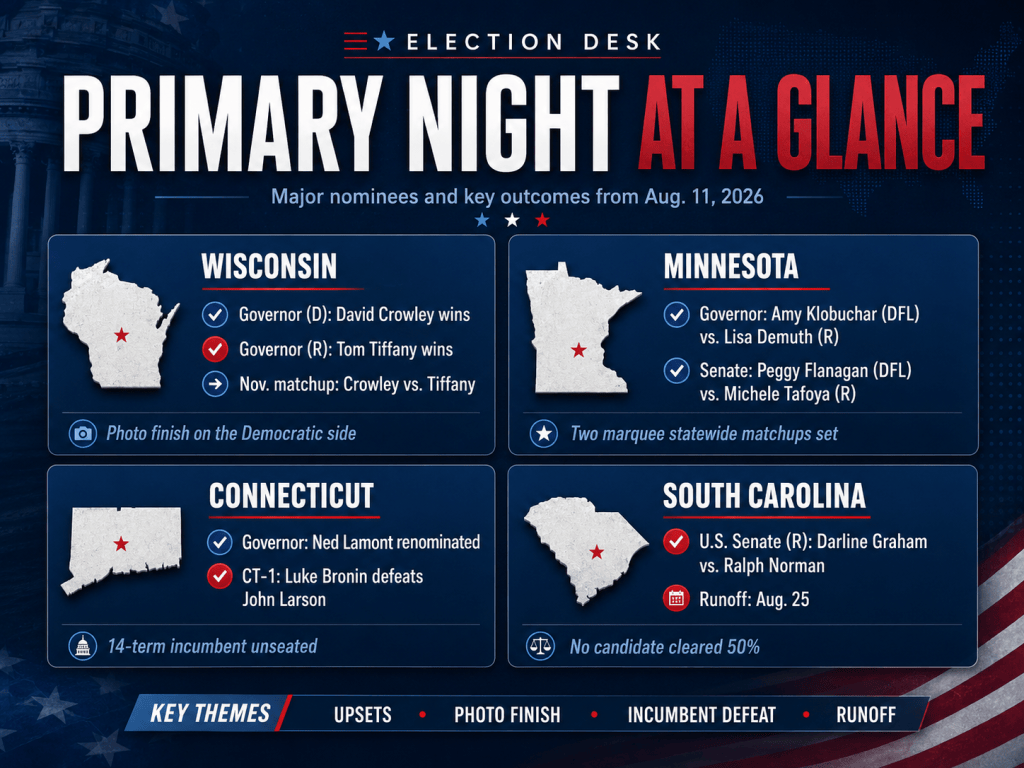
Voters in six states went to the polls on August 11, 2026, in one of the busiest primary nights of the midterm cycle, settling nominations for governor, U.S. Senate and U.S. House seats that will help define the fall campaign. The results split unevenly along ideological lines within both parties: progressive-aligned candidates won the marquee Democratic Senate primary in Minnesota and unseated a 14-term incumbent in Connecticut, while a more moderate candidate narrowly prevailed in Wisconsin’s closely watched governor’s race and a state legislative leader outran both her party’s endorsed candidate and a Trump-backed rival in Minnesota’s Republican gubernatorial primary. In South Carolina, Republicans set up a runoff to decide who succeeds the late Sen. Lindsey Graham on the November ballot.
Several results remained unofficial as of publication, with counties continuing to canvass ballots ahead of certification deadlines that vary by state. This article distinguishes calls made by the Associated Press or network decision desks from final, certified counts where the two differ, and flags candidate disputes as disputes rather than as fact.
The results split unevenly along ideological lines within both parties.
Wisconsin: Crowley edges Hong in a photo finish
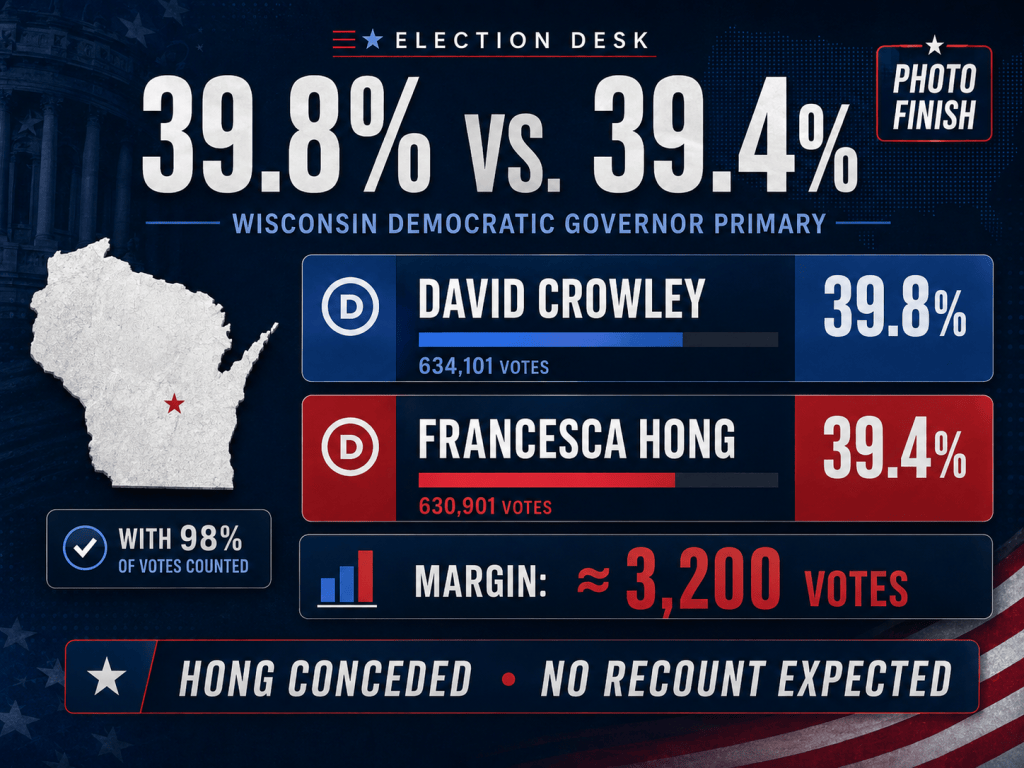
Milwaukee County Executive David Crowley won the Democratic primary for governor, narrowly defeating state Rep. Francesca Hong in a race the Associated Press did not call until the early hours of August 12. With 98% of votes counted, Crowley led Hong 39.8% to 39.4%, a margin of roughly 3,200 votes; state Sen. Kelda Roys and former Department of Administration Secretary Joel Brennan trailed with 7.5% and 4.7%, respectively.
The result reversed the trajectory of the race. Public polling throughout the campaign, including successive Marquette University Law School surveys and a final State Navigate poll showing Hong ahead by 22 points, had shown Hong — a state legislator, chef and self-described democratic socialist — leading the field by double digits. Crowley had dropped out of the race in early July and endorsed then-Lt. Gov. Sara Rodriguez before reentering the race 10 days later after Rodriguez herself dropped out amid a campaign-finance dispute; he went on to win the backing of retiring Gov. Tony Evers, who had otherwise stayed neutral in the primary until its final days. Former Lt. Gov. Mandela Barnes, the party’s 2022 U.S. Senate nominee, also entered and exited the race without gaining traction.
Because Crowley’s margin fell under one percentage point, Hong’s campaign had the option to request a recount; state law would have required her campaign to cover the cost since the gap exceeded 0.25 points. Hong conceded overnight rather than pursue one, and the AP called the race after her concession, reportedly delayed in part by an error in uploading absentee ballot data in Milwaukee.
On the Republican side, U.S. Rep. Tom Tiffany won his primary in a landslide, taking roughly 97% of the vote against Andy Manske, a 27-year-old medical service technician, according to AP figures. Tiffany, who represents Wisconsin’s 7th Congressional District and holds President Trump’s endorsement, will face Crowley in November. In a further wrinkle on the Republican side, David Varnam defeated Will Martin — a former staffer in the Thompson and Walker administrations — in an upset in the lieutenant governor primary, meaning Tiffany’s running mate was not his own preferred pick.
Crowley will face Tiffany in the November general election. Both Democratic candidates said in the campaign’s final days that they expected the party to unify behind whichever candidate won, framing Tiffany rather than each other as the real opponent. Wisconsin’s primary night also included down-ballot House contests: Rebecca Cooke won the Democratic nomination in the 3rd Congressional District, and Fred Clark won the Democratic nomination in the 7th, both districts Republicans currently hold.
Minnesota: a Klobuchar-Demuth governor’s race and a progressive Senate upset
Minnesota held simultaneous primaries for governor and the state’s open U.S. Senate seat, both triggered by retirements — Gov. Tim Walz’s decision not to seek a third term and Sen. Tina Smith’s retirement from the Senate.
In the DFL gubernatorial primary, U.S. Sen. Amy Klobuchar won her party’s nomination by an overwhelming margin, taking roughly 89% of the vote against six lesser-known candidates. Klobuchar, who has represented Minnesota in the Senate since 2007, entered the governor’s race in January with the DFL’s backing and Walz’s support; a win in November would make her the state’s first elected female governor. She has centered her campaign on addressing fraud in state programs, an issue that dogged Walz’s final years in office.
The Republican gubernatorial primary was more competitive and produced the night’s clearest upset. House Speaker Lisa Demuth won the nomination with roughly 44% of the vote, defeating Trump-endorsed businessman Mike Lindell, the MyPillow founder, who took about 32%, and Kendall Qualls, who held the state party’s formal endorsement, at about 22%. Both Lindell and Qualls held stronger standing in the delegate-driven endorsement process yet lost the primary itself; Qualls conceded and congratulated Demuth on election night, while Lindell — a prominent promoter of unfounded claims about the 2020 presidential election — said on his media platform that he would not concede and described the results as “mathematically impossible,” without citing supporting evidence as of publication. The Associated Press called the race for Demuth before midnight. Demuth will face Klobuchar in November in a race that guarantees Minnesota its first female governor regardless of outcome.
Both Lindell and Qualls held stronger standing in the delegate-driven endorsement process yet lost the primary itself.
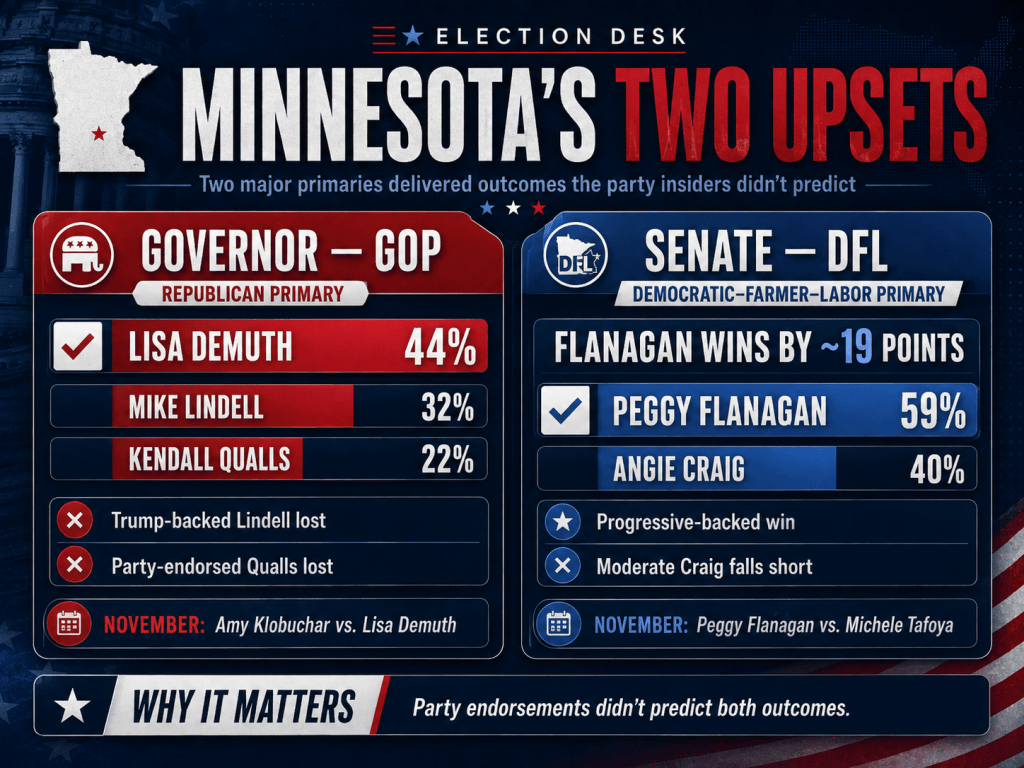
In the DFL Senate primary, Lt. Gov. Peggy Flanagan defeated U.S. Rep. Angie Craig by a wide margin — roughly 19 points, according to AP returns with 86% of the vote counted. The race divided the party’s national figures along ideological lines: Flanagan, who campaigned on expanding Medicare and curtailing federal immigration enforcement authority, drew endorsements from Sens. Bernie Sanders of Vermont and Elizabeth Warren of Massachusetts, along with outgoing Sen. Smith. Craig, who has positioned herself as a moderate during four terms representing Minnesota’s 2nd Congressional District, was backed by Sens. Tammy Baldwin, Ruben Gallego, Jacky Rosen and Andy Kim, as well as former Transportation Secretary Pete Buttigieg. Much of the late campaign centered on Craig’s 2025 vote on federal immigration enforcement authority, which Flanagan’s campaign highlighted amid federal enforcement activity in the state earlier this year.
On the Republican side of the Senate race, former NFL sideline reporter Michele Tafoya won her primary outright with roughly 51-52% of the vote in a nine-candidate field, according to AP figures, defeating Adam Schwarze — who held the state party’s endorsement — and 2024 nominee Royce White. Flanagan will face Tafoya in November; Minnesota has not elected a Republican to statewide office since 2006, though Republicans have pointed to tightening presidential-year margins as grounds for optimism.
Connecticut: Lamont holds off primary challenge; Larson unseated in the 1st District
Gov. Ned Lamont won renomination to a third term, defeating state Rep. Josh Elliott in the first primary challenge to a sitting Connecticut governor since 1978. The Associated Press called the race shortly after polls closed at 8 p.m.; in a full tally reported by the Connecticut Business & Industry Association, Lamont ultimately took roughly 68% of the vote to Elliott’s 32%, sweeping all but three towns statewide, including Elliott’s own hometown of Hamden. Elliott, who raised roughly $3.8 million through the state’s public financing program against Lamont’s $9.5 million in personal spending, said afterward that his campaign had exceeded expectations by forcing the state’s first gubernatorial primary in nearly five decades; he will seek reelection to his state House seat rather than leave office. Lamont will face Republican state Sen. Ryan Fazio, 36, of Greenwich, who ran unopposed for his party’s nomination, in November.
The more consequential result for Connecticut’s federal delegation came in the 1st Congressional District, where former Hartford Mayor Luke Bronin defeated 14-term incumbent U.S. Rep. John Larson. According to unofficial results from the Connecticut Secretary of the State’s office, Bronin won 54.39% of the vote (28,441 votes) to Larson’s 32.69% (17,094 votes), with state Rep. Jillian Gilchrest of West Hartford taking 8.17% and Hartford Board of Education member Ruth Fortune taking 4.75%. The Associated Press called the race around 10 p.m.
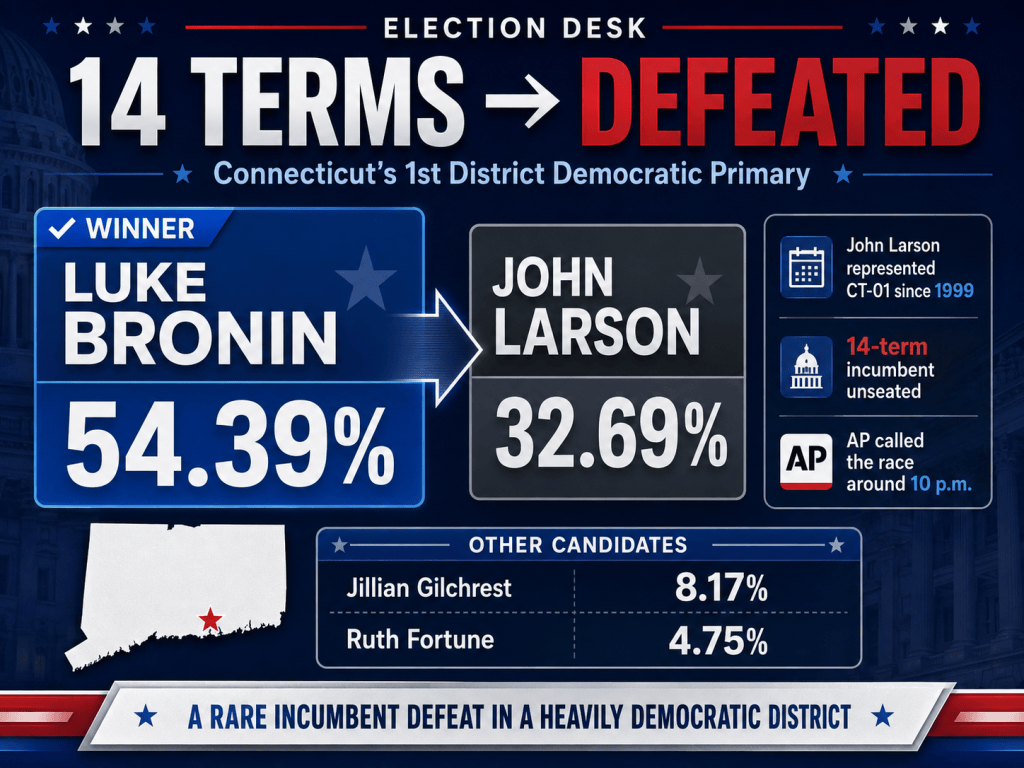
Larson had represented the heavily Democratic Hartford-area district since 1999 — nearly three decades in Congress.
Larson, 78, had represented the heavily Democratic Hartford-area district since 1999 — nearly three decades in Congress — and had also lost his party’s formal nominating endorsement in May. He faced renewed scrutiny over his health after a 2025 episode on the House floor, which he later attributed to a heart condition treated with medication. Speaking to supporters at his election-night watch party, Larson told the crowd he felt “apologetic” that he had let down colleagues who had campaigned for him, prompting shouts of “no you didn’t” from the room; he did not mention Bronin by name in his remarks. Bronin, for his part, praised Larson’s long career of public service in his own victory speech and called for a Democratic Party with more energy and ambition. Outside groups spent more than $2 million combined on the four-way race, with the bulk of spending flowing to Bronin and Larson; Gilchrest and Fortune both said afterward that they had been unable to compete financially. Bronin will be heavily favored against Republican nominee Amy Chai in a district that reelected Larson with 63% of the vote in 2024.
South Carolina: Graham and Norman advance to Aug. 25 runoff
South Carolina Republicans set up a runoff to determine their nominee for the U.S. Senate seat left vacant by the death of Sen. Lindsey Graham, who died July 11 at age 71 of an aortic dissection, just weeks after winning his own primary for a fifth term. In local-outlet tallies reported the morning after the election, Sen. Darline Graham (legally Darline Graham Nordone) — Graham’s sister, appointed by Gov. Henry McMaster to serve the remainder of his term — led the field with 32.7% of the vote, followed by U.S. Rep. Ralph Norman at 24.6% and U.S. Rep. Russell Fry at 19.6%. Former Gov. Mark Sanford finished further back and will not advance. Because no candidate cleared 50%, Graham and Norman will meet in an Aug. 25 runoff to determine the Republican nominee; AP and CNN called the runoff spots Tuesday night. Election Desk was not able to independently confirm these totals reflect a fully complete count as of publication and will update if the state election commission’s certified figures differ.
Because no candidate cleared 50%, Graham and Norman will meet in an Aug. 25 runoff.
Graham, a political newcomer whose candidacy has centered on continuing her brother’s legacy, holds the endorsement of President Trump and financial backing from the National Republican Senatorial Committee; she was ceremonially sworn in by Senate President Pro Tempore Chuck Grassley on July 14. Norman, who placed third in South Carolina’s June gubernatorial primary, has built his campaign around federal spending cuts and has agreed to debate Graham ahead of the runoff, though a debate had not been scheduled as of publication. Both campaigns and outside groups spent heavily on the primary: AdImpact figures cited by the Epoch Times put pro-Fry and pro-Graham advertising spending at roughly $1.5 million and $1.4 million, respectively, as of an Aug. 7 analysis.
The winner of the runoff will face Democratic nominee Dr. Annie Andrews, a Charleston-area pediatrician who won her party’s nomination without a special primary — she had already secured the Democratic nomination against Lindsey Graham in the state’s regularly scheduled June 9 primary, before his death reshaped the race. Andrews previously ran unsuccessfully against U.S. Rep. Nancy Mace in South Carolina’s 1st Congressional District in 2022. No Democrat has won statewide office in South Carolina in two decades.
Elsewhere on the ballot
Vermont held its own competitive primary night, topped by the Democratic race for governor. As of 11 p.m. on election night, economist Amanda Janoo led former child-care advocacy leader Aly Richards, 49% to 46%, in results the Associated Press had not yet certified; Richards conceded shortly before midnight, calling it “the honor of a lifetime” to have run and pledging to help unify the party behind Janoo. Janoo, a first-time candidate, campaigned on new taxes on large technology and data-center companies and on reducing the state’s reliance on federal funding; Richards had the backing of a well-funded political action committee. Republican Gov. Phil Scott, seeking a sixth two-year term, was unopposed in his own primary and will face Janoo in November.
Down-ballot, former Lt. Gov. Molly Gray won a three-way Democratic primary for lieutenant governor, defeating Ryan McLaren, a former aide to Sen. Peter Welch, and Esther Charlestin, the party’s 2024 gubernatorial nominee; the AP called the race after about 24% of the vote was counted, with Gray holding 59% support. She will face Republican incumbent Lt. Gov. John Rodgers, who was unopposed for renomination, in November. In the Democratic primary for state auditor, Tim Ashe defeated a multi-candidate field to win the nomination against Republican perennial candidate H. Brooke Paige. Vermont’s other statewide row offices — secretary of state and attorney general — were uncontested in both parties’ primaries. In the state’s lone U.S. House seat, Republican Gerald Malloy, a two-time former U.S. Senate nominee, won his party’s primary with about 76% of the vote over Mark Coester, and will face Democratic Rep. Becca Balint, who ran unopposed, in November.
Alabama held special congressional primaries in four districts — the 1st, 2nd, 6th and 7th — after the state redrew its congressional map earlier this year following a Supreme Court ruling that narrowed Section 2 of the Voting Rights Act. Because that redistricting fight remains unresolved in federal court, Tuesday’s results there carry more legal uncertainty than an ordinary primary; Election Desk has published a separate explainer, “Alabama Holds Congressional Primaries Under a Map Still Tied Up in Court,” covering the litigation history, the four districts’ results and what happens next.

What’s ahead
South Carolina’s Republican Senate runoff on Aug. 25 will be the next marquee contest on the primary calendar, testing whether President Trump’s endorsement of Darline Graham outweighs the institutional experience of Ralph Norman in a compressed, low-turnout race. Mike Lindell’s disputed loss in Minnesota’s Republican gubernatorial primary bears watching as well: as of publication, he had not conceded or presented public evidence for his claim that the results were “mathematically impossible,” and Election Desk will follow whether that dispute proceeds to a formal recount request or legal challenge. Several of Tuesday’s other results remain unofficial pending county and state canvassing; Wisconsin’s tight gubernatorial primary in particular will not be final until certification, though Hong’s concession removes the likelihood of a recount. Election Desk will continue to track certification timelines, filing deadlines and general-election matchups as the midterm cycle moves into the fall.
Sourcing note: Vote totals and race calls in this article are drawn from Associated Press reporting as relayed by state and local outlets — PBS Wisconsin, Wisconsin Examiner, CT Mirror, CT NewsJunkie, Patch/Connecticut Secretary of the State data, the Connecticut Business & Industry Association, NBC Connecticut, Live 5 News, MinnPost, the Minnesota Star Tribune, Valley News Live, KNSI, VTDigger, the Valley News, NPR and The Washington Post — supplemented by NBC News’ decision-desk results pages. The Wisconsin, Connecticut and CT-1 figures reflect AP’s reporting at 98% or more of the expected vote counted, or unofficial Secretary of the State results. The South Carolina figures come from a local-outlet tally published the morning after the election but could not be independently confirmed as a complete or certified count; Election Desk will update if the state election commission’s certified results differ. The Vermont, Minnesota Senate and Minnesota governor figures cited are as of election-night reporting, ranging from roughly 24% to 99% of the vote counted depending on the race, and are not yet certified. Mike Lindell’s claim that the Minnesota governor primary results were “mathematically impossible” is reported as a disputed claim, not a verified fact; Election Desk has not independently reviewed his basis for it. Readers should treat all primary-night percentages as unofficial until confirmed by state canvassing boards.
For more on the 2026 midterm primary calendar and upcoming general-election matchups, visit electiondesk.org.


Leave a comment