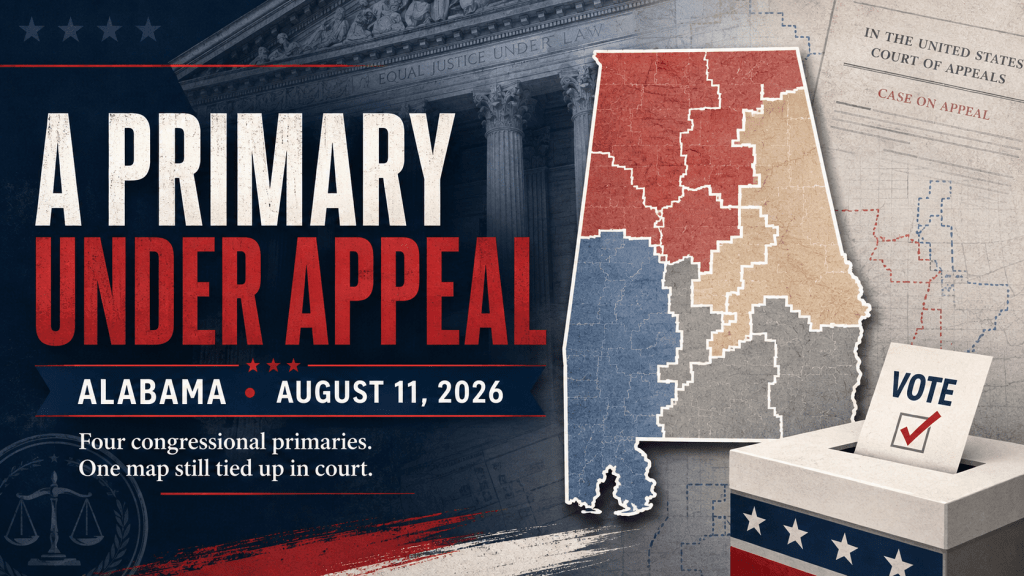
Alabama voters chose nominees Tuesday in four congressional districts under a map that remains the subject of active federal litigation — meaning the party nominees selected on August 11 could still be undone depending on how that litigation resolves. Turnout was among the lowest in state history, a fact several officials and candidates attributed to the compressed timeline and the confusion of holding a second primary just three months after the state’s regularly scheduled one.
The special primaries in Alabama’s 1st, 2nd, 6th and 7th Congressional Districts are a direct product of the U.S. Supreme Court’s ruling this year in Louisiana v. Callais, which narrowed the standard for challenging congressional maps as racial gerrymanders under Section 2 of the Voting Rights Act. That ruling reopened a long-running Alabama redistricting case and, for now, has allowed the state to use a map that federal judges twice found intentionally discriminated against Black voters.
Alabama just held congressional primaries whose legal effect still depends on what happens in federal court.
How Alabama got here
The dispute traces to Allen v. Milligan, in which the Supreme Court affirmed in June 2023 that Alabama’s congressional map likely violated Section 2 of the Voting Rights Act by including only one district, out of seven, where Black voters had a realistic opportunity to elect their preferred candidate. The Alabama Legislature’s attempt to redraw the map later that year was itself rejected by a three-judge federal panel, which found it still fell short. A court-appointed special master then drew a remedial map with two Black-opportunity districts; that map was used in the 2024 general election and in Alabama’s regularly scheduled 2026 primary on May 19.
In May 2025, after a full trial, the same three-judge panel went further, ruling that the Legislature’s 2023 map had been drawn with intentional racial discrimination — a finding the court described as “not a close call.” Alabama appealed to the Supreme Court again. While that appeal was pending, the Court decided Louisiana v. Callais in the spring of 2026, significantly raising the bar for proving that a map’s design amounts to an unconstitutional racial gerrymander. On May 11, 2026, the Supreme Court vacated the panel’s 2025 ruling and sent the Alabama case back for reconsideration in light of Callais.

Anticipating that the 2023 map would ultimately be reinstated, Republican Gov. Kay Ivey called a special legislative session and set special primaries for August 11 in the four districts whose lines would change under that map. But on May 26, the same three-judge panel, reconsidering the case as instructed, again found the 2023 map intentionally discriminatory and blocked its use, ordering the state back to the court-drawn map. Alabama immediately appealed and sought an emergency stay. On June 2, the Supreme Court granted it in a 6-3, unsigned order, clearing the way for the state to use the 2023 map for the August primary while the underlying legal fight continues on remand. Justice Sonia Sotomayor, joined by Justices Elena Kagan and Ketanji Brown Jackson, dissented, writing that the majority had discarded extensive factual findings from the lower court’s trial.
Because the litigation remains unresolved, Alabama Secretary of State Wes Allen has said that Tuesday’s votes will be tabulated but are legally “void for the purposes of determining the party nominees” unless the 2023 map is ultimately upheld. If the courts instead require the state to revert to the remedial map with two Black-opportunity districts, the party nominees in the affected districts would instead be determined by the results of the state’s already-completed May 19 primary, which was conducted under that map.
Tuesday’s votes will be counted — but they may not ultimately determine the party nominees.

What changed on the map
The 2023 map reduces the number of Democratic-leaning districts in Alabama’s seven-district delegation from two to one, according to multiple outlets’ analysis of the new boundaries, while leaving the 7th District — held by Democratic Rep. Terri Sewell since 2011 — majority-Black and safely Democratic. The most consequential change is in the 2nd District, represented since 2024 by Democratic Rep. Shomari Figures, which loses most of Mobile, his political base. Under the district lines used in the 2024 election, Kamala Harris carried the 2nd District 53% to 46%; under the new lines, Donald Trump would have carried the same district roughly 57% to 42%, according to PBS NewsHour’s analysis of 2024 presidential results. The district’s Black population share falls from roughly half to about 40% under the new map.
The biggest political consequence is in the 2nd District: a seat Democrats won in 2024 becomes significantly more Republican under the disputed lines.

The 1st District is open, as Republican Rep. Barry Moore is running for the U.S. Senate seat being vacated by Sen. Tommy Tuberville rather than seeking reelection. The 6th District, represented by Republican Rep. Gary Palmer since 2014, remains Republican-leaning but was described by some analysts as less safely so under the new lines than before — making it, along with the 2nd, one of the more competitive contests on the fall ballot.
The results

Turnout across the four districts was roughly 5% of registered voters as of late Tuesday, according to the Alabama Secretary of State’s office — well below the 23% turnout in the state’s May 19 regular primary and the nearly 11% turnout in a June 16 runoff. Several candidates and voters cited confusion over the shifting map and election dates, along with late-summer timing, as likely factors.
1st District: Former U.S. Rep. Jerry Carl won the Republican nomination with roughly 74% of the vote over three challengers, defeating Austin Sidwell, John Mills and Lucas Burger. Carl, who represented the district from 2021 to 2025, will face Democratic nominee Clyde Jones in November.
2nd District: State Rep. Rhett Marques, who holds President Trump’s endorsement, won the Republican nomination with just over 50% of the vote in a six-candidate field that included Hampton Harris, David Matthews, Joshua McKee, James Richardson and Christian Horn. Rep. Shomari Figures ran unopposed for the Democratic nomination and will seek a second term against Marques in a district now rated more competitive for Republicans than the one he won in 2024.
6th District: Rep. Gary Palmer won the Republican nomination for a seventh term with roughly 87-88% of the vote over Case Dixon. On the Democratic side, former Pelham City Council member Maurice Mercer won a four-candidate primary with about 64% of the vote, ahead of Ashtyn Kennedy, Keith Pilkington and Jacob Bouma-Sims. Palmer and Mercer will face off in November.
7th District: Former educator Ammie Akin won the Republican nomination with roughly 75-77% of the vote over David Perry. She will face nine-term Democratic incumbent Rep. Terri Sewell, who ran unopposed, in a district that remains majority-Black and safely Democratic under the new lines.
Unlike most Alabama primaries, none of Tuesday’s races were subject to a runoff regardless of whether a candidate cleared 50% of the vote, under the terms of Ivey’s special-session call.
A roughly 5% turnout election could help determine four congressional nominees — or eventually determine none of them.
What’s ahead
The core legal question — whether Alabama’s 2023 map or the court-drawn remedial map will govern the state’s congressional elections for the rest of the decade — remains unresolved on remand at the U.S. District Court for the Northern District of Alabama. Because the Supreme Court’s June 2 order was a stay rather than a final ruling, further proceedings, and potentially another emergency appeal, remain possible before the map is settled for good. Election Desk will track the district court’s next steps and any subsequent Supreme Court action, along with whether Tuesday’s results are ultimately confirmed or superseded by the May 19 primary results, as the case continues.
For related Election Desk coverage of the Section 2 landscape after Louisiana v. Callais, including similar mid-decade redistricting fights in Louisiana, Texas and other states, see Election Desk’s Election Law and Process section.

Sourcing note: Legal history in this article draws on court filings and reporting summarized by the ACLU, the NAACP Legal Defense Fund, SCOTUSblog, the Loyola Law School “All About Redistricting” case tracker and Alabama Reflector’s ongoing coverage of Milligan v. Allen and related cases. Race results and turnout figures are drawn from the Alabama Secretary of State’s office as relayed by Alabama Reflector, AL.com/al reporter, ABC 33/40, WBHM and PBS NewsHour, and reflect unofficial, uncertified returns; some outlets reported slightly different vote shares at different points in the count (for example, Gov. Palmer’s margin was reported at both 87% and 88%, and turnout at both “roughly 5%” and 5.24%). Because the underlying map is under active litigation, even fully certified results could be superseded by a future court order; Election Desk will update this article if that occurs.
For more on the 2026 midterm primary calendar and ongoing redistricting litigation, visit electiondesk.org.


Leave a comment