
A federal judge in Boston on Tuesday expanded, to cover the entire country, an order blocking the U.S. Postal Service from carrying out President Trump’s executive order restricting mail-in ballots — even as the Supreme Court considers two separate emergency requests to lift her earlier, narrower injunction against the same directive.
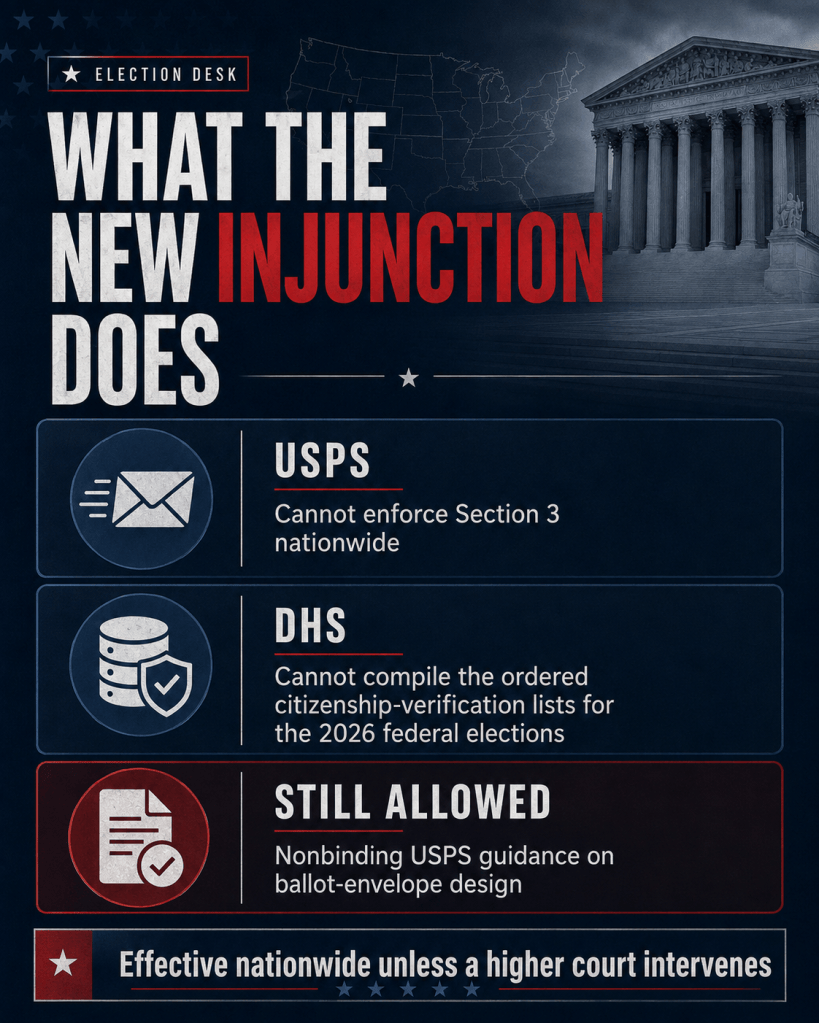
U.S. District Judge Indira Talwani’s ruling came in League of Women Voters of Massachusetts v. Trump, a case now consolidated with a 23-state challenge to Executive Order 14399, “Ensuring Citizenship Verification and Integrity in Federal Elections.” Tuesday’s preliminary injunction bars USPS from implementing or enforcing Section 3 of the order — which would restrict delivery of mail ballots to voters not on a federally maintained list — nationwide, and blocks the Department of Homeland Security from compiling the citizen-verification lists called for elsewhere in the order, for the November 3 midterms or any earlier federal election.
What the new order does
Tuesday’s ruling is Talwani’s second injunction against the executive order and the first to apply outside the states that sued. Her June 25 preliminary injunction, and a July 7 final judgment declaring Sections 2 and 3 “ultra vires,” covered only the 23 states and the District of Columbia that are plaintiffs in the consolidated case. The League of Women Voters plaintiffs, who brought a related but separate suit, asked Talwani to go further and bar USPS from applying the order anywhere in the country, arguing that voters in non-party states faced the same risk of disenfranchisement.
Tuesday’s ruling is Talwani’s second injunction against the executive order and the first to apply outside the states that sued.
Talwani agreed, writing that the approaching election left no room for half-measures: with less than 90 days remaining before Nov. 3, she said, “the critical need for an injunction to prevent Defendants from changing election rules on the eve of the election” applied regardless of whether a given state had joined the litigation. Her order does not prevent the federal government from issuing nonbinding guidance to USPS on ballot-mail envelope design, and Talwani required the plaintiff organizations to post a $100 bond.
The order leaves untouched a separate carve-out: twelve Republican-led states — Alabama, Florida, Indiana, Kansas, Louisiana, Missouri, Montana, Nebraska, Oklahoma, South Carolina, South Dakota and Texas — intervened in the litigation in support of the executive order, and Talwani’s earlier injunctions applied only to plaintiff jurisdictions. It remains unclear whether or how Tuesday’s nationwide expansion affects those intervenor states’ posture in the case.
Two pending requests at the Supreme Court
Talwani’s ruling lands in the middle of an unresolved fight one level up. The federal government and a bloc of Republican-led states have each asked the Supreme Court to pause her earlier injunction while the case proceeds — meaning the justices could still act to unwind both the original and the expanded blocks before November.
Solicitor General D. John Sauer filed the first application, Trump v. California (No. 26A124), on July 27, days after a divided panel of the 1st U.S. Circuit Court of Appeals declined to stay Talwani’s injunction pending appeal. Sauer argued the district court intervened prematurely, before federal agencies had settled on how they would implement the order, and that any delay in enforcement would cause the government “serious irreparable harm” that could not be undone after the election.
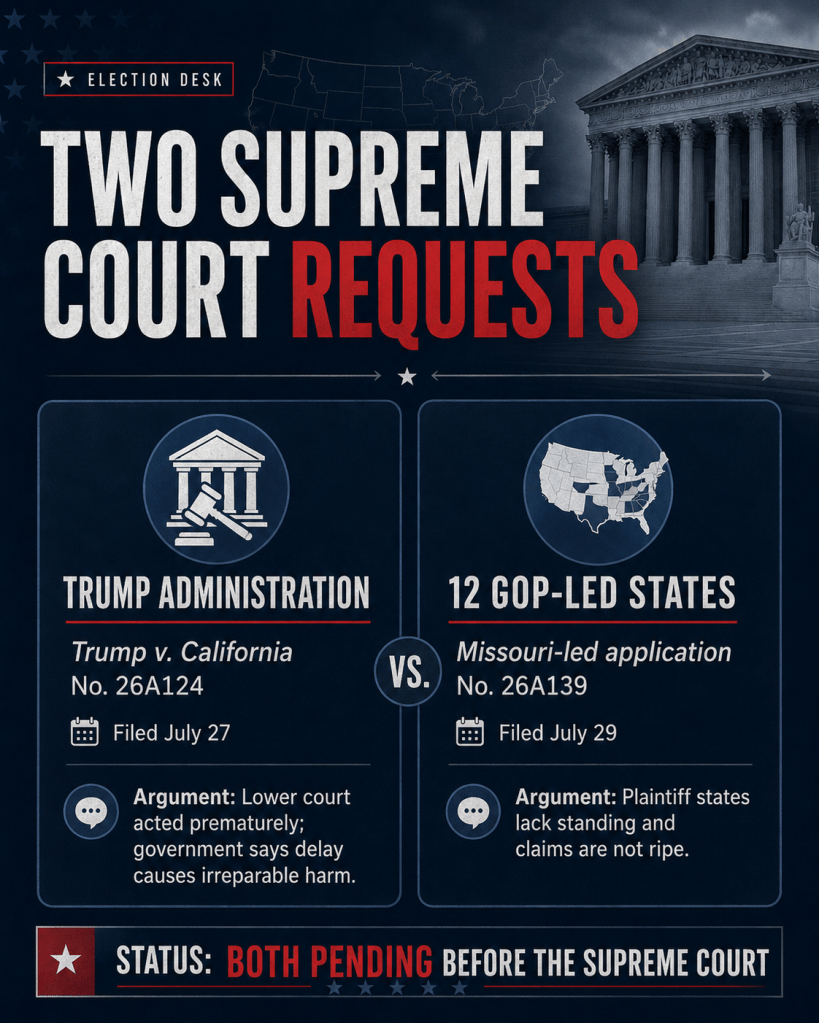
Two days later, the twelve intervenor states led by Missouri filed their own application (No. 26A139), arguing separately that the plaintiff states lack standing and that their claims are not yet ripe for judicial review. Justice Ketanji Brown Jackson, who handles emergency matters from the 1st Circuit, ordered the 23 plaintiff states to respond by Aug. 3; they filed opposition briefs that day, joined by amicus filings from former governors, former judges and disability-rights groups. Jackson can act on the applications herself or refer them to the full Court. As of Tuesday, neither application had been decided.
How the litigation reached this point
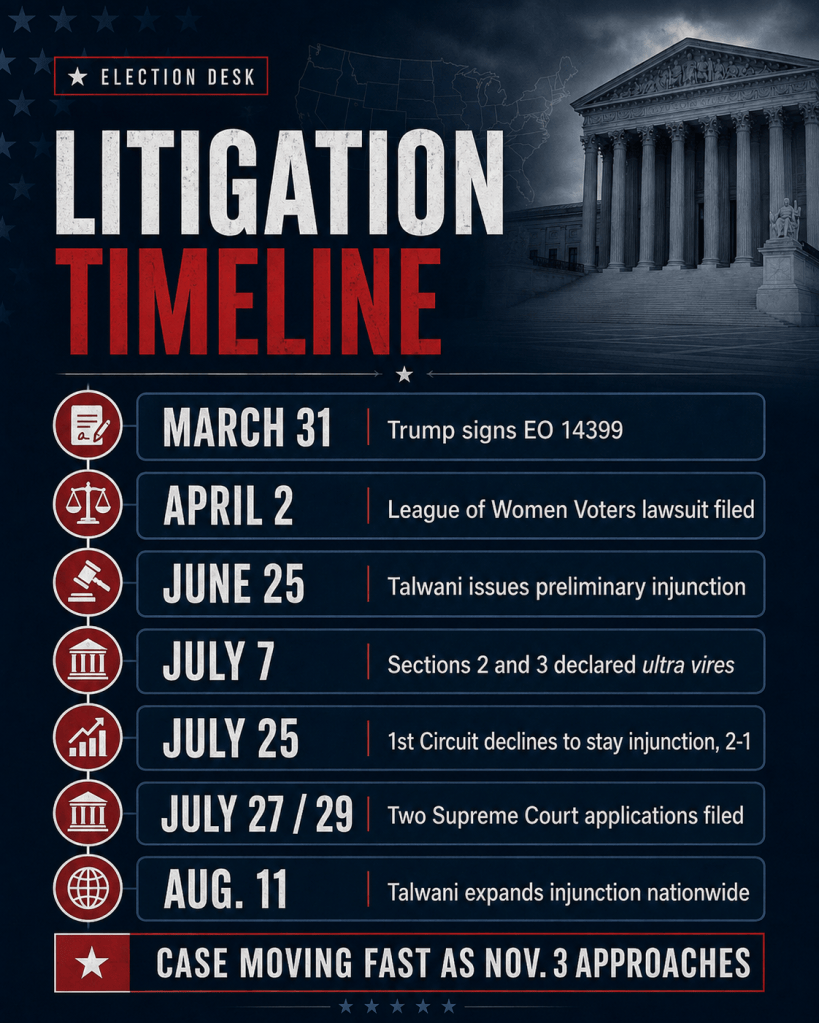
President Trump signed Executive Order 14399 on March 31, directing USPS to withhold delivery of mail ballots from voters not enrolled on state-furnished lists and instructing DHS to assemble citizen-verification data from federal databases. The League of Women Voters of Massachusetts and seven other voting-rights organizations sued two days later; California and 21 other Democratic-led states and D.C. later brought a parallel challenge that was consolidated with the League’s case.
Talwani granted the states’ preliminary injunction on June 25 and entered final judgment on July 7, holding that the order’s mail-ballot and citizenship-list provisions exceeded the president’s authority and encroached on states’ constitutional control of elections. The 1st Circuit upheld that injunction on July 25 in a 2-1 decision, with the majority warning that letting the order take effect for this fall’s elections “would sow confusion and threaten disenfranchisement of many eligible voters.” Judge Joshua Dunlap, a Trump appointee, dissented in part, concluding the plaintiff states had not shown sufficient harm to challenge the citizenship-list provision specifically.
Throughout the litigation, the federal government has largely avoided defending the order’s substance, instead asking courts to postpone review on standing and ripeness grounds. A parallel case in Washington, D.C. — NAACP v. USPS — produced a nationwide injunction that the D.C. Circuit later paused, prompting the League plaintiffs to return to Talwani in July with the renewed, nationwide request she granted Tuesday.
The Supreme Court’s handling of the two pending stay applications is now the central open question.
What’s ahead
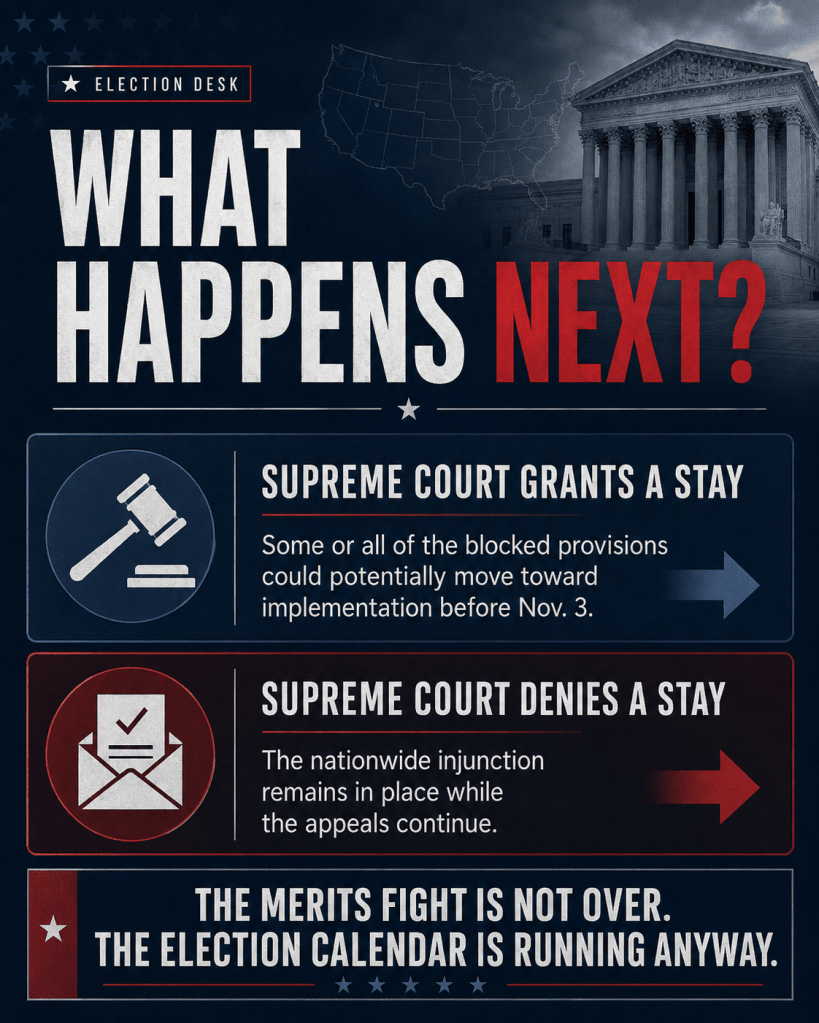
The Supreme Court’s handling of the two pending stay applications is now the central open question. A grant of either application could clear the way for USPS and DHS to begin implementing the order well before November; a denial would leave Tuesday’s nationwide injunction in place through the midterms. Separately, the intervenor states’ relationship to a nationwide — rather than plaintiff-state-only — injunction is likely to be litigated further, as is the underlying merits appeal now pending before the 1st Circuit.
A grant of either application could clear the way for USPS and DHS to begin implementing the order well before November; a denial would leave Tuesday’s nationwide injunction in place through the midterms.
Election Desk is tracking litigation over Executive Order 14399 as part of its ongoing coverage of the 2026 midterm elections.
Sources: This article draws on Judge Talwani’s Aug. 11, 2026 memorandum and order in the consolidated case (D. Mass., No. 1:26-cv-11549), her June 25 and July 7 rulings, and the 1st Circuit’s July 25 order, along with the stay applications and responses filed with the Supreme Court in Trump v. California (No. 26A124) and the Missouri-led states’ application (No. 26A139), as tracked by SCOTUSblog. Additional reporting and case background were drawn from Democracy Docket, the Brennan Center for Justice’s litigation tracker, and wire and daily coverage from Reuters, the Associated Press, and Law & Crime.


Leave a comment