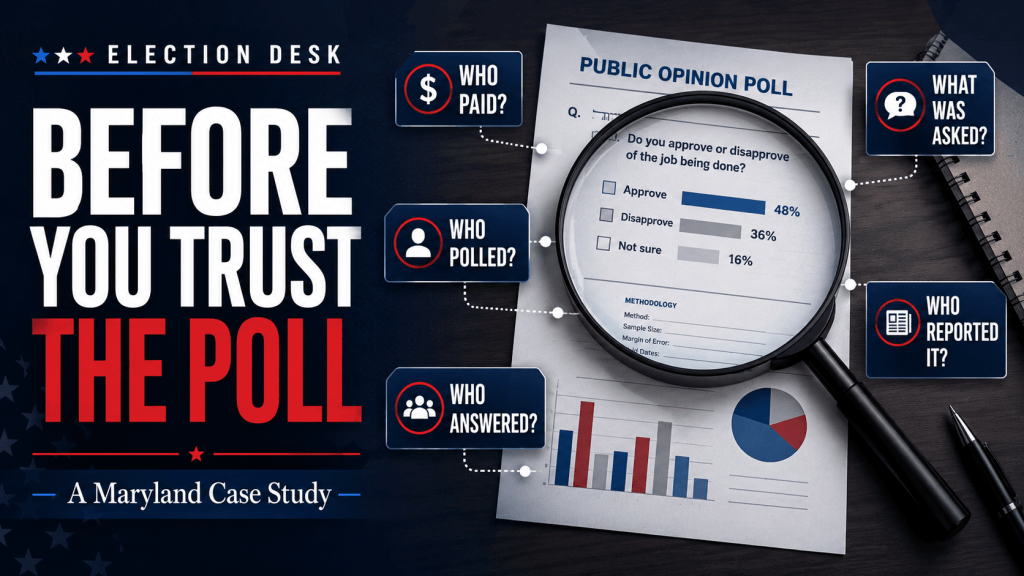
A Maryland governor’s race poll made headlines this week, showing a wide early lead for one candidate. Instead of reporting the topline numbers, Election Desk is using this poll to walk through how to evaluate any political survey, using this one as a real example of what to look for.
This is not a story about whether the poll’s numbers are right or wrong. It’s about the questions voters should ask before deciding how much weight to give any poll they see in the news.
This is not a story about whether the poll’s numbers are right or wrong. It’s about the questions voters should ask before deciding how much weight to give any poll they see in the news.
Who paid for it, and who ran it

Every public poll has a sponsor, the person or organization that pays for it, and a pollster, the firm that designs and fields it. Those can be the same or different, and both matter.
In this case, the poll was commissioned by a public affairs firm and an Annapolis lobbying firm, working together, and conducted by an outside polling firm. All three are private businesses. None of them are required to be neutral, and nothing in election law says they have to be.
That’s normal. Plenty of legitimate, accurate polling comes from firms that also do partisan or advocacy work. The industry group that sets professional standards, the American Association for Public Opinion Research, doesn’t ask pollsters to be nonpartisan. It asks them to disclose who paid for the poll, who conducted it, and how it was done, so readers can judge the results with that context in hand.
What good disclosure looks like
AAPOR’s Transparency Initiative sets out what a pollster should make public, some of it immediately, some within 30 days of a request. The immediate-disclosure list includes:
- Who sponsored and who conducted the research
- The exact wording of the questions asked
- The population that was sampled, and how
- Sample size and margin of error
- The dates the survey was in the field
- How respondents were contacted (phone, text, online panel, etc.)

In the Maryland poll, most of that basic information was made public: sample size, dates, margin of error, and the general method (a text-message-to-web survey). What wasn’t made public, at least not in any coverage Election Desk could find, was the full partisan breakdown of who responded, or the exact question wording used to get the “strongly approve” versus “somewhat approve” split. Those numbers exist. Whether they’re released publicly, or only on request, is a decision the pollster and sponsor get to make on their own timeline.
Why the sponsor’s other business matters
A polling firm’s other clients don’t tell you whether a specific poll’s numbers are accurate. Good methodology can produce accurate results regardless of who’s paying for it, and bad methodology can produce inaccurate results even with a “neutral” sponsor.
A polling firm’s other clients don’t tell you whether a specific poll’s numbers are accurate.
What a sponsor’s client list does tell you is something about incentive and audience. A firm that primarily represents one party’s candidates, or that lobbies for companies with active business before the state government being polled, has reasons to want certain findings to circulate. That doesn’t make the numbers false. It’s one more data point voters can weigh, the same way they’d weigh a nutrition claim differently depending on whether it came from an independent lab or the food company itself.
Watching who repeats the numbers
There’s a second layer worth understanding: how a poll travels from a press release into news coverage. When multiple outlets report a poll’s findings, readers often assume that repetition equals independent verification. It doesn’t always.
When multiple outlets report a poll’s findings, readers often assume that repetition equals independent verification. It doesn’t always.
In this case, two of the outlets that reported the poll’s topline numbers this week have a direct institutional relationship with the poll’s sponsor: journalists from both outlets co-host a podcast that is sponsored by, and produced with, the same public affairs and lobbying firms behind the poll. That relationship was disclosed on the podcast’s own promotional materials, but it wasn’t mentioned in the news stories reporting the poll results.

That’s a disclosure gap worth flagging generally, not just in this case. When a poll gets covered by multiple outlets, it’s worth checking whether those outlets are actually separate sources of confirmation, or whether they’re drawing on the same underlying relationship with the pollster.
A short checklist for reading any poll

- Who sponsored it, and who conducted it? Are those the same entity?
- What’s the sample size and margin of error, and does the poll’s headline claim exceed what that margin can support?
- What was the exact question wording? Different phrasing can produce different results on the same underlying opinion.
- Has the pollster released full crosstabs, including partisan composition of the sample, or only summary toplines?
- Do the outlets reporting on it have any financial or institutional relationship with the sponsor or pollster?
None of this is about deciding a poll is right or wrong. It’s about giving voters the tools to read past a headline number and understand what’s actually being measured, and who’s measuring it.
Sources: American Association for Public Opinion Research, Transparency Initiative and Disclosure Standards (aapor.org); Maryland Matters (Bryan P. Sears, Aug. 12, 2026); Blended Public Affairs and Zenith Research public websites; Baltimore Fishbowl and Apple Podcasts listings for the Maryland Now podcast.


Leave a comment