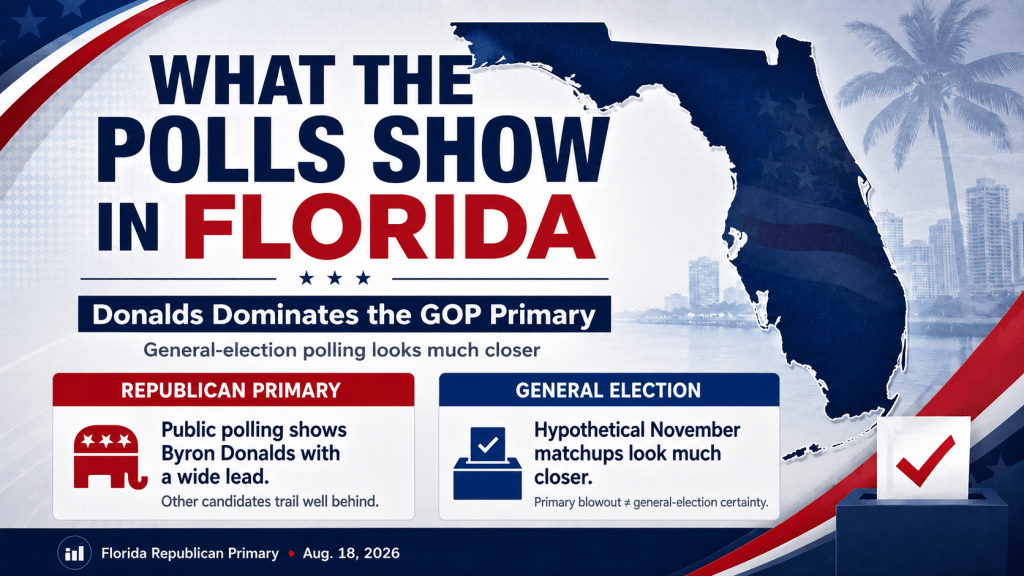
Florida Republicans choose a nominee for governor on Aug. 18, and public polling has shown a consistent pattern since spring: U.S. Rep. Byron Donalds holds a wide lead over Lt. Gov. Jay Collins, former House Speaker Paul Renner and businessman James Fishback, with a sizable share of voters still undecided as of the most recent surveys.
“Public polling has shown a consistent pattern since spring: Byron Donalds holds a wide lead, with a sizable share of Republican voters still undecided.”

The Republican primary
A Tampa Bay Times average of polls, updated Aug. 10 and built from surveys aggregated by The New York Times, put Donalds roughly 40 points ahead of his nearest rival with the primary one week out. That tracks with the individual polls and other averages below, which show Donalds in the mid-to-high 40s and no other candidate above 18 percent in any survey reviewed.
- Change Research (May 13–16, drawn from a survey of 2,070 registered voters, including 1,593 identified as likely to vote in 2026; the primary-ballot subsample isn’t specified in available source material): Donalds 48%, Collins 8%, Renner 3%, undecided roughly 28%. Fishback placed second in this survey; the firm’s public release did not specify his exact percentage. Change Research is generally identified as a Democratic-aligned research firm, a relevant factor in weighing its primary-electorate assumptions.
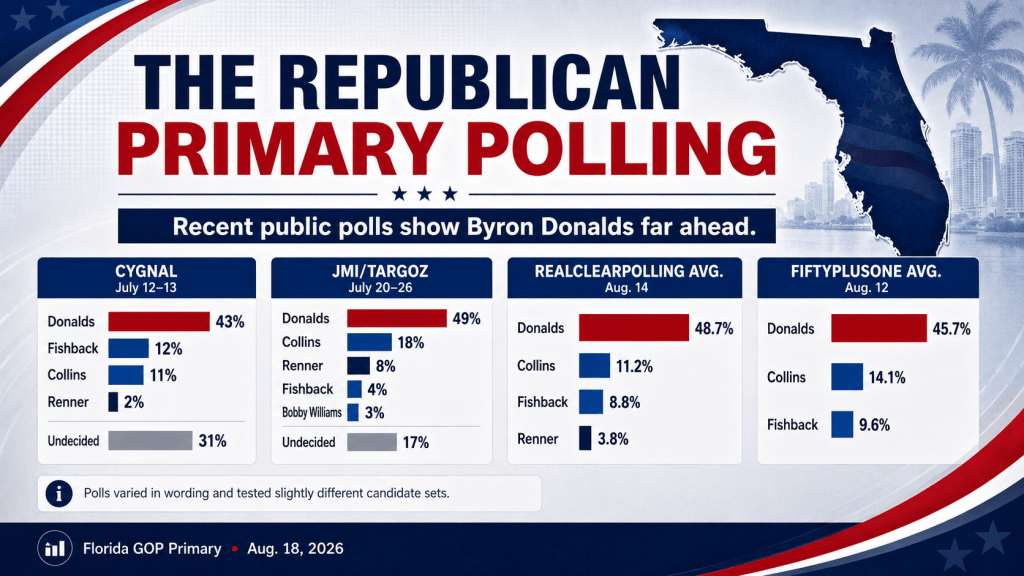
- Cygnal (July 12–13, 500 likely GOP primary voters, margin of error ±4.38 points): Donalds 43%, Fishback 12%, Collins 11%, Renner 2%, undecided 31%. Cygnal is generally identified as a Republican-aligned polling and communications firm.
- James Madison Institute (commissioned poll, fielded by Targoz Market Research July 20–26 among 1,400 registered Florida voters; topline figures confirmed directly against JMI’s own published marginals document): among the 532 respondents identified as likely Republican primary voters, Donalds 49%, Collins 18%, Renner 8%, Fishback 4%, non-profit leader Bobby Williams 3%, undecided 17%. Williams did not appear in secondary coverage of this poll reviewed for this article; his inclusion here is drawn directly from JMI’s topline document. JMI is a Tallahassee-based conservative-leaning think tank that commissioned but did not itself field the survey. The poll’s stated overall margin of error is ±2.62 percentage points, based on the full 1,400-respondent sample; JMI’s published materials do not give a separate margin of error for the smaller 532-person Republican-primary-likely-voter subsample. The same release reported Donalds still leading among voters classified as unlikely to turn out, at 28%, with Renner at 12% and Collins at 10% in that subgroup.
- RealClearPolling average (as of Aug. 14): Donalds 48.7%, Collins 11.2%, Fishback 8.8%, Renner 3.8% — a Donalds advantage of 37.5 points over the second-place candidate.
- FiftyPlusOne average (Aug. 12): Donalds 45.7%, Collins 14.1%, Fishback 9.6% — a 32-point Donalds advantage.
- Tampa Bay Times average (updated Aug. 10, built from polls aggregated by The New York Times): Donalds ahead by roughly 40 points over the second-place candidate, with the Times noting that individual results are weighted by recency and sample size and that some included surveys did not test every candidate on the ballot.
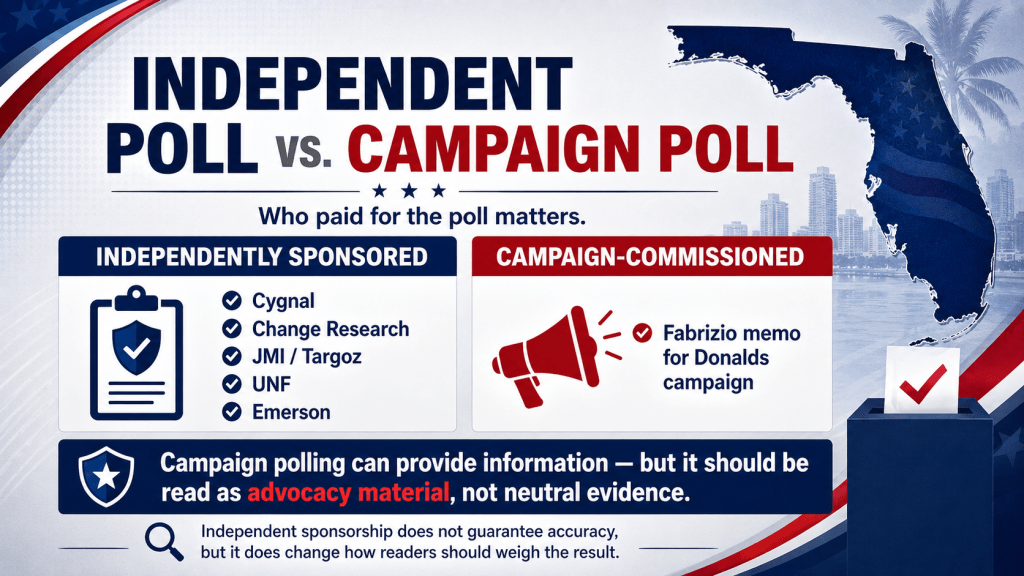
Not independently confirmed / campaign-sponsored: A memo from pollster Tony Fabrizio, who worked for the Trump 2024 campaign and was commissioned by the Donalds campaign itself, reported Donalds at 47% in a three-candidate test (Renner 4%, Fishback 5%, undecided 43%), rising to 76% among respondents told that President Donald Trump had endorsed him. The memo’s fielding dates were not stated in available source material. Because this poll was conducted for and released by a candidate’s own campaign, its methodology has not been independently reviewed, and its topline figures should be read as advocacy material rather than as a neutral data point.
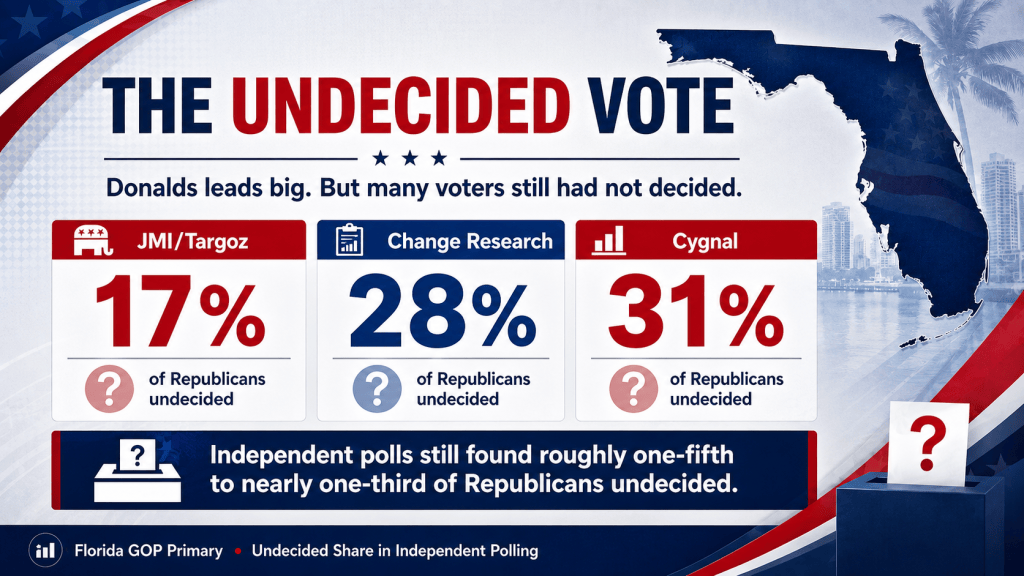
Among the independently sponsored polls, the undecided share has ranged from roughly 17 to 31 percent (James Madison Institute/Targoz at 17%, Change Research at 28%, Cygnal at 31%). Multiple pollsters — Cygnal and James Madison Institute among them — have attributed the gap in candidate support primarily to name recognition rather than settled preference. Cygnal’s release specifically noted that challengers plus undecided voters combined account for a majority of the electorate, and identified a generational divide in which Fishback’s support skews younger while Donalds performs better with older voters.
“Donalds’ lead is enormous, but the undecided vote has still ranged from roughly 17 to 31 percent in independently sponsored polls.”
DeSantis has not endorsed a candidate in the race; Trump has endorsed Donalds. Donalds, a sitting U.S. representative from Naples, has substantially outraised his rivals. State campaign finance filings cited in an undated USA Today Network report show Donalds raised roughly $10.2 million through his political committee and main campaign account over a trailing three-month period, more than ten times the roughly $1 million reported by Democratic candidate David Jolly since entering the race in late April. Separately, an earlier report put Donalds’ total at just over $7.1 million as of an April 1 filing deadline, with no other Republican candidate having reported $1 million raised by that same date; because these two figures come from different reporting windows, they should be read as snapshots at different points in the campaign rather than as directly comparable current totals. Casey DeSantis, the governor’s wife, has not filed to run and has been tested only in hypothetical primary and general-election matchups by some pollsters; Gov. Ron DeSantis, who is term-limited, has not endorsed in the race.
The Democratic primary
The Democratic field changed materially over the course of the campaign. Orange County Mayor Jerry Demings, who had been running for governor, suspended his campaign on June 5 after disclosing a prostate cancer diagnosis, which he and his campaign described as caught early and treatable. Demings said at the time that he intended to finish his current term as Orange County mayor while stepping back from the statewide race; multiple outlets that covered his announcement, including his own public statement, are the basis for this account.
That withdrawal means two of the polls initially reviewed for this article — Emerson College Polling (early April) and Change Research (May 13–16), both of which tested former Republican congressman David Jolly against Demings — no longer reflect the current Democratic field and are not reported here as current standings. At the time those polls were fielded, they had shown Jolly leading Demings, 21%-10% in the Emerson survey and 42%-27% in the Change Research survey.
Since Demings’ exit, Jolly — who registered as a Democrat in 2025 — has been treated by state party figures as the presumptive nominee. His most prominent remaining primary opponent is Dayna Marie Foster, a 32-year-old Fort Lauderdale high school math teacher and first-time candidate who has raised just over $30,000 and was endorsed by the Democratic Progressive Caucus of Florida on Aug. 13. Two other Democrats appear on the JMI/Targoz primary ballot in small single digits: Thomas Fernandez (4% among likely voters) and Evelyn Castillo-Bach (3%); a fourth candidate, Stephann Norman, registered 0%. Per JMI’s own topline document, among the 341 respondents identified as likely Democratic primary voters, Jolly led with 47%, Foster had 4%, and 42% were undecided; among the full 389-person Democratic-primary sample (which includes less-certain voters), Jolly’s share was 42% and undecided rose to 46%.
General election matchups
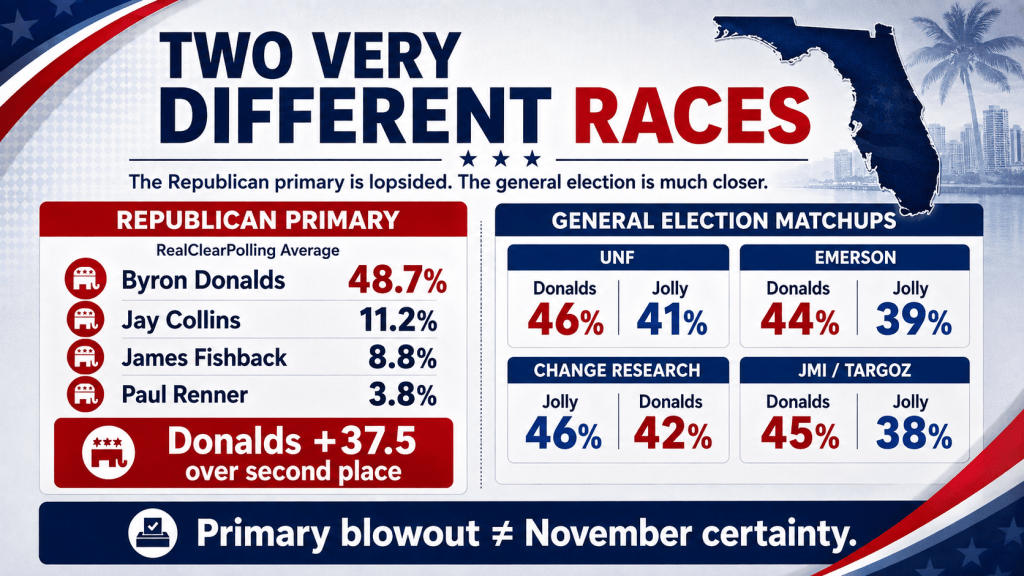
Where the Republican primary numbers show a lopsided race, hypothetical Donalds-vs.-Jolly and Collins-vs.-Jolly matchups show a competitive one. The pollsters’ differing institutional affiliations are relevant context for reading the results below:
- University of North Florida’s Public Opinion Research Lab (July 8–17, margin of error ±3.8 points, an academic polling program): Donalds 46%, Jolly 41%.
- Emerson College Polling (early April): Donalds 44%, Jolly 39%, undecided 15%.
- Change Research (May 13–16): Jolly 46%, Donalds 42%, among registered voters identified as likely to vote.
- James Madison Institute (fielded by Targoz Market Research, July 20–26): per JMI’s own topline document, among likely voters, Donalds led Jolly 45% to 38% in one hypothetical matchup, and Collins led Jolly 44% to 39% in a separate matchup that tested Collins instead of Donalds as the Republican nominee. Separately, coverage of the poll’s crosstabs reported Jolly leading Donalds 36% to 19% among voters with no party affiliation, with more than 40% of that subgroup undecided — a 17-point gap in a bloc of roughly 3.8 million registered NPA voters statewide; that specific crosstab was not independently located in JMI’s published marginals and is sourced here to reporting on the poll rather than to the topline document directly.
“The Republican primary looks lopsided. The general election does not.”
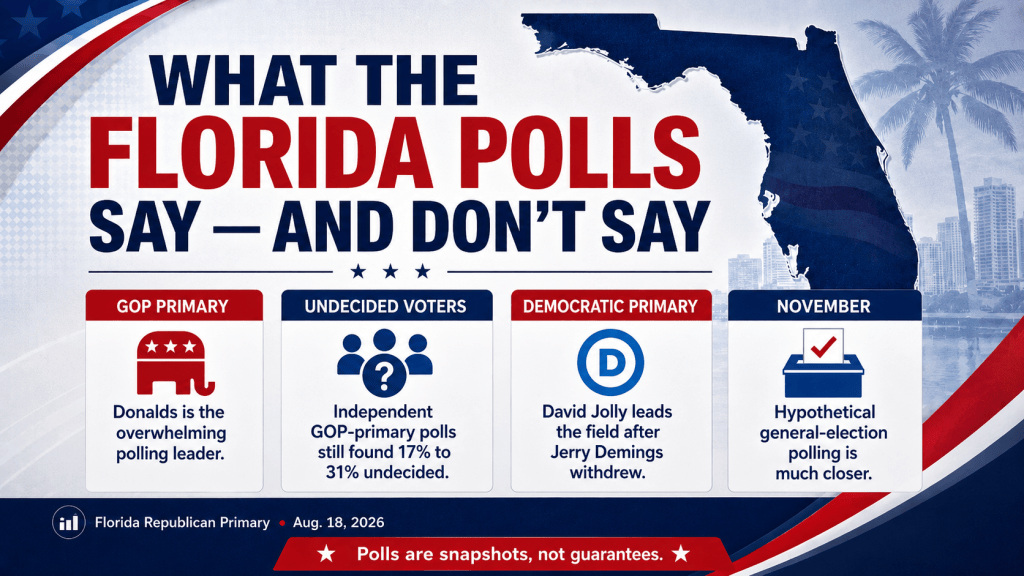
The spread across polls with confirmed overall toplines is narrower than the primary numbers suggest: Donalds or the leading Republican was ahead by 5 to 7 points in three of the four surveys reviewed (UNF +5, Emerson +5, JMI/Targoz +7 for Donalds and +5 for Collins), while Jolly led by 4 points in the one Democratic-aligned firm’s survey (Change Research). This is consistent with the sample and likely-voter modeling differences that typically separate general-election polling this far ahead of a race, rather than indicating a change in the underlying contest. The Cook Political Report currently rates the Florida governor’s race as Solid Republican, citing the state’s roughly 1.5-million-voter GOP registration advantage and Trump’s 13-point margin in Florida in the 2024 presidential election. Florida has not elected a Democratic governor since 1994.
Sourcing note
Topline figures for Cygnal, Change Research, Emerson College Polling and the University of North Florida are drawn from each organization’s own public release or from contemporaneous reporting describing those releases. James Madison Institute/Targoz figures in this piece — the Republican and Democratic primary toplines and both general-election hypotheticals (Donalds-Jolly and Collins-Jolly) — were confirmed directly against JMI’s own published marginals document, dated July 29, 2026, and hosted at jamesmadison.org; the NPA/independent-voter general-election crosstab is the one JMI-linked figure in this piece not independently located in that document and is instead sourced to reporting on the poll’s crosstabs. The James Madison Institute commissioned the poll; Targoz Market Research fielded it. The poll’s overall margin of error, ±2.62 points, is based on the full 1,400-respondent sample; JMI’s published materials do not break out a separate margin of error for the smaller primary-election subsamples (532 likely GOP primary voters; 341 likely Democratic primary voters). The RealClearPolling, FiftyPlusOne, and Tampa Bay Times/New York Times figures are polling averages compiled by those organizations from multiple underlying surveys, not results of a single poll; the Times has noted its aggregation weights individual polls by recency and sample size and that not every included survey tested all four Republican candidates. The Fabrizio memo is disclosed above as campaign-commissioned, not independent, research; its fielding dates were not available. Partisan or ideological affiliations noted for Cygnal (Republican-aligned), Change Research (Democratic-aligned) and the James Madison Institute (conservative-leaning think tank) reflect general characterizations reported in coverage of Florida polling and are provided so readers can weigh methodology accordingly; Emerson College Polling and the University of North Florida’s Public Opinion Research Lab are academic operations without a reported partisan affiliation. The two campaign-fundraising figures cited come from reports covering different filing windows (an April 1 deadline snapshot and a separate trailing-three-month figure) and are flagged in text as non-comparable snapshots rather than a single current total. Jerry Demings’ withdrawal from the Democratic primary and the reason given for it are drawn from his own public statement as reported independently by multiple outlets, including NBC 6 South Florida, the Tampa Bay Times, and Jacksonville Today. All reported figures are subject to each survey’s stated margin of error and undecided/refused share.


Leave a comment